

May 15, 2026
Staff Report
ISLAMABAD
The family of Muhammad Irfan, a Quetta youth allegedly detained by counter-terrorism authorities in January, has demanded he be produced in court, highlighting a stark disconnect between local grievances and the Balochistan government’s claims that its new legal framework has ended enforced disappearances.
A family left in limbo
Irfan, son of Kamal Din, was arrested and taken from their home in the Killi Qambrani area of Quetta on January 22, at around 2:30 AM by the Counter-Terrorism Department (CTD) police and other security agencies, informs Nihal Khan, an uncle.
Nearly four months have passed since his disappearance. From that day to this, his parents, grandmother, and relatives have been unable to sleep, spending their days and nights weeping and praying for his return with the Quran held over their heads.
Irfan, who works with his uncle at a local vegetable market, was married just three months before his detention; his wife is currently pregnant. Nihal maintains that Irfan is entirely innocent, has committed no crime, and has no affiliation with any banned organization. While Irfan’s father is a retired government employee, Khan noted that the youth might have occasionally raised his voice for missing persons out of human sympathy or participated in a peaceful protest—but insists he has done nothing to deserve such a punishment.
“If he is guilty, or if there is any allegation against him, then he must be presented in court,” Khan demanded, questioning the immense suffering being endured by Irfan’s pregnant wife and elderly parents. He added that the family feels entirely helpless as local police refuse to register a case regarding the abduction, allegedly asking the family how they could register a First Information Report (FIR) against their own institutions.
The government’s stance: New laws and counter-claims
In sharp contrast to the family’s plight, Balochistan Chief Minister Mir Sarfraz Bugti and Provincial Interior Minister Zia Ullah Langove maintain that the issue of missing persons is being systematically resolved. Central to their strategy is the ‘Balochistan Prevention of Detention and Radicalization Act,’ introduced in January 2026.
The Chief Minister claims that after February 1, 2026, the state can no longer be accused of enforced disappearances. Under the new law, suspects are to be held in specific legal centers where they receive counseling, and their families are officially notified of their presence.
Meanwhile, Interior Minister Zia Ullah Langove remains firm in his stance that a large number of those declared missing are actually residing in the training camps of banned outfits or are actively involved in anti-state activities—a narrative he claims is used as political propaganda against the state. The provincial government has consistently maintained that while dialogue is open to those who accept the writ of the state, those who take up arms will face the harshest possible punishments.
Rights groups paint a darker picture
However, human rights organizations and activists present data that contradicts official claims. In its latest findings, the Human Rights Commission of Pakistan (HRCP) highlighted that enforced disappearances persisted throughout the year, impacting government officials, students, and rights activists alike. The HRCP noted a continuous decline in Balochistan’s human rights situation, citing violations perpetrated by both state actors and separatist militant groups. The commission added that these disappearances heavily disrupt freedom of movement, as devastated families frequently block main provincial highways in protest.
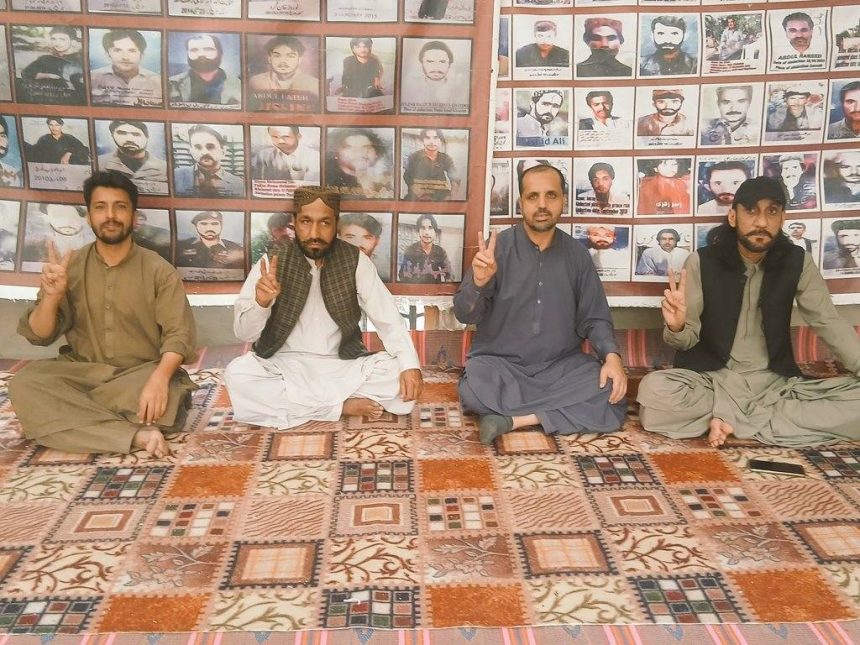
Nasrullah Baloch, head of the Voice for Baloch Missing Persons (VBMP), stated that far from decreasing, enforced disappearances are on the rise, exacerbating a deep sense of insecurity among the public. Speaking to VoicePk, Baloch noted that the VBMP protest camp in front of the Quetta Press Club has now reached its 6,164th day.
“Enforced disappearances have increased; women, children, and predominantly youth are being picked up,” Nasrullah Baloch stated, describing the situation as grave. He added that, tragically, the mutilated bodies of these youths are frequently recovered days after their disappearance.
The statistical toll
According to VBMP data, the scale of the crisis remains severe across consecutive years:
| Year |
Forcibly Disappeared |
Recovered Alive | Bodies Found |
| 2025 |
1,300+ |
317 |
79 |
| 2026 (To Date) |
250+ |
— |
— |
Currently, more than 6,500 cases are registered with the VBMP.
Huran Baloch, Central General Secretary of the VBMP, told Voicepk that the nature of the crackdown is shifting. “It has been a year since Mahjabin went missing,” she said. “The tragedy now is that women are being brought before cameras and forced under duress to dissociate themselves from armed organizations. Fake encounters are also being carried out.”
Rejecting the government’s new policy of keeping individuals in dedicated detention centers, Huran Baloch demanded a return to constitutional supremacy. “We want the matter to be handled according to the Constitution and the law; those facing allegations must be brought to court. For those who have been killed or died under torture, their families have a right to be informed.”
The affected families and human rights organizations continue to appeal to all state institutions to release all innocent detainees, including Muhammad Irfan, and to ensure that anyone facing formal allegations is afforded due process in a court of law.