

December 11, 2025
By Kaleem Ullah
LAHORE
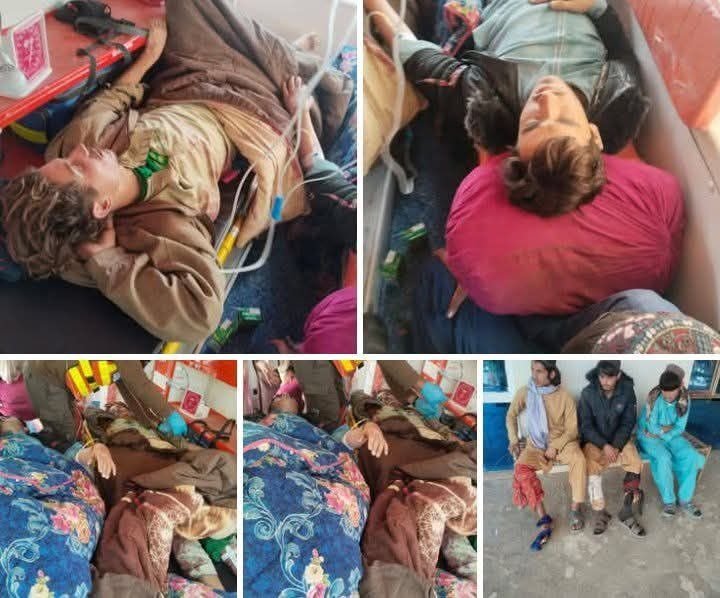
Tuesday was a day of devastation for 22-year-old Kifayatullah, after he and his father were both left severely injured after becoming the targets of a quadcopter drone strike.
Kifayat had called a mason to his house for some construction work and had asked his two young nephews to take the day off from school to help. He was busy assisting the mason, while his elderly and sick father sat nearby on a chair, watching them work. A quadcopter drone hovered overhead, but since drone flights had become a routine part of life in their area, they ignored it and continued working.
Even in retrospect, he believes he was not wrong to have ignored the drone. There was nothing he had done wrong after all. “Why would they target us?” he had asked himself that day.
They were passing each other cement blocks and carrying on with their work when a they noticed that a second quadcopter appeared and began hovering overhead. When he and the mason looked up, they saw the drone flash a sharp light. Then he heard the mason shout in fear, “Run! The drone has dropped a bomb!”
Kifayatullah belongs to Darozenda, a village located in the Spinwam tehsil of North Waziristan—an area where quadcopter drone incidents have been occurring almost daily or every few days. Members of parliament Iqbal Wazir (provincial assembly) and a former member of the National Assembly Nazir also hail from this region. Yet even when lawmakers call this place home, there is a state of lawlessness around when it comes to drone attacks.
“I had barely taken a few steps toward the room when I got hit and fell to the ground injured. Since my father could not get up quickly from his chair, he was hit as well,” recalls Kifayatullah. “At the same moment, one of the projectiles struck our transformer, blowing it apart,” he said. The sun is setting and Kifayat sits outside his home, distractedly watching children play.
Even after they had done their work, the drones lingered overhead for at least 10 to 15 minutes, making it impossible for anyone to immediately rush them to the hospital. Eventually, after the drones withdrew, villagers rushed to the spot and transported both father and son to the Mir Ali Hospital. They received treatment there, but Kifayat says a piece of shrapnel still remains lodged in his thigh – as if a reminder for life of that day. The doctors have told him it cannot be removed due to the risk of a permanent disability.
“At the hospital, a man wearing civilian clothes came to see us. We told him that they had injured us and destroyed our transformer. He said nothing and walked away. Other than him, no one came to check on us or offer any support,” he says.
The consistent presence of quadcopter drones in the area was evident, even during this Kifayat’s call with Voicepk. Only moments ago, Kifayatullah told Voicepk that a drone had appeared again near the playground but returned without launching an attack.
This is not just Kifayatullah’s ordeal. It is a tragic reality and a routine for the residents of North Waziristan, where such incidents have repeatedly injure elderly people, children, and women.
In another spot of the same region, in Zallalol Khel village, two young friends, Sanawar Khan and Gowwa Khan, had been sitting near the banks of the Kurram stream at sundown when a quadcopter allegedly appeared and dropped explosives on them. Both were seriously injured and were taken to Dawaba Hospital.
Sanawar’s father, Najam Khan, tells Voicepk, “I called my son and told him to come home because we had an invitation to attend to. While I was talking to him, a drone was already hovering overhead. Shortly after I hung up, I heard a blast. Moments later, my son called and said they had been hit in a drone attack and asked us to bring charpoys to carry them. He had fainted because of the heavy bleeding. We rushed them to Dawaba Hospital, where he is still under treatment.”
Four drone attacks have taken place in the Spinwam area only within the span of a week.
Locals say that a day after this incident, on early Monday morning, security forces conducted a search operation in a village called Serdog, in Spinwam. After the search, forces allegedly targeted homes—and even a shop—with drone strikes, injuring three women and six young men. They were immediately shifted to Khalifa Gul Nawaz Hospital in Bannu. One of the injured died on Wednesday.
Human rights organisations say that drone strikes—now increasingly executed through quadcopters—have resulted in the deaths of numerous civilians. In June, Amnesty International reported that at least 17 civilians, including five children, had been killed in such operations in 2025.
That statement came a month after a drone strike in North Waziristan’s Hurmaz area killed four children. Locals staged an eight-day sit-in with the bodies, demanding justice. The protest ended after an agreement with the local and military administration. Organizers of the Mir Ali sit-in told Voicepk that they were given written assurance that drones would no longer target civilians.
However, in that incident, the military’s media wing, ISPR, issued a statement claiming that security forces had been “falsely implicated” and that the attack had actually been carried out by the banned Tehreek-e-Taliban Pakistan (TTP). The TTP, however, had not issued any statement at the time.
After the tragedy, the KP Relief Minister, who is also from North Waziristan, met the affected families in Mir Ali and distributed compensation cheques of Rs. 5 million each among families of those killed and the injured.
Locals say that drone strikes have created such an environment of fear that whenever people spot a drone, they rush to gather their children and move them indoors. But escaping is risky—because running suggests suspicious movement and that can itself become a reason for getting targeted.
In recent months, quadcopter drone attacks have escalated across Pakistan’s tribal belt and adjoining areas—reportedly carried out by both security forces and militant groups. Data compiled by Voicepk shows alarming civilian losses. Since April this year, more than 46 people have been killed and over 160 injured—most of them children.
Most of the time however when it comes to the government’s perspective, there is silence. To inquire about and receive a response regarding the recent incidents of quadcopter drone strikes in Tehsil Sheewa, Voicepk also reached out to the District Police Officer (DPO) of North Waziristan, but did not receive a response until the filing of this report.