

October 10, 2026
By Hashir Ahsan
ISLAMABAD
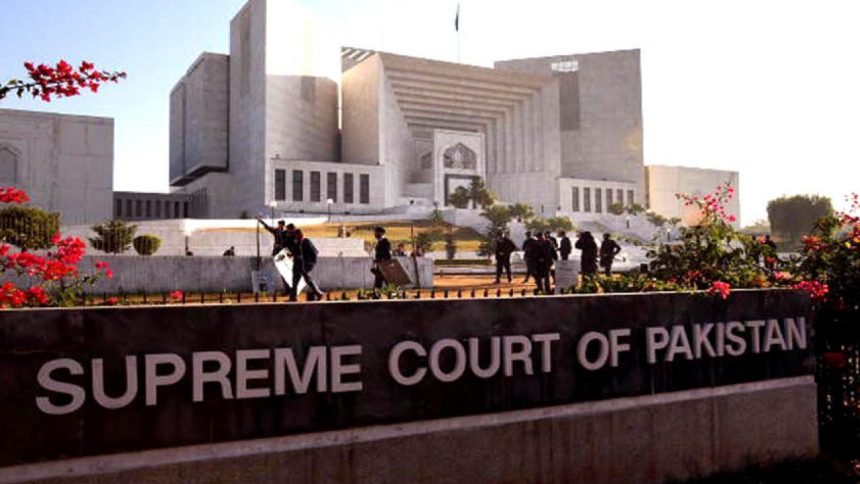
The Supreme Court pronounced its verdict in a blasphemy case, and has maintained death penalty for one of the accused while acquitting the other. Under the decision, announced in the open court in Islamabad, the appeal filed by Qaiser Ayub was dismissed, while the appeal request of his brother and co-accused Amoon Ayub was accepted, setting aside his death sentence, ordering his immediate release from jail.
The court declared the 10-month FIR delay of the case, a legal conflict between police and FIA, and upheld the death sentence and fine of Qaiser Ayub upon proof of guilt. The case was heard by a three-member bench comprising Chief Justice Yahya Afridi, Justice Shakeel Ahmad, and Justice Ishtiaq Ibrahim, while the judgment was authored by Justice Ishtiaq Ibrahim.
The apex court, while reviewing the legal application of Section 295-C of the Pakistan Penal Code in its judgment, said that the law was extremely comprehensive, so that any act of blasphemy committed through words, writing, pictures, gestures, or insinuations could not escape punishment. The court said that the inclusion of the words “directly or indirectly”, in the law, ensured that regardless of technical interpretations or clever evasions, if the criminal act and sacrilegious intent were proven, the offense would be deemed complete.
The Supreme Court clarified in its decision that there was no prior enmity or acquaintance between the complainant and the accused, and while the complainant resided in Talagang area, the accused resided in Lahore; therefore, the complainant had no reason to falsely implicate anyone located so far away in a capital offense like this.
The 10-month delay in lodging the FIR due to the jurisdictional confusion between the police and the FIA did not adversely affect the prosecution’s case, as the complainant had submitted a written application to the police immediately after the incident.
Rejection of accused’s plea
The Supreme Court completely rejected the defense plea of accused Qaiser Ayub, in which he claimed that the WordPress blog was created without his permission and that the material found in the recovered devices was planted by the police itself.
The court held that alongside the blasphemous content, Qaiser Ayub’s highly personal and confidential documents—such as international travel e-tickets, US visa forms, bank drafts, and private family emails—were present in the recovered devices. It is simply impossible for any police or investigating agency to prepare such detailed personal data of an individual and plant it into their hardware.
The presence of personal data and blasphemous content on the same hard drive establishes an irrefutable chain of ownership. Furthermore, Qaiser Ayub’s emails proved continuous contact with individuals worldwide spreading blasphemous material, fully demonstrating his criminal intent and organized role. On the other hand, regarding co-accused Amoon Ayub, the Supreme Court declared after judicial scrutiny that the case against him was based merely on a PTCL connection, an office lease agreement, and the recovery of a laptop from his in-laws’ home.
The court observed that it was common practice for family members to obtain PTCL or internet connections and office agreements in one another’s names, and merely having a connection legally registered under someone’s name could not make them guilty of a serious crime. Regarding the recovery of the Dell laptop from Amoon Ayub’s in-laws’ residence, prosecution witness ASI Mehboob Hussain admitted during cross-examination that the front portion of the laptop was empty, raising doubt about its structural condition and internal drive.
Because of the shared usage of electronic devices between brothers, the probability exists that Amoon Ayub lacked actual knowledge (mens rea) of the content inside the laptop. Therefore, the court concluded that the standard of evidence against Amoon Ayub was extremely weak and fails to prove guilt beyond reasonable doubt; on this basis, he is granted the benefit of doubt, acquitted of all charges, and ordered to be released immediately, while the death sentence of Qaiser Ayub is maintained.
Background
The case was registered at City Police Station Talagang under Section 295-C of the Pakistan Penal Code on June 9, 2011, under FIR No. 105. In the case, the Additional Sessions Judge Talagang sentenced both accused to death and a fine of PKR 100,000 each on December 13, 2018, specifying six months of simple imprisonment in default of payment of the fine, after which the Rawalpindi Bench of the Lahore High Court also upheld these sentences on June 8, 2022.
The case originated in August 2010 when Muhammad Saeed, a resident of Tehsil Talagang, became aware of a public blog on the internet (www.ucopak.wordpress.com) where highly blasphemous content, sacrilegious images, and articles were uploaded. When the complainant thoroughly inspected this web page, he found that full personal identification and contact details of its creators and administrators were listed on the blog, including the names, mobile numbers, PTCL landline number, email IDs, and Lahore office address of the accused, connected to an organization named ‘United Christian Organization Pakistan’ (UCOPAK) and its main domain (www.ucopak.org).
Upon seeing this content containing extreme desecration of sacred figures, the complainant immediately approached City Police Station Talagang with printed evidence of the material and a written application. The local police, displaying apathy and ambiguity regarding technical jurisdiction over internet-based crimes, directed the complainant to the Cyber Crime Wing of the Federal Investigation Agency (FIA) instead of registering an FIR.
FIR Inquiry
A preliminary inquiry was initiated by the Cyber Crime Wing of the FIA over the complainant’s application, during which scrutiny of official records from the Pakistan Telecommunication Company Limited (PTCL) established that the landline number was registered in the name of accused Amoon Ayub, while the web domain www.ucopak.org was owned by accused Qaiser Ayub.
At that time, due to the lack of direct legal authority for the FIA Cyber Crime Wing to take action and prosecute under Section 295-C of the Pakistan Penal Code, the matter was sent back to the local police, following which a formal FIR was registered at City Police Station Talagang on June 9, 2011, after a delay of approximately 10 months.
When the police attempted to arrest the accused, it was revealed that both had absconded. After continuous efforts, accused Qaiser Ayub was arrested on November 16, 2014. During police custody, Qaiser Ayub voluntarily made a confessional statement and led the police team to his office, from where significant electronic equipment and computer hardware were recovered and confiscated by SP Jabbar Hussain on behalf of the state, with a recovery memo prepared.
Devices
The devices recovered upon the pointation of Qaiser Ayub included a black Dell CPU, an Acer tower CPU, an Intel Inside CPU tower, four hard disks, CDs, a white PTCL device, a red Wi-Tribe Wi-Fi device, two external devices, an ATXT Wi-Fi device, an MP3 player, a telephone set with charger, a Lenovo laptop, a Dell OptiPlex LCD, two Dell keyboards, an old mouse, and a new mouse.
Subsequently, on April 18, 2015, co-accused Amoon Ayub was also arrested, and during his personal search, a Samsung mobile phone along with a SIM card was recovered and confiscated on behalf of the state.
During investigation, Amoon Ayub made a disclosure on April 22, 2015, leading the police to his in-laws’ residence located in Maryam Colony, Lahore, from where a Dell laptop was recovered. All confiscated hardware and devices were sent for scientific and digital forensic analysis to the FIA Cyber Crime Wing in Islamabad, where FIA Deputy Director Mahmood-ul-Hassan conducted a complete forensic examination and prepared detailed forensic reports and technical reports.
Forensic Reports
According to the details of the forensic analysis, dozens of files containing explicit blasphemous material, sacrilegious pictures, and articles were directly recovered from the hard drives of the Acer CPU and Lenovo laptop recovered from Qaiser Ayub.
The report also revealed that Qaiser Ayub’s personal email IDs (contact@ucopak.org and qaiser@ucopak.org) were used to control the website www.ucopak.org as an administrator and run the blog.
The domain registration order form dated June 2, 2009 and attached records prove that Qaiser Ayub personally purchased the web domain. From the Lenovo laptop, highly personal data of Qaiser Ayub was also found, including international e-tickets, US hotel reservations, US visa forms, bank statements, Western Union receipts, and private emails.
Forensic experts also proved that the internet IP address from which the blog was created and operated was connected to the PTCL landline connection registered in the name of Amoon Ayub.