


June 5, 2026
By Iqra Manzoor
LAHORE
“I was born a westerner in Iran, but I am an Iranian in the West,” Marjane Satrapi once reflected through the voice of her younger self in Persepolis, a line that distilled the fractured sense of belonging that shaped both her life and her storytelling.
It is this world — part memory, part lived history — that Satrapi brought to global attention through Persepolis, the autobiographical graphic novel that traced her childhood in Iran during and after the 1979 Islamic Revolution.
Satrapi, the Iranian-French author, illustrator and filmmaker, has died at the age of 56, the French president’s office said on Thursday. French President Emmanuel Macron described her as “a leading figure of French culture and an artist devoted to freedom, whose work carried a universal message and earned her immense international renown.”
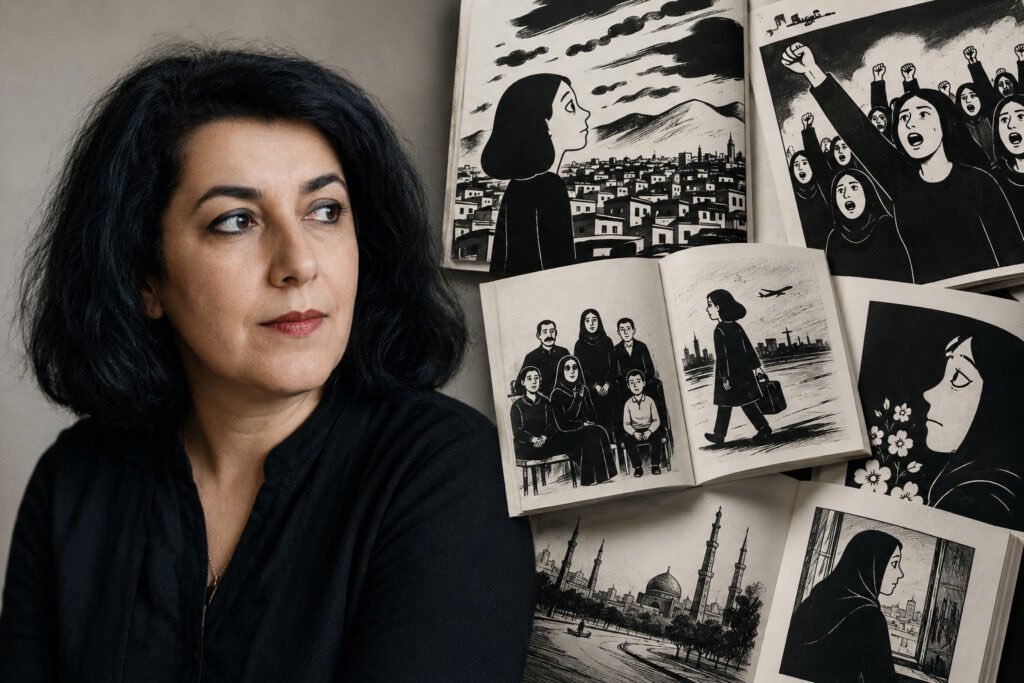
A statement from her family, shared with AFP, said she had died of “sadness” a little over a year after the death of her husband, Swedish actor and filmmaker Mattias Ripa.
The 1979 Islamic Revolution: a turning point in Iran
The 1979 Islamic Revolution was a major political upheaval that overthrew Iran’s monarchy under Shah Mohammad Reza Pahlavi and led to the establishment of an Islamic Republic under Ayatollah Ruhollah Khomeini. It brought together a wide coalition of political and social groups, but power later consolidated under religious leadership.
After the revolution, Iran’s political and social order changed significantly. Public life became more regulated, with stricter rules around dress, behaviour, and expression, particularly for women. Cultural and political life also came under tighter ideological control, reshaping everyday experiences in schools, homes, and public spaces.
For Marjane Satrapi, this was not distant history but lived reality — the backdrop of her childhood, later captured in Persepolis through the eyes of a young girl growing up in a rapidly changing society.
Childhood under revolution
Born in 1969 in Tehran, Satrapi grew up in a politically conscious household during a period of intense upheaval. The revolution did not only transform the state — it transformed childhood itself, shaping what could be said, worn, or imagined.
For Satrapi, these changes were lived experiences, absorbed through classrooms, family conversations, and the quiet negotiations of growing up as a girl in a society where ideology increasingly shaped daily life.
“I come from a country where a woman is worth half a man,” she once told Variety, adding, “I never thought I had one leg less just because I was a woman.”
Persepolis and the language of lived experience
Her breakthrough work, Persepolis, became a rare bridge between personal memory and global understanding. Told in stark black-and-white illustrations, it followed a young girl navigating war, revolution, exile and return — but more importantly, it showed how political systems settle into everyday life, shaping fear, humour, silence and resistance.
The book was later adapted into an animated film that won the Jury Prize at Cannes and was nominated for an Academy Award, further widening its reach and impact.
Senior journalist and co-chairperson of the Human Rights Commission of Pakistan (HRCP), Munizae Jahangir, said Satrapi played a defining role in shaping global understanding of post-revolution Iran.
“Marjane Satrapi was among the first to bring global attention to the political realities of post-revolution Iran, particularly through the lived experience of women and children,” she said. “Through Persepolis, she made those experiences accessible to audiences worldwide in a deeply human way.”
In a post on X (formerly Twitter), Jahangir described Persepolis as a “unique” work that broadened visibility of women’s narratives from the region.
Marjane Satrapi had an extraordinarily creative way of telling a story,Persepolis was a joy to read,my sister @sj244 introduced me to it saying a new book has come & it’s unique it in its https://t.co/fRhkiuybOu our part of the world, we have very few women storytellers who… https://t.co/27zCbg8xeB
— Munizae Jahangir (@MunizaeJahangir) June 5, 2026
Exile and identity
Satrapi left Iran as a teenager, spending time in Austria before later settling in France. Exile became a defining thread in her work — not just displacement, but a shifting sense of identity between cultures and languages.
Beyond Persepolis, she directed films including Chicken with Plums, The Voices and Radioactive, continuing to explore individuality, resistance and control through dark humour and political reflection.
Speaking about the film industry, Satrapi once said: “Beyond a certain budget, they don’t trust women directors… Of course we can handle it. It’s 5,000 years of culture.”
A critic of power and hypocrisy
Over the years, she became a vocal critic of authoritarianism and a defender of artistic freedom, frequently speaking out on exile, censorship and political hypocrisy.
In 2025, she declined France’s Legion of Honour, criticising what she called the country’s “hypocritical attitude” toward Iran and unequal treatment of Iranian dissidents compared to privileged elites.
Tributes from across the world
Following news of her death, tributes poured in from across the global cultural and film community.
Actor and human rights advocate Nazanin Boniadi said she was “deeply saddened” by Satrapi’s passing, calling her “a towering artist and a singular voice” and remembering her as a steadfast advocate for Iran.
I’m deeply saddened to hear of the loss of Marjane Satrapi.
Marjane was a towering artist, a singular voice, and a steadfast advocate for the Iranian people. Beyond her remarkable achievements, I will remember a woman of extraordinary passion and heart.
We bonded over our… pic.twitter.com/fngbTpg1lN
— Nazanin Boniadi (@NazaninBoniadi) June 4, 2026
Film producer Kathleen Kennedy called Satrapi “a true original,” saying she turned her personal story into something universally understood and was an artist of conscience who “broke the door open on her own terms.”
Legacy
Satrapi also contributed to public art, including a large-scale textile installation for the Paris 2024 Olympics depicting athletes moving around the Eiffel Tower.
What remains of her work is not only a record of political upheaval, but a deeply personal mapping of what it means to grow up inside it — to be a child trying to understand a world that keeps changing its shape.
Her stories did not simply describe history. They made it feel human.
And in that insistence, Marjane Satrapi leaves behind a voice that continues to travel — between Iran and Europe, childhood and exile, silence and expression.