

April 22, 2026
By Mateen Ali
LAHORE
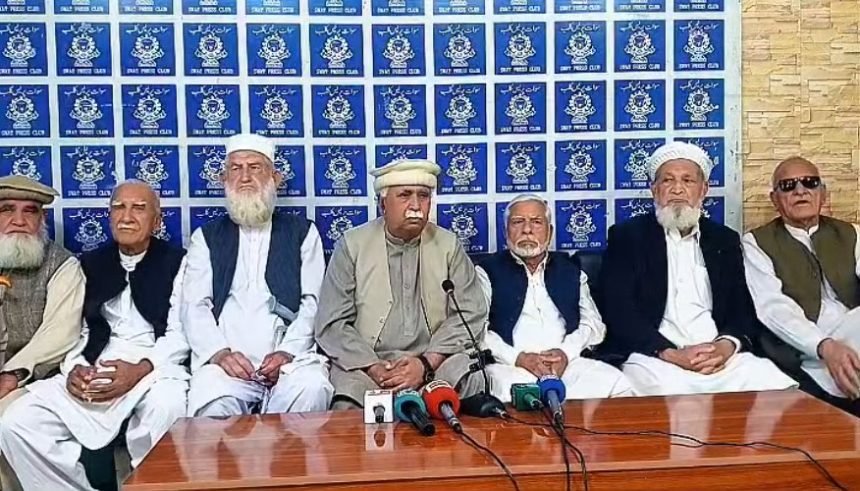
The Swat Qaumi Jirga held a press conference recently, where it warned of worsening security conditions in the region and gave the authorities a one-month deadline to restore control or face mass protests.
Tension is once again rising in the Swat Valley, a region that, not long ago, was seen as a hard-won success against militancy. Today, residents, political leaders, and members of the Swat Qaumi Jirga warn that the calm may be slipping. There are small but persistent signs of militant activity, along with a growing sense that the state response is not keeping pace.
Signs of a militant return
At the center of these concerns is the reappearance of militants linked to Tehreek-i-Taliban Pakistan (TTP), reportedly active in scattered pockets across the valley. While their numbers appear limited, locals say their presence is becoming harder to ignore.
In recent months, incidents ranging from targeted attacks to roadside blasts have reinforced fears that militant networks are quietly regrouping. Political figures, particularly those affiliated with the Awami National Party (ANP), have been frequent targets. A senior ANP leader, Mumtaz Ali Khan, narrowly escaped a roadside blast in November, while previous years have seen deadly attacks on both political workers and jirga members.
Residents in several areas report that armed individuals have begun routine patrolling—an echo of earlier years when militant authority replaced state governance. There are also increasing allegations of extortion, particularly targeting orchard owners, a key part of Swat’s local economy.
Unanswered attacks and rising frustration
Zahid Khan, a core committee member of the Swat Qaumi Jirga told voicepk, “these incidents are not isolated several attempts to disrupt the peace in Swat over recent years.” He specifically pointed to attacks on figures such as Mumtaz Ali Khan and Ayub Khan Ashari, adding that “the state has been unable to control the security situation” and that “investigations into the incidents have yielded no results, leaving families without justice and communities without reassurance.”
Questions over control
These concerns deepen, according to Zahid Khan, when viewed against what he describes as “operational ambiguity on the ground.” He recalls a past incident in the Matta area where, he says, police were reportedly instructed not to engage militants because “security personnel had their own men in the mix.” While such claims are difficult to independently verify, Khan argues they contribute to a “long-standing and controversial perception” of a “good Taliban vs bad Taliban” policy, which critics say has “weakened consistent counterterrorism efforts.”
“Given all the power the state has,” Khan asks, “are they facilitating these militants for their own agendas?” The question reflects a deeper erosion of trust between local communities and security institutions.
“In our many meetings with the police, we have asked them repeatedly whether they even have full control,” said Zahid Khan.
Public mobilization and ultimatum
Public sentiment in Swat has already begun to mobilize. In September, thousands gathered under the banner of Ulasi Pasoon (public uprising), calling for peace and accountability. Organizers warn that similar—or larger—gatherings could take place if the situation continues to worsen.
The Swat Qaumi Jirga has now issued a clear ultimatum: the state has one month to show meaningful control over the situation. Failing that, they say, mass protests will follow.
For a region that has already endured the devastation of militancy, the stakes are deeply personal. The people of Swat are not simply reacting to isolated incidents—they are responding to a familiar pattern, and the fear that history could repeat itself.