

Feb 9, 2026
Press Release
LAHORE
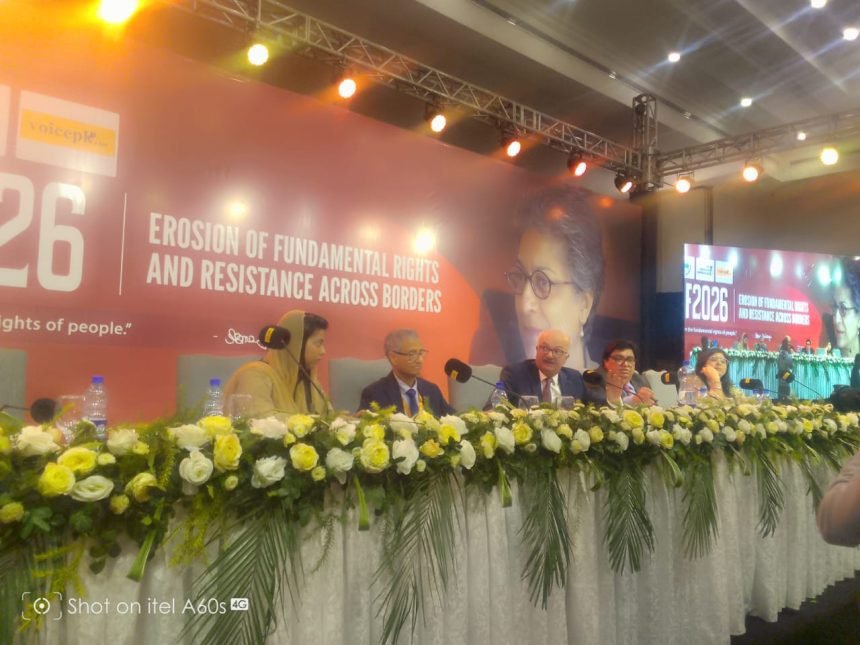
On the first day of the Asma Jahangir Conference on February 7, a session titled, “The Politicization of Religion and its Impact on Minorities” addressed a packed hall, where a diverse audience came together to hear the perspectives of the panelists. The session examined how the state and political elements exploited religious rhetoric for power, ultimately leading to the systemic marginalization, legal discrimination, and increased physical insecurity of religious minority communities.
The panelists included Federal Minister for Minority Affairs, Kheel Das Kohistani, Justice of the Lahore High Court Shehram Sarwar, former UN Special Rapporteur on Freedom of Religion and Belief (Maldives) Ahmed Shaheed, former parliamentarian Mary James Gill, and minority rights activist Jayaa Jaggi. The session was moderated by Xari Jalil, co-founding editor of Voicepk.
In his keynote address Justice Shehram Sarwar, said that Asma Jahangir’s legacy embodies the struggle for democracy, human rights, and judicial independence in Pakistan. She was a true champion of justice, advocating tirelessly for the marginalized and vulnerable. Her work reminds us that law should be a tool for justice, not oppression. Justice Sarwar said that the legal community should defend minority rights not as a charity but as a constitutional duty.
“The responsibility of safeguarding minority rights does not rest with the judge alone,” he said. “The bar plays a critical role or often the first line of defence for those who feel excluded or threatened.”
Ethical advocacy, competent representation and respect for professional standards are essential to maintaining public confidence in justice. He addressed young lawyers and law students saying that they should reflect on the thought that the defence of minority rights was not a niche practice, but it was central to constitutional law. “It requires patience, preparation and moral clarity. Advocacy should be grounded in law not is what strengthens institutions, he said, adding that advocacy that respects the dignity of all parties strengthens demands.
Ultimately the challenge of politicised religion cannot be addressed solely through litigation or legislation. It requires a constitutional ethos, a shared commitment among institutions and citizens to the principles of equality, tolerance and the lawful governance.
Such an ethos does not demand uniformity of belief, it demands respect for difference, confidence in law and rejection of violence.
Former MPA Mary James Gill mentioned a case study she had worked on from Lahore’s constituency of NA-127, with 8000 Christian voters, where it showed their top priorities were gas, water, roads, employment, and education. Only 124 wanted political representation, and 27 mentioned forced conversion as a top issue, she said, adding that this highlights how even within minorities, certain are privileged while others are marginalized.
“Homogenizing minority groups has damaged us,” she said. “We need to look at each group differently, considering their population size and unique challenges.”
Speaking about the reaction of civil society on the alleged ‘toothlessness’ of the newly formed National Commission for Minorities Rights (NCMR), Jayaa Jaggi said that there should be no difference of opinion on certain things including rights for minorities. She said she had hope that the minority commission was activated and allowed to work effectively.
“We can have differing opinions on something like which color is more beautiful, but we cannot have differing opinions on whether early marriage should happen or not,” she said. “We cannot have differing opinions on whether a person should be killed or not. On freedom of religion and belief, there cannot be a difference of opinion, and with respect and appreciation, I’ll not take that difference of opinion. As far as the commission on minorities is concerned, since I’ve been part of meetings with the law ministry, I really hope that the document that has been finalized mentions financial autonomy.”
Mentioning forced conversions issue, she said that the child marriage law had also been passed, but every day there is news about a minor getting illegally married and forcibly converted.
“I now hope it will be implemented because if it’s not, ultimately, the people who made this law, who will be contributing… If they don’t do anything, I’ll just be another hopeless young person surviving and breathing in this country. I have high hopes it will pursue forced conversion cases with dedication, like no other commission has.”
Federal Minister for Minority Affairs, Kheel Das Kohistani stated that setting a minimum age of marriage is not a religious concern, however legislative attempts to do so are impeded by extremist groups. He also condemned child marriages and questioned how anyone could marry a 12- or 13-year-old child.
Voices have been raised at the child marriage bill passed by parliament, he said. “If a 12- or 13-year-old girl is taken away, whether by choice or force, and presented in court, I believe it’s a matter of governance and justice. The girl should be asked about her wishes, and then we can discuss religion,” he said. “How can a 12-year-old girl marry? That’s where the problem starts. There’s a religious preference in these laws, and it’s affecting people. We’re all part of society, and this fear is impacting our laws, society, and community. We should have a dialogue about it.”
He said that when making laws, we should think: “Would I marry off my 12-year-old daughter?” In our Hindu religion, we don’t allow it. Let’s be open about it, debate, and stop this injustice. Forcing a 12 to 13-year-old girl into marriage and conversion, and then denying her justice, is wrong. Rinkle Kumari’s family went to court, and was crying but were humiliated. There are many such girls. We shouldn’t hide it; we should talk about it openly,” said the Minister.
Meanwhile Ahmed Shaheed, UN Special Rapporteur on Freedom of Religion and Belief spoke about the impact of GSP plus, and what would the impact be on Pakistan’s if it continues to lag behind in the implementation of laws and policies concerning minorities.
“Let’s reframe debates on religious freedom, acknowledging discrimination as a form of racism,” he said. “We need to understand what’s happening and work together for change.”
The session noted that the laws must be fully implemented to ensure that no child is married under the age of 18.
The session strongly condemned the hundreds of minority girls being forcibly converted daily and agreed that any kind of faith conversion should have a proper procedure. The session agreed that a comprehensive legislation must be enacted to criminalize forced faith conversions.
It was noted that while cases of forced conversions and blasphemy were running in court, usually the judges had to face immense pressure at the hands of mobs and this affected such cases being dealt with sensitively.
There was also serious concern about an alarming new trend of online blasphemy accusations which ended up with hundreds being sent behind bars. It was agreed that this new trend was a particularly dangerous form of politicization of religion and would end up affecting the religious minorities.
The session also noted that economic discrimination of the labour class was one of the worst forms of discrimination because of politicization resulting in social/economic isolation.
It was recommended that a robust protection framework for women and girls at risk of forced conversion must be established. This included access to (safe) shelters that acknowledge Freedom of Religion and Belief, legal aid, psychosocial support, and confidential reporting mechanisms including mandatory, continuous training for law enforcement agencies, judicial officers, prosecutors, and members of the legal fraternity.
Accountability measures must apply to perpetrators as well as officials who enable, ignore, or mishandle such cases.