

Dec 2, 2025
Islam Gul Afridi
PESHAWAR
Thirty-year-old Khalida Gul*, a mother of two, has travelled for three hours with her father from their village to the HIV/AIDS centre at Peshawar’s Hayatabad Medical Complex only for routine tests and to collect her medication.
Five years ago, during the birth of her first child at a private health facility in the village, she needed a blood transfusion. Her family purchased blood from an outside source, which was administered without screening.
“That blood belonged to an HIV-positive donor,” she said, adding that she contracted the virus as a result. However, through timely medication and preventive measures, both her husband and second child have remained HIV-negative, she says.
Her father, 60-year-old retired government employee Muhammad Maskeen Abbasi, says the family was initially overwhelmed with fear after her diagnosis.
“But the counselling and guidance from the HIV/AIDS programme staff made life easier,” he says. He adds that his son-in-law works in Karachi as a labourer while he regularly accompanies his daughter to Peshawar every six months for follow-up and medicines.
“Financial stress and social attitudes,” he says, “are the most difficult challenges.”
Rising number of patients in KP
According to the Khyber Pukhtunkhwa HIV, Hepatitis and Thalassaemia Control Programme, 1,276 new patients were registered as of November 25 this year, pushing the total number of registered HIV cases in the province to 9,749, including 2,454 women. Last year, 1,265 cases were registered.
Programme head Dr Tariq Hayat says 70 per cent of registered patients are men, while the remaining include women, children, and transgender persons. He said many male patients work abroad for long periods and are deported after testing positive there. “Without informing their wives, they resume sexual relations at home, which results in transmission,” he said.
He adds that without timely diagnosis and treatment, unborn children are also at risk. “People in Pakistan, and especially in KP, hide the disease. But it is an infection like hepatitis or others, transmitted through various means,” he says, rejecting the notion that HIV spreads only through “unnatural sexual practices”.
Two decades of treatment and community support
Palwasha Khan (name changed) contracted HIV 30 years ago after receiving unscreened blood during treatment for an illness. For the last 20 years, she has been taking anti-retroviral medication without interruption. She now assists patients across the province, country, and even abroad by helping them access medicines and guiding them through treatment.
She says both her children were born HIV-negative and her husband has also remained unaffected.
“This proves that with timely medication, one can live a normal life,” she says. However, she notes that patients—especially women—face severe social stigma once their status becomes known.
Palwasha says women face far more complex barriers than men. These include delayed testing, difficulty obtaining medicines, being forced to use separate utensils at home, being restricted to cleaning chores, and even being denied physical contact with their own children. She says family counselling sessions conducted by programme staff often help change attitudes.
Dr Anum, coordinator of the HIV centres at HMC and Lady Reading Hospital, says women avoid seeking treatment openly due to shame, fear, and restrictive social norms, worsening their health risks. Every patient, she says, must visit any of the 13 provincial centres every six months for tests to assess viral load and to collect medicines for several months.
“Men come for follow-ups,” she says, “but many do not bring their wives. They simply collect medication using their documents.”
“I returned and started life again”
Sajid Khan*, a 30-year-old resident of Peshawar, worked for six years at a telecommunication company in Dubai. Two years ago, during a routine medical exam to renew his visa, he tested positive for HIV and was dismissed.
“I returned to Pakistan in a state of deep distress,” he says. At the HMC centre, he received counselling and free treatment. He declined to discuss the cause of his infection but said he now runs a successful mobile repair business. Initially, he hid his diagnosis from family members. “But after counselling by programme staff, I told them. Life has improved since then.”
Jalal Khan, Monitoring and Evaluation Officer at the programme, said media reports often sensationalise the rise in cases.
“This is incorrect,” he said. “Because of awareness and improved services, more people are coming forward for testing and treatment, which is a positive development.”
He said an estimated 29,702 people in KP are currently living with HIV, a number expected to reach 40,000 next year, many of whom are not enrolled in treatment. Bringing them into care—through testing, follow-ups, and regular medication—is critical, he stressed.
He noted that the Global Fund has cut HIV-related support by 30%, with funding expected to end by 2030. In response, the KP Health Department has submitted a Rs2.6 billion PC-1, with Rs400 million earmarked for awareness initiatives. Last year’s PC-1 was worth Rs480 million.
Changing attitudes at home
Sajida* says her husband, a labourer, was diagnosed with HIV five years ago during medical tests for travel to Saudi Arabia. After counselling at the HMC centre, she and her children were tested; the children were clear, but she was HIV-positive.
She says she often experiences fatigue and fever, but regular medication has improved her health. Financial constraints, she says, make it difficult to visit hospitals regularly. Social stigma, however, is harder to bear.
“Even close family members avoid eating with me,” she says. Her in-laws do not allow her to hold her children, fearing transmission. “Awareness has improved things somewhat, but stigma persists.”
According to Palwasha, many women cannot afford transport to treatment centres.
“Some receive their medicines hidden inside grocery bags sent from local shops so that no one finds out,” she said. She added that many husbands take second wives and subject their spouses to emotional abuse, which worsens their psychological condition. “But timely treatment allows women to live normally, maintain safe marital relations, and give birth to HIV-negative children.”
Does HIV spread only through ‘unnatural’ sexual practices?
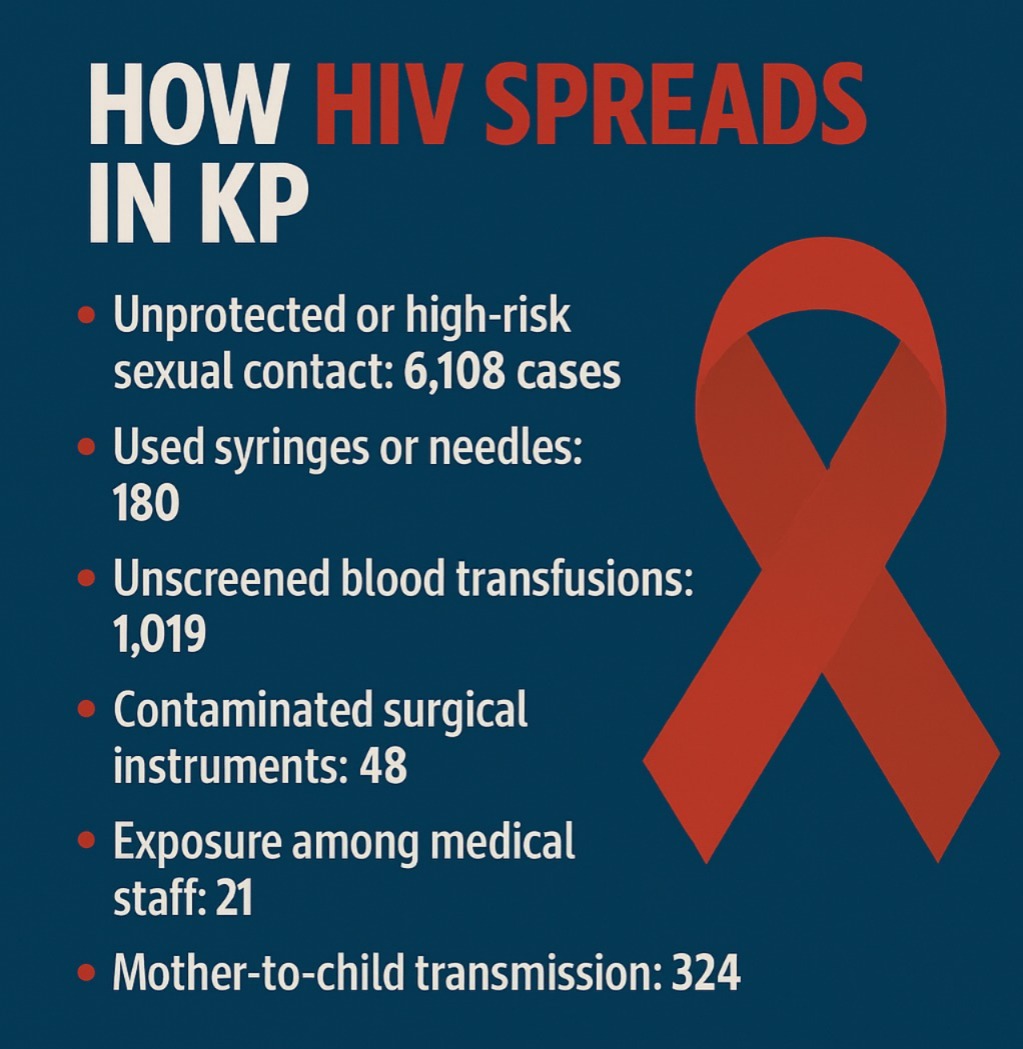
Medical specialist Dr Raza Muhammad Khan said HIV is not limited to sexual contact and spreads like other infections. Contaminated medical equipment, reused needles for piercing or shaving, unprotected or high-risk sexual relations, same-sex relations, and transfusion of infected blood can all transmit the virus. People with multiple sexual partners—regardless of gender—face higher risk, he said.
Is HIV Incurable?
Dr Tariq Hayat says people should not fear the disease.
“Misconceptions and propaganda have caused preventable deaths,” he says. Prevention is essential, he stressed, but those who contract the virus must seek registration at provincial centres where free testing and medication are available.
“Most HIV-positive individuals work, earn, and live normal social lives,” he says. “But there is absolutely no room for negligence in medication.”