

October 27, 2025
By Xari Jalil
LAHORE
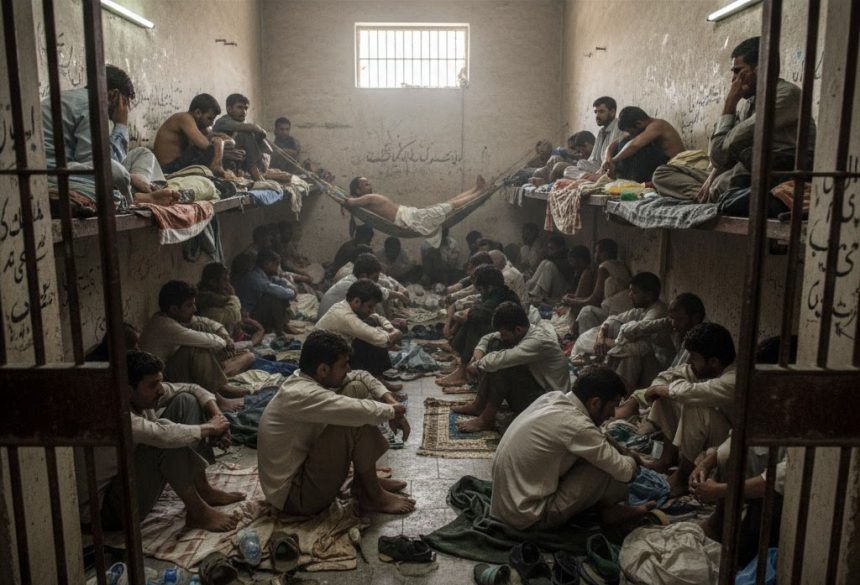
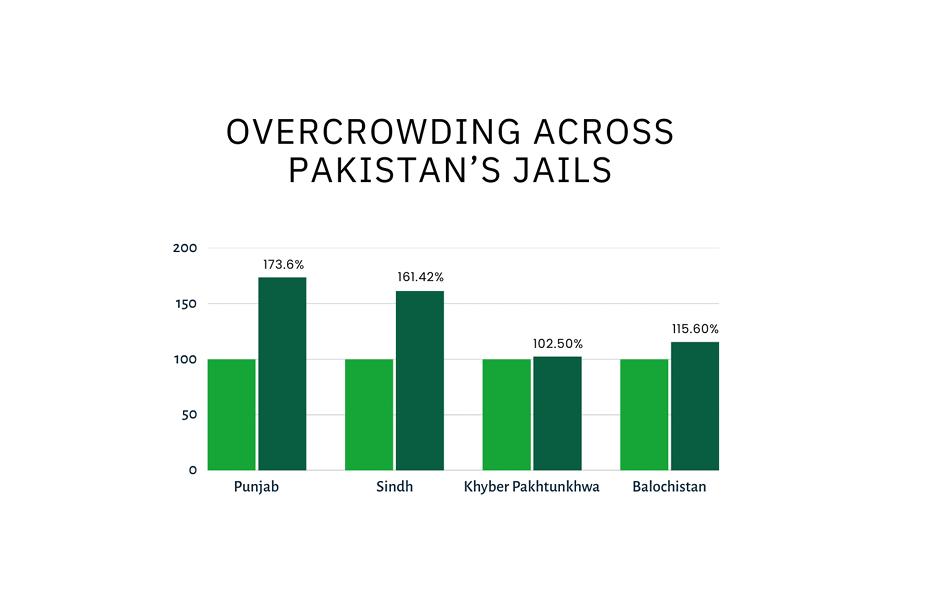
District Jail Lahore, commonly known as Camp Jail, is in the throes of a profound crisis. Visits to the Lahore Camp Jail recently by the Asma Jahangir Legal Aid Cell (AGHS) has revealed some worrying statistics that show an overcrowding by 52 percent, and a prison population that needs much more than just rehabilitation.
Authorized to accommodate just 2,500 male inmates, the facility has recently swelled beyond its capacity to house a staggering 6,874 prisoners. This overwhelming population surge has pushed the jail to nearly triple its intended capacity, straining every aspect of its operation—from medical care to rehabilitation efforts—and signalling a deep systemic failure within the provincial penal system.
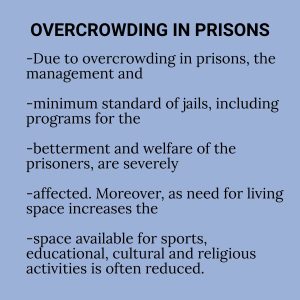
This severe congestion has created immediate dangers: sanitation has become precarious, disease transmission has accelerated, and the vital separation between hardened criminals and vulnerable populations, such as juveniles, becomes nearly impossible to maintain.
Inspector General of Prisons (IG), Mian Farooq Nazeer, while speaking to Voicepk in an exclusive interview said that the biggest issue that the prisons were facing was that of overcrowding.
“There are huge issues of overcrowding in Kasur, Lahore, Faisalabad, Sheikhupura, Sialkot, Gujranwala – all the jails in Central Punjab,” he said. “The jails in eastern and western side and even in the south of Punjab there is no overcrowding – in fact there is undercrowding. In the last ten years we have made several jails which are functioning. There are three women’s jails that will be made functional hopefully by the end of this year. So the issues of overcrowding in the women’s section will improve as well. There are two new jails – one in Rawalpindi which is still under construction. This year’s developmental budget also includes Lahore’s jail too. And the existing jails mentioned above where there is overcrowding – we are making additional barracks.”
He said overcrowding results in several other problems. “Space, hygiene, rush hour during prisoners-family meetings, interview sheds, small kitchens, fewer hospital beds
The humanitarian emergency inside Camp Jail was the focus of a recent monitoring and legal assistance visit conducted by the Asma Jahangir Legal Aid Cell (AGHS) team. The agenda of the visit was to provide free legal support and assess the living conditions, particularly within the segregated sections for juveniles and minority inmates. What they uncovered – and have been seeing since a long time now – was a system at its breaking point, one where overcrowding is the biggest threat to providing justice to inmates.
The Paradox of Reform vs. Reality
The juvenile section of District Jail Lahore is conceptually designed as a “reformative school”—a space intended to nurture growth rather than simply contain crime. Here, young inmates are offered academic classes alongside practical, skill-based vocational training. This curriculum includes instruction in stitching, handicrafts, and electrician skills, supported by a basic computer lab. These programs represent a crucial attempt to equip young offenders with tools for a productive life post-release.
But the sheer volume of cases and the excruciating pace of the judicial process systematically dismantle these efforts. On October 14, the day of the AGHS visit, the jail housed 42 juveniles, every single one of whom was an under-trial prisoner (UTP).
The legal aid team met with 18 of these young men, and without exception, all 18 signed a Power of Attorney (PoA) seeking immediate legal representation. This 100% sign-up rate among those interviewed is a devastating indictment of their lack of access to timely legal counsel, leaving them trapped in custody with no clear path to justice. For many, complex legal entanglements—including some juveniles facing multiple First Information Reports (FIRs)—mean their future is indefinitely paused behind bars.
Women Protection Officer at AGHS, Robina Shaheen, has spent the last 30 years working for women’s welfare especially in jails and her experience of making prison visits and observing the issues present there, has been vast.
“If I have ever seen any government department make any kind of improvement, then it has to be the Prisons Department,” she says. “I started my work in 1994, and made my first jail visit then. From then to now I have seen a lot of improvement. A lot of negative things have also happened that should never have taken place, but I would like to point out that many things have changed for the better. However these things are all ruined by the issue of overcrowding.”
Shaheen specifies that until there is overcrowding in jails, there will be no use of anything good.
“There are 45 jails, and there is space for 38,000 people in them, however at present there are more than 70,000 people in these jails,” she says. “In District Jail Lahore for instance there are over 7,000 people yet there is only space for 2000. So no matter what the government or welfare organizations do – until the issue of over population is not resolved, there will be no benefit trickling down to the inmates.”
She says there are more UTPs than convicts in jail, as a result of delays in cases, the lack of an efficient parole system, and a complicated bail system. Because of this implementing safety is also a big challenge.
The Vicious Cycle of the Under-Trial System
The struggle for the juvenile population mirrors the plight of the general inmate body. The under-trial population overwhelmingly dominates the facility’s headcount, accounting for the vast majority of the nearly 7,000 inmates. The AGHS team managed to secure 65 PoAs from general under-trial prisoners, underscoring the massive reliance on pro bono organizations to keep the justice system moving.
Not only that. This reliance is a symptom of intense systemic judicial backlog. Every UTP represents a cost to the state and, more importantly, a potential miscarriage of justice—a person detained who is yet to be proven guilty. The delay in trial proceedings means thousands are serving sentences before conviction, consuming resources and worsening the living conditions for everyone else.
The AGHS team noted that while they had seen progress in some previously handled cases, with 23 prisoners’ cases decided as of the report date, 35 cases remained pending from previous interventions. This backlog demonstrates that even with dedicated legal aid, the scale of the challenge remains monumental.
Criminal lawyer Shabbir Hussain says that the right to a fair and speedy trial is a fundamental guarantee under Article 10-A of the Constitution of Pakistan, 1973, which ensures due process and fair trial for every person. Unreasonable delay in trial proceedings adversely affects this right and undermines the administration of justice.
“Such delay causes prolonged mental, social, and economic stress to the accused, often amounting to punishment before conviction. It restricts liberty, tarnishes reputation, and may hinder the ability to effectively defend oneself due to fading evidence or unavailability of witnesses. The best example is those who await trials under blasphemy cases.”
A System Under Strain: Resource DeficienciesThe crushing overpopulation directly translates into critical resource shortfalls, as confirmed by jail management during the visit. Among the most urgent deficiencies cited were:
Infrastructure: A critical need for the construction of new correctional facilities to distribute the current prison load across the province.
Medical Services: The existing medical inadequacies are severe. Furthermore, there is an explicit need for ambulances specifically equipped for handicapped inmates, who frequently require transportation to court hearings but face logistical barriers due to their physical needs.
Basic Necessities: Prisoners lack fundamental supplies, including adequate shoes and clothing, a basic dignity shortfall that speaks volumes about the budgetary strain on the facility.
The Women’s Prison Crisis: Dispersion and Neglect
Perhaps the most glaring infrastructure gap highlighted in the report concerns female inmates. The entire province of Punjab, home to over 120 million people, currently relies on only one dedicated women’s prison, which is alarming in itself.
This catastrophic shortage forces the convicted female population to be detained across several dispersed facilities, including District Jail Faisalabad, District Jail Sheikhupura, and Central Jail Multan. This dispersion prevents specialized care, central oversight, and consistent access to gender-sensitive rehabilitation programs.
Analysis of the convicted women’s records reveals the severity of their sentences, underscoring the necessity of appropriate infrastructure. Women are serving lengthy terms—often a decade or more—for serious offenses ranging from murder (Section 302 of the Pakistan Penal Code) to drug-related charges (Narcotics Control Act). For example, records show inmates serving long sentences such as 12-years imprisonment with Rs300,000 fine, or 25-years imprisonment Rs500,000 fine, indicating long-term commitments that demand a humane and specialized environment, not a scattered, ad hoc solution.
The Call for a Judicial Overhaul
Meanwhile in its earlier report on jails, AGHS identified many issues due to overcrowding.
One major challenge was that of security. Overcrowded prisons are difficult to manage and are often plagued by increase in conflict and violence. This is because movement of prisoners is limited, adding to the stress and hostility felt by inmates.
The report said that keeping prisoners in limited space caused difficulties for the staff to maintain discipline and implement safety measures. Lack of space also leads to conflicts and violence amongst prisoners where they become a threat to their own safety. Overcrowding becomes challenging when prisoners have to go to courts and look after their security measures. It is quite clear that overcrowding is being caused by the vast number of prisoners who are under trial rather than those convicted.
Lack of Health Facilities
The medical and health facilities provided by the government in prisons are scarce and do not mark up to even the bare minimum standards. There is a significant population suffering from serious health diseases including hepatitis and HIV, as well as drug addiction. Unfortunately, even the services being provided are not enough to take care of this.
The situation inside the District Jail Lahore—from the suffocating overcrowding to the resource scarcity and the desperate reliance on external legal aid—is a powerful metaphor for the wider challenges facing Pakistan’s justice system. While the dedication of the jail staff and organizations like AGHS, is commendable, their vigilance alone cannot solve an institutional problem.
The challenges observed by the AGHS team serve to remind that true reform requires a comprehensive overhaul. However there must be a massive investment in new, humane prison infrastructure; significant judicial reforms to expedite the under-trial process; and guaranteed, quality legal counsel for all indigent and juvenile prisoners. Without these fundamental changes, the high walls of prison will continue to conceal a breaking point in the pursuit of justice and rehabilitation.