

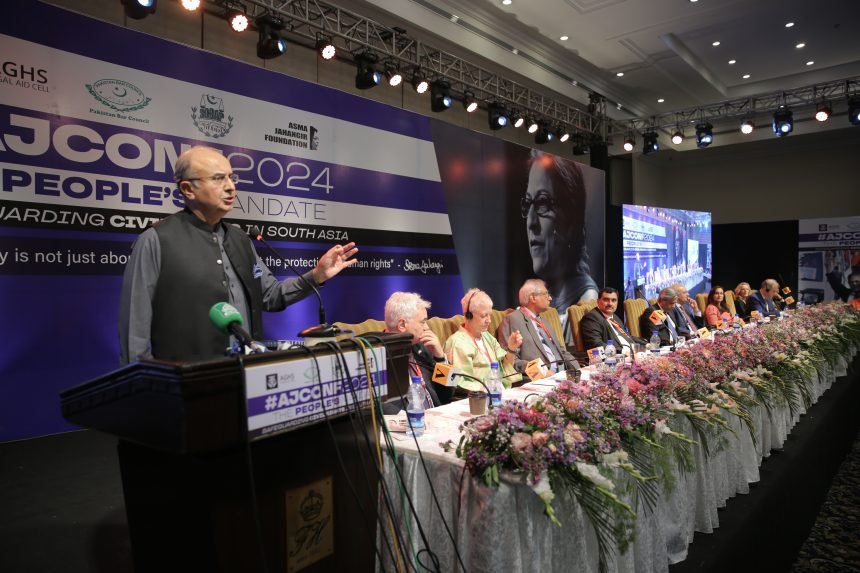
The 5th Asma Jahangir Conference titled “The People’s Mandate: Safeguarding Civil Rights in South Asia” was held on the 27th and 28th of April in Lahore, Pakistan. The recurring conference commemorates AGHS Legal Aid Cell’s co-founder Asma Jahangir’s legacy by highlighting the most pressing human rights issues and bringing together all stakeholders for the biggest human rights and legal conference in the region.
AGHS Legal Aid Cell (Pakistan’s first women-led law firm established by the late Asma Jahangir providing free legal aid to women and children) in collaboration with the Supreme Court Bar Association of Pakistan (SCBAP) and the Pakistan Bar Council (PBC), organized the event. This year’s event featured 126 speakers and over 3,476 attendees. Of the 20 international speakers, 12 attended in person while 8 made their addresses virtually.
The international speakers included the Chair of the UN Committee on Enforced Disappearances, former Justices of the High Court of Denmark and the Supreme Court of Sri Lanka, a peace activist from the West Bank, Palestine, a former election observer and MP of the European Parliament, and a journalist from India, among others.
Honourable Mr. Justice Syed Mansoor Ali Shah, the Senior Puisne Justice of the Supreme Court of Pakistan, honoured the event as the Chief Guest of Honour for the inaugural, while Mr. Yusuf Raza Gilani, the current Chairman of the Senate and former Prime Minister of the Islamic Republic of Pakistan, delivered his address as the Chief Guest of Honour for the closing ceremony. Additionally, the 5th Asma Jahangir Conference was attended by 12 Honourable Ambassadors, 4 Deputy Heads of Mission, and staff from their respective missions in Pakistan.
The national speakers included two former Prime Ministers of the Islamic Republic of Pakistan, Federal and Provincial Ministers, parliamentarians, senators, Justices, civil society and INGO representatives, and human rights activists from across the country. The event was also attended by 50 current and former office bearers of various Bar Councils and Associations. AJCONF 2024 established 8 institutional alliances with different universities and saw the participation of over 300 undergraduate students. Moreover, the conference also hosted 124 female lawyers who specially traveled from urban and rural areas of different provinces to attend the conference as participants. The Conference Secretary, lawyer Aown Kazmi, underscored that the conference’s objective is to highlight the most critical human rights issues and bring together all stakeholders to implement human rights-centric policies and actions across various focus areas, such as religious minority rights, gender equality, climate change, extremism, criminal justice reforms, and other high-priority issues in the country and region.
Inaugural | The Judiciary’s Role: Safeguarding Civil Rights
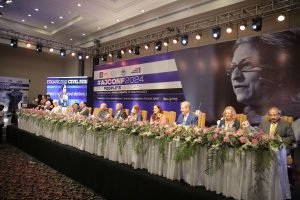
In continuation of the ethos established by the previous four editions of AJCONF, this year saw leading politicians, senior judges, ambassadors, legal experts, media personnel, and human rights activists from Europe, the United Kingdom, the United States, Canada, and South Asia actively participating in discussions across 23 sessions.
Inaugurating the conference, Sulema Jahangir, a board member of AGHS Legal Aid Cell, said that the organizers of the conference have no intention to make this conference confrontational or partisan. But it would be hypocritical to hold the conference in the name of Asma Jahangir and not discuss controversial topics. She condemned military trials of civilians in a democratic regime, upheld the supremacy of law, and remarked that “without the judiciary playing its due role, the crisis of constitutionalism will only become endemic and existential.”
The inaugural session was addressed by ambassadors representing the European Union, the Kingdom of Netherlands, Germany, the United Kingdom and Spain. They were unanimous in their commitment to upholding people’s rights and advocated for the independence of the judiciary in Pakistan.
Ambassador of the EU to Pakistan, H. E. Dr. Riina Kionka, briefed the audience on the EU’s support for human rights through three methods: political advocacy, trade, and development cooperation. She explained that the General Scheme of Preferences Plus (GSP+) allows Pakistani exports quota-free and duty-free access to European markets, provided that Pakistan demonstrates progress in implementing 27 international core conventions on human rights, governance, labor rights and environmental standards.
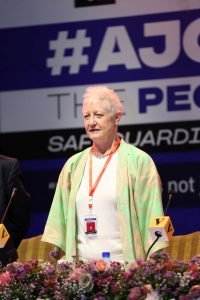
Advocating for the right to free expression, Ambassador of the Kingdom of the Netherlands H. E. Ms. Henny Fokel de Vries said, “Information empowers individuals and social media blackouts impede the right to free expression. We must uphold the principles of human rights and justice to safeguard the rights and dignity of every individual.”
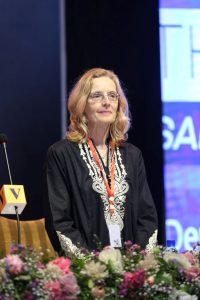
Ambassador of the Federal Republic of Germany, H. E. Mr. Alfred Grannas, held that the mother of all basic rights is the protection of human dignity. “The inviolability of human dignity… is the yardstick for all other basic rights,” he said, adding that Pakistan and Germany are two out of a measly four countries that recognize human dignity as a basic right.
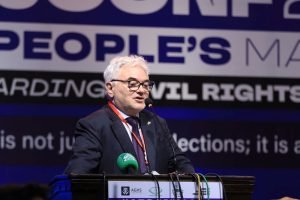
Dr. Noor Khan, Deputy Head of the Royal Norwegian Embassy, asserted that access to schools, particularly girls, remains a challenge in Pakistan. She also emphasized Norway’s concern over the humanitarian crisis resulting from the Israel-Gaza conflict, and called for the release of all hostages, humanitarian access and an immediate ceasefire.
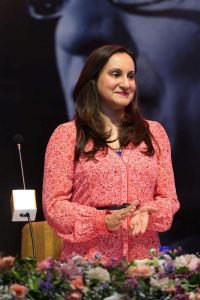
H. E. Ms. Jane Marriott, United Kingdom High Commissioner to Pakistan, said “There can be no society without freedom of expression. We urge the government of Pakistan to lift the ban on X.”
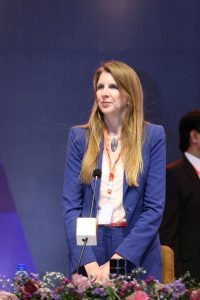
H. E. Mr. José Antonio de Ory, Ambassador of Spain to Pakistan, reiterated Spain’s commitment to support a just solution to the Russo-Ukraine and Israel-Gaza conflicts, and its repeated calls for ceasefire, the release of hostages, an end to violations of international laws and international humanitarian laws, and the establishment of two states.
He also expressed his Spanish pride for being able to live in an open, egalitarian and inclusive society – a country where healthcare and education is mandatory and free for all, whether they are Spanish citizens or immigrants.
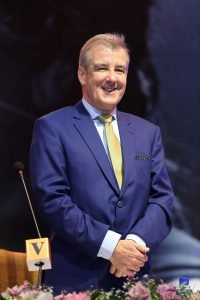
At the inaugural session, the legal fraternity was represented by the Federal Minister for Law and Justice Azam Nazeer Tarar, Vice-Chair of Pakistan Bar Council (PBC) Riazat Ali Sahar, and President of the Supreme Court Bar Association of Pakistan (SCBAP) Shahzad Shaukat.
Tarar stated that the government is committed to fulfilling its constitutional and international obligations by creating an atmosphere where the rights of the people in Pakistan are protected.
Sahar held that the unwavering commitment of the Supreme Court of Pakistan ensured that the General Election 2024 was held as per schedule on 8th February.
“The judiciary is displaying an uncalled-for desire to be popular,” held Shaukat.
Hon. Justice Mansoor Ali Shah, in his address as the keynote speaker, acknowledged that there “have been dark patches in the judiciary and I am not proud of that.” He said that the judiciary must be transformed into a robust institution, adding that the judiciary is working with 4,000 judges in the country deciding cases every day. “But most of the judgments are not credible. The system is dysfunctional. It is sluggish and needs to be made expeditious.”
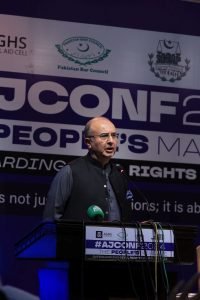
He gave three ways of strengthening the judiciary, saying that the courts must adopt new-age information technology to create a smart dashboard of cases, change the judges’ appointment process where nepotism is not entertained and the method through which new judges are appointed is rigorous – and “whereby the judges who are not performing well are asked to leave”. Hon. Justice Mansoor said that “the best thing to happen is the Practice and Procedure Act, whereby a bench decides who will hear the case. It is a commendable improvement. We have to work towards leaving no room for individual adventurism.”
Justice Shah stressed the importance of including women in the judiciary. “A critical perspective regarding women is missing in the judiciary. There are only 562 female judges in Pakistan and that’s a number too small.” He also emphasized the importance of training judges and building a firewall where the institution is well guarded.
Reviving Parliamentary Democracy: Learning from the Past and Shaping the Future
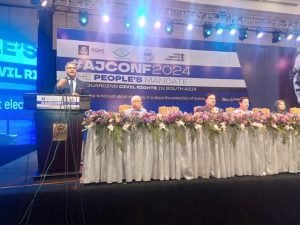
This discussion was moderated by journalist Zahid Hussain, and featured Syed Ali Zafar, a Pakistan Tehreek-e-Insaf (PTI) Senator and former Minister for Law and Justice; Dr. Nafisa Shah, a senior parliamentarian of the Pakistan Peoples Party (PPP) and a Member of the National Assembly (MNA); Khurram Dastgir, a senior leader of the Pakistan Muslim League–Nawaz (PML–N) and former Minister of Foreign Affairs; and Sanaullah Baloch, a former Senator from the Balochistan National Party–Mengal (BNP–M).
Zafar said, “Our parliamentary system lacks true democracy, but the essence of a parliamentary democracy lies in the will of the people. Imran Khan’s leadership has ignited recognition among the people that they hold the power to effect change in our nation”.
Dr. Shah said the Constitution of 1973 is this country’s moral compass. “Parliamentary democracy gained validity after the 18th amendment,” she posited, adding that the PTI’s 2014 “Tsunami March” marked the beginning of hybrid rule in Pakistan.
Dastgir expressed his view that politicians should display tolerance for other parties in the parliament.
Baloch said that parliamentary democracy is a culture which has no existence in Pakistan, political parties have become rental parties.
Eroding the Rule of Law: Conflicting Judicial Decisions
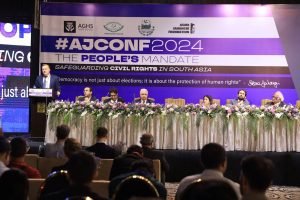
The panel featured former Justice of the Supreme Court of Sri Lanka and Chairman of the Human Rights Commission of Sri Lanka (HRCSL), Lakshman Tikiri Bandara Dehideniya; Professor of Constitutional Law at the University of Denmark and former Justice of the High Court of Denmark, Frederik Waage; the World Jurist Association’s (WJA) Foreign Affairs International Advisor, Diego Solana Giménez; former Advocate-General General for Pakistan, Irfan Qadir; AGHS Legal Aid Cell board member, Sulema Jahangir; and former President of the Sindh High Court Bar Association (SHCBA), Barrister Salahuddin Ahmed. Human Rights Watch’s (HRW) Senior Counsel for Asia, Saroop Ijaz, moderated the session.
Giménez stated that judges are often the most vulnerable in any system and face immense pressure. Therefore, safeguarding their independence is paramount for justice.
Waage said that cooperation between the courts and the parliament, from the point of view of Danish civil law, is a part of the balance of power. He added that it is necessary “to be aware where you take the political decisions (and you take the political decisions in the parliament), and where you take the legal decisions.”
Justice (Retd.) Dehideniya mentioned that judges must accept criticism if it is constructive – referring to procedures in his own country – adding that the court cannot question any criticism of judgements under the privileges of the Parliament. However, this privileged criticism may reduce the public’s trust in the judicial system.
Qadir held that the sheer number of conflicting judicial decisions have caused much chaos, and insisted on the need for a constitutional package which ensures the preservation of a strict dichotomy of powers.
Salahudin posited that judges must show discipline in following precedents, and courage to confront all legal issues involved in previous incorrect judgments.
South Asia’s Election Year
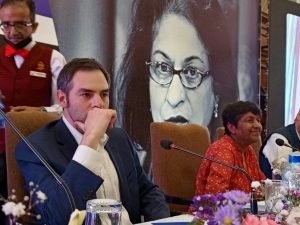
The session, moderated by Samina Ahmed of the International Crisis Group (ICG), was attended by American analyst, Michael Kugelman; founder and President of the Pakistan Institute of Legislative Development and Transparency (PILDAT), Ahmed Bilal Mahmood; Indian rights activist, Roshmi Goswami (virtually); Executive Director of Transparency International Bangladesh (TIB), Iftekhar Zaman (virtually); and Sri Lanka’s Executive Director of the Centre for Policy Alternatives, Dr. Paikiasothy Saravanamuttu (virtually).
Mahmood said that Pakistan is second out of nine South Asian countries in terms of lowest voter turnout because people do not trust the election process. He also stated that from 1985 onwards, the super executive pre-determines which party may not come into power and which parties may be allowed to come into power.
Dr. Saravanamuttu stated that in addition to being bankrupt, his country is facing a crisis of governance where no institution is functioning as intended. He expressed his view that the economy will dominate campaigns for the presidential elections later this year, and while he gives the incumbent government credit for stabilizing the economy to some extent, it has remained problematic on the front of human rights and civil liberties.
Zaman said that for Bangladesh, the people’s mandate has become a target of zero-sum game in politics. He added that it is more appropriate to refer to “elections” in Bangladesh as “selections” as the ruling party uses its tenure to manipulate the governing space. He also explained that the ruling party consists of the business lobby and bureaucracy and not the people.
Goswami said she regrets that due to the relationship between India and Pakistan, she was not granted a visa to attend the event in person. “But we are talking about elections at a moment when the concept of human rights and democracy cannot be ignored because of developments in Gaza,” she said.
Kugelman stated that he measured the success of an election per a continuum of zero to 10. “Afghanistan is at zero because the Taliban do not do elections,” he said. Pakistan and Bangladesh were at the lower end of this continuum due to serious concerns regarding irregularities and rigging during elections, while further up were Nepal, Maldives and Bhutan where there were scant such reports.
Loss, Damage and Climate Reparations
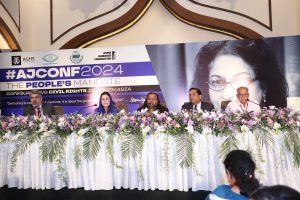
The session, moderated by environmental lawyer Rafay Alam, was attended by PPP MNA, Naz Baloch; former International Union for Conservation of Nature (IUCN) Global Vice-President and former Advisor to the Prime Minister for Climate Change, Malik Amin Aslam; Gilgit-based climate change and civil rights activist, Baba Jan; and labor leader and climate damages advocate Farooq Tariq.
“Though Pakistan emits less than 1% of carbon, it is being drastically affected by climate change,” Baloch asserted.
Jan said that the people have built along the lakesides and riversides in Gilgit. “We need to check ad-hoc development in disaster-prone areas,” he urged.
Silencing the Media
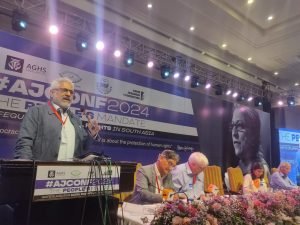
The session was moderated by senior journalist Matiuallah Jan, with award-winning senior journalist, Hamid Mir; author and former host of the BBC’s Newshour, Owen Bennett-Jones from the UK; senior journalist for the Pakistani national newspaper Dawn, Arifa Noor; founding-editor of the Indian digital news outlet The Wire, Siddharth Varadarajan; and veteran journalist and former General-Secretary of the Pakistan Federal Union of Journalists (PFUJ), Nasir Zaidi, on the panel.
Mir said “The constitution has been rendered ineffective. Pakistani journalists should leave journalism and do colonialism.” Stressing his point, he mentioned the murder of Pakistani journalist Arshad Sharif in Kenya, saying “Arshad Sharif is a news of the past”.
Bennett-Jones pointed out that Pakistani leaders often cite press laws in the West as restrictive, with strict libel laws and regulations regarding privacy and hate speech. However, “instead of emulating these laws, they should strive to create their own fair system.”
He added “While the West boasts a rule of law, we must remember that blindly copying their restrictive measures is not the solution. Rather, we should aim to establish a collaborative legal framework that fosters a strong global community.” He suggested building a global community for journalists where their rights can be protected collaboratively.
Noor said the economic model of television has ruined the profession of journalism. “We do not tell the story of the people but of politicians. Yet, we cannot name the Pashtun Tahaffuz Movement (PTM) or Baloch nationalists, in my view that is real censorship. The rest is the fight of the elite. And I do not see any resistance from the media,” she opined.
Noor added that technology is changing the dynamics of our profession, stating that, “Voices of social media will have to be heard and laws should not be used to criminalize the media.”
Varadaranjan said the most perilous silence is the one we impose upon ourselves. In India, a significant portion of the media has chosen self-censorship or collusion. “According to a 2023 survey, 82% of journalists believe their bosses are pro-government. This is election time but no TV channel in India is informing viewers about issues,” he explained.
He further said, “Digital media is independent but the state is clamping down, citing law and order, national security, and fake news. This has led to the censorship of social media platforms.”
Zaidi asserted that in Pakistan today the media is increasingly controlled and that the deep state has a hand in this control instead of just the government.
Criminal Justice Reform and Prolonged Incarceration
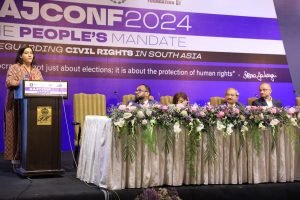
Moderated by Associate Director of the Legal Aid Society (LAS) Maliha Zia, the session featured Justice Ali Baqar Najafi of the Lahore High Court (LHC); former LHC Justice Nasira Iqbal; Assistant Inspector General (AIG) of Prisons, Punjab, Dr. Qadeer Alam; and Office of the United Nations High Commissioner for Human Rights (OHCHR)’s Human Rights and Drug Policy Advisor Zaved Mehmood.
Justice Najafi recommended using modern technology to expedite trials to reduce under-trial prisoner (UTP) populations. He further stressed the sensitization of judges and expressed his view that the right of bail should be duly acknowledged.
Justice (Retd.) Iqbal highlighted how there is little chance of justice when the convict and the UTP are kept in the same place.
Dr. Alam stated that Punjab has 25,000 death row prisoners. Their period of confinement is more than 5 years, and death row itself is a violation of human rights, therefore the judiciary should play a proactive role in reducing their number. “Prison should be a last resort. There are other models including community sentencing.”
Mehmood highlighted how in Pakistan, 19.6% of the prison population is not convicted but incarcerated under pre-trial detention for drug-related offenses.
Gaza – Breach of International Law
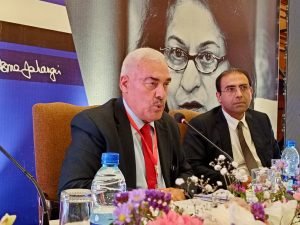
The session was moderated by Saroop Ijaz, and included high-profile speakers such as keynote Francesca Albanese (virtually), the United Nations Special Rapporteur on the Occupied Palestinian Territories; Shawan Jabarin, Director of the Palestinian human rights organization Al Haq, and who has been recognized by Amnesty International as a prisoner of conscience; and Reverend Munther Isaac (virtually), the pastor of the Evangelical Lutheran Church in Bethlehem, Palestine.
Albanese said that she does not have words to express the ongoing tragedy in Gaza. Further she noted that “What Israel is doing is genocide. If this genocide is not punished not only will this be yet again the most serious denial of justice to the Palestinians but also the world will have condoned what can be seen as a “proportionate” genocide”
Reverend Isaac, joining online, noted how this is not a religious conflict, stating that “We as Palestinian Christians are not caught in-between this battle of Muslims and Jews as many in the West try to describe us; we are part of the Palestinian people”.
Jabarin said of the crises in Gaza, “This is worse than apartheid because it is not just an attempt to subjugate Palestinians but to erase them.”
Kashmir: Scrapping Article 370
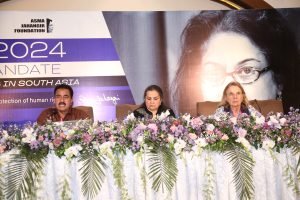
The session was moderated by prominent journalist and anchor Nasim Zehra, with British journalist, Victoria Schofield; and senior staff correspondent for Dawn in Kashmir, Tariq Naqash, as speakers.
Schofield said Kashmir must be viewed as one region rather than a fragmented one. “Disappearances in Kashmir have no accountability. Families do not know what happened to their members. Many women have been left as widows.”
Naqash added that the people of Kashmir are still struggling and their concerns are not being addressed.
Reclaiming the Space: Reading the Constitution from Women’s Perspective
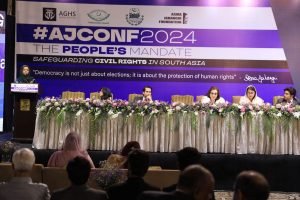
Former Parliamentary Secretary for Law and Justice, Mehnaz Akbar Aziz; Secretary of the Law and Justice Commission of Pakistan, Riffat Inaam Butt; Senior Associate at AGHS Legal Aid Cell , Ans Mashood; Director of the PBC’s Directorate of Legal Education, Usama Malik; and Dr. Nafisa Shah participated in this session moderated by Sadaf Aziz, the Dean of the Shaikh Ahmad Hassan School of Law (SAHSOL), Lahore University of Management Sciences (LUMS).
Malik stated that the Objectives Resolution, which is the preamble of the Constitution of Pakistan, does not mention women. He further pointed out that the masculine pronouns used throughout the Constitution created constitutional challenges for Benazir Bhutto in the superior courts when she was twice elected as Prime Minister of the Islamic Republic of Pakistan.
Butt said there is a stark difference in rights guaranteed to women and girls in the Constitution and their guaranteed in reality. She also opined that there is no space to reclaim as it was not given in the first place, and that women through their own efforts are carving space for themselves.
Mashood explained that gender is the only protected ground under Article 25 of the Constitution that protects gender, whereas Articles 26 and 27 cover four other grounds. However, under Pakistan’s present Constitutional legal framework, sex is the only one protected standard. As such, women of ethnic or religious minority status, who may be facing double the persecution because of their latter identity, do not receive intersectional benefits or protections provided by the Constitution.
Aziz asserted that the language of the Constitution of Pakistan is patriarchal, and there is a dire need to correct it. However, the present state of the Parliament is a roadblock to the implementation of these changes. She also opined that women’s representation can only be a priority area for the government if it is mandated by GSP+ or the International Monetary Fund (IMF).
Shah held that women are not only invisible in the language of the law but also in public spaces, adding that considering the gender demography of the country, women should represent at least 50% of Parliament.
The Expulsion of Afghans
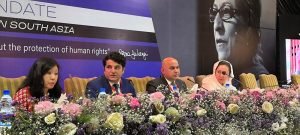
The session was moderated by journalist and Afghanistan-Pakistan policy expert Ahmed Rashid. Director of the Afghan Women Skills Development Center and Nobel Peace Prize nominee, Mahbouba Seraj (virtually); Spokesperson and Association Communications Officer for the United Nations High Commissioner for Refugees (UNHCR), Qaiser Khan Afridi; refugee rights activist, Fatima Atif; OHCHR officer, Christine Chung; Chief Executive Officer of the Society for Human Rights and Prisoners Aid (SHARP), Mudassar Javed; and Associate Director of HRW’s Asia Division, Patricia Gossman (virtually) attended as panelists.
Seraj said, “I am disgusted at how Afghans have been expelled by a neighbor such as Pakistan, which has played a role in bringing Afghanistan to its current state.” She called for international collaboration to determine the future of Afghanistan, and criticized the interference of Pakistan as well as Iran, Russia, and China in Afghan affairs – “It is compromising Afghanistan’s security.”
Afridi asserted the UNHCR opposes the Pakistani government’s plan to deport Afghan asylum-seekers, and urged the state to see these people through a humanitarian rather than a political lens. “They are victims of war, they are not perpetrators,” he appealed, reiterating the UNHCR’s commitment to continue to provide technical and financial support to the government to register refugee communities in Pakistan.
Gossman stressed that one should be careful to term the repatriation of Afghan nationals as them “returning” to their country as in most cases, asylum-seekers who have settled and built their lives in Pakistan are being forced or coerced to leave. She described the dire situation faced by refugees returning to Afghanistan and stressed the need for international attention and assistance.
Atif pointed out that the biggest hindrance to a humanitarian response to the Afghan refugee crisis is the lack of relevant laws, adding that had Pakistan signed the 1951 Refugee Convention, the government would have been obligated to inculcate refugee laws. She also pointed out that since August 2021, Afghans pouring into Pakistan via the border have remained deprived of their basic fundamental rights, and lambasted the government of Pakistan for restricting UNHCR from registering any more refugees.
Javed lamented the lack of infrastructure in Afghanistan, particularly affecting women and children, and questioned the absence of support from the international community given their promises to Afghan refugees.
Chung announced that Pakistan’s human rights situation would be reviewed in Geneva in August, raising concerns about its obligations under international law. She further warned that Pakistan would face tough questions regarding its failure to implement these obligations in policymaking.
Challenges to Women, Minorities and Transgenders’ Participation in Elections

Raheela Durrani, Provincial Minister of Education for Balochistan; Samar Bilour, a former Member of the Provincial Assembly (MPA) of Khyber Pakhtunkhwa; Dr. Saveera Parkash, the first Hindu woman to contest the 2024 General Elections from Buner; Sobia Khan, a Peshawar-based radio jockey and a transgender activist to contest the 2024 General Elections; and Mehnaz Akber Aziz spoke in this session moderated by Farzana Ali, Aaj News’s Peshawar Bureau Chief.
Aziz expressed that the people’s voices must be reflected in the corridors of policy-making and the corridors of power and that women’s voices and minorities’ voices must all be heard.
Durrani related her experience of being appointed as Deputy Speaker of the Balochistan Assembly, but facing a delay in the notification of her position for 10 months.
Bilour recounted the difficulties she faced as a female politician in her province.
Dr. Parkash disclosed that she had faced accusations of exploiting her identity as a woman and a minority during her election campaign.
Khan lamented the ridicule their community faces upon entering politics.
The Cost of Violence
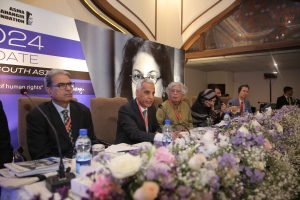
The session was moderated by senior journalist Ghazi Salahuddin, with Olivier de Frouville, Chair of the UN Committee on Enforced Disappearances, attending as keynote. The speakers included Jahangir Khan Jadoon, former Advocate-General of Islamabad; Dr. Mahrang Baloch, a leader of the Baloch Yakjehti Committee (BYC); Shabbir Hussain Gigyani, a senior advocate of the Supreme Court; Tahir Hussain, Vice-Chair of the Human Rights Commission of Pakistan’s (HRCP) Balochistan Chapter; and Zegar Sher, a Swat-based human rights advocate.
In his keynote address, de Frouville urged Pakistan to ratify the International Convention for the Protection of All Persons from Enforced Disappearance.
Dr. Mahrang Baloch, a Baloch rights activist and a leader of the Baloch Yakjehti Committee (BYC) stressed the importance of parliamentary and judicial intervention in resolving the issue of missing persons for real democracy to thrive. Dr. Baloch also apprised attendees of the threats faced by families of missing persons, and condemned the murder of Balach Moula Bux, labeling it a blemish on Pakistan’s judiciary and military.
Jadoon highlighted the helplessness of the courts in cases of enforced disappearances, attributing it to the involvement of intelligence agencies.
Electoral Reforms
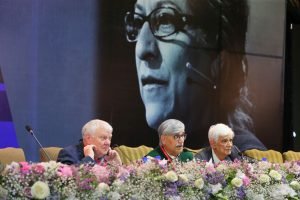
The session included Former Senator Taj Haider; former Member of the EU Parliament John Cushnahan; and MNA Bilal Azhar Kayani, with Ahmed Bilal Mehmood as moderator.
Cushnahan recounted his experience in Pakistan between 2002-2004, leading the election observation team. “Upon arrival, I encountered a hostile reaction, including from the ECP,” he recalled, adding that the team’s early arrival was perceived as an attempt to catch pre-election rigging, contrary to expectations of a smooth election day.
Senator Haider expressed his view that the establishment of Pakistan is in collaboration with extremist elements, which is why ordinary citizens have no faith in the electoral process. He also asserted that true resistance serves as the real firewall for ensuring free and fair elections.
Kayani said that the Elections Act of 2017 was a major step forward for reforming the electoral process, as it not only was formed through consensus but also empowered the Election Commission of Pakistan (ECP). He also expressed his reservations over Electronic Voting Machines (EVM), stating that nine countries that utilized them for their elections wound up discarding them.
Fundamental Rights: Parallel Judicial Systems
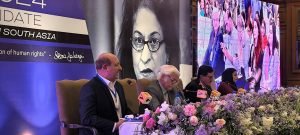
The session, moderated by former PBC Vice-Chair Abid Saqi, featured Zahoor Ahmed Shahwani, a former judge of the Federal Shariat Court; Farhatullah Babar, a former senator as well as former Spokesperson to the President of Pakistan; Shah Khawar, former LHC Justice and former Additional Attorney-General for Pakistan; and Barrister Khadija Siddiqi, a human rights advocate.
Shahwani stressed that the trial of civilians in parallel courts has opened the doors for rights violations and significantly weakened political parties.
Saqi said that there should be no special courts for separate matters such as accountability or other offenses as it creates parallel systems which can be unfair and without due process.
Siddiqi said that 105 civilians have been tried in military courts after the May 9 incident. She added that the conviction rate in these secret trials being conducted by army officials, and not trained judges. is unsurprisingly almost 100%.
Babar said that there should be a judicial inquiry into the May 9 incident because there are accusations of it being engineered.
Federalism: Empowering the Provinces
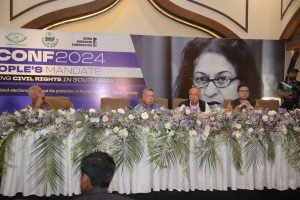
Journalist and anchorperson Wusatullah Khan moderated this session with Dr. Abdul Malik Baloch, former Chief Minister of Balochistan; Afrasiab Khattak, a senior leader of the National Democratic Movement (NDM) and former senator; and Ahmad Iqbal, former Mayor of Narowal, participating as speakers.
Iqbal said, “The lack of local government elections has fueled resentment among the people.”
Dr. Baloch stressed the importance of devolving real power to the provinces. “Many departments assigned to the provinces are now controlled by irrelevant authorities, leaving only the establishment functioning effectively.”
Khattak said, “Fulfilling the principles of federalism entails ensuring equitable power distribution among all nations and communities. Unfortunately, the local government structure has consistently suffered during periods of martial law.”
Space for Dialogue with Nationalist Parties
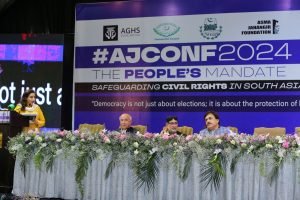
The session, moderated by AGHS Legal Aid Cell board member Munizae Jahangir, featured BNP-M Chairman Sardar Muhammad Akhtar Mengal; Deputy Chairman of the Senate, Syedaal Khan Nazar; Chairman of the Pashtoonkhwa National Awami Party (PKNAP), Khushal Khan Kakar (virtually); and Dr. Abdul Malik Baloch.
Dr. Malik Baloch said the authorities tend to overlook the deeper issues facing Balochistan, merely scratching the surface of our challenges. He asserted that Balochistan has never seen free and fair elections. “But this time, the elections broke all records in tampering.”
Akhtar Mengal, BNP-M chairman, said that while mainstream parties acknowledge the urgency of resolving the issue of missing persons, they have thus far failed to do so effectively. “The solution lies solely in political means, not through the use of force.”
Legislative Constraints and Judicial Violence against Women
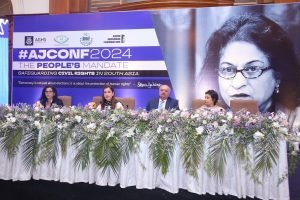
The session was moderated by Nida Aly, the Executive Director of AGHS Legal Aid Cell, with United Nations Special Rapporteur on Violence against Women and Girls, Reem Alsalem (virtually); Chairperson of the National Commission on the Rights of the Child (NCRC) Ayesha Raza Farooq; Federal Ombudsperson for Protection Against Harassment of Women, Fauzia Viqar; and former Chairperson of the National Commission on the Status of Women (NCSW), Anis Haroon, on the panel.
Aly, reflecting on the topic of legislative constraints noted how gender inequality is the basis of all violence that happens against women.
In her keynote address, Alsalem spoke about the impact of parental alienation and how it gives rise to gender biases, disproportionately affecting mothers.
Viqar explained that less than 13% of women in Pakistan have bank accounts and less than 2% of women are in the police department.
Farooq briefed the audience on the Commission’s efforts to make child labor a non-compoundable and non-bailable offense.
Radicalising Mainstream Politics
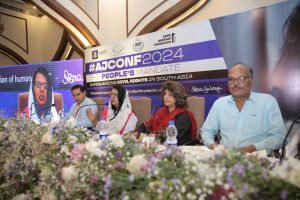
The session was moderated by author and security analyst Amir Rana, with Director of the Dr. M.A.Kazi Institute of Chemistry at the University of Sindh, Prof. Dr. Arfana Mallah; Chairman of the National Minorities Alliance of Pakistan, Lala Robin; and Ghazala Shafique, a pastor of the Holy Trinity Cathedral in Karachi.
Robin said, “In my 60 years, I have never seen any equality as citizens when it comes to religious minorities.”
Pastor Shafique said that radicalization is not an overnight process, and that Pakistan started off as a secular state but the Objectives Resolution transformed it into the Islamic Republic.
Dr. Mallah stated that mainstream political parties have adjusted the narratives of radical political parties, explaining how the Jamaat-e-Islami started off as a small anti-Partition, anti-nationalist political collective to pressure mainstream parties into inculcating radical policies.
Growing Debt Burden: The Impact of State and IMF Policies
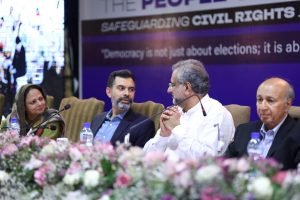
Moderated by Farhan Bokhari, Pakistan correspondent for the Financial Times, the session featured former Prime Minister of the Islamic Republic of Pakistan, Shahid Khaqan Abbasi; former Governors of the State Bank of Pakistan, Reza Baqir and Shahid Hafiz Kardar; and former Minister of State for Finance and Revenue, Dr. Aisha Ghaus Pasha, as panelists.
Abbasi expressed regret that the current federal government’s income fails to cover the interest on previous loans. He stressed on the need for additional borrowing from the IMF to fund defense expenditure, and acknowledged that the IMF alone cannot resolve Pakistan’s economic challenges.
Dr. Pasha stated that while Pakistan borrowed approximately $65 billion in the first 65 years of its existence, the country has doubled its external debt in just the last 12 years.
Kardar said bureaucrats and politicians do not want to curtail the country’s expenditures.
Baqir said economic rehabilitation is not possible without political stability. “We need a non-partisan plan and complete ownership to deal with the problem of debt burden.”
Online Hate Speech and Disinformation
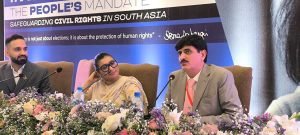
The session, moderated by Director of Bolo Bhi, Usama Khilji, featured Deputy Director of the Cyber Crime Wing at the Federal Investigation Agency (FIA) Mehmood Ul Hassan; Executive Director of the Digital Rights Foundation (DRF) Nighat Dad; and Head of Meta’s Human Rights Policy for Asia-Pacific Frederick Rawski (virtually) on the panel.
Hassan disclosed that the agency receives over 100,000 complaints annually but lacks monitoring powers. “FIA initiates action solely upon receiving complaints.”
Referring to the ban on X (formerly Twitter), Dad questioned the rationale behind adopting Cyber Crime laws without a data protection law. She demanded a re-evaluation of such actions.
Rawski explained that the company is trying to find balance in dealing with content related to Israel and Palestine when he was questioned about shadow-banning of pro-Palestine content on the platform.
Vigilante Justice
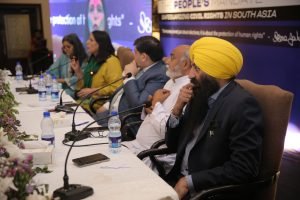
The session was moderated by HRCP Director Farah Zia, and featured Syed Farhad Ali Shah, Prosecutor General for Punjab; Sardar Ramesh Singh Arora, Provincial Minister of Punjab for Minorities Affairs; Farhat Haq, an author on blasphemy politics; Father Khalid Mukhtar, the pastor of the St. Thomas Catholic Church in Jaranwala; and Tomás Fernandez Villazala (virtually), head of the Hate Crimes National Office in Spain.
Shah stated that per his research, mob violence in Pakistan is not exclusive to religious issues as economic vulnerability and lack of faith in the justice system can prompt people to resort to vigilantism.
Father Mukhtar recounted his firsthand experience of the violent incident at St. John’s Church, and urged for expediting the trials of such cases which have remained stalled for decades.
Haq criticized the politicization of blasphemy by the Tehreek-e-Labbaik Pakistan (TLP).
Arora asserted no one has the right to take the law into their own hands, and that entire communities should not have to pay for the act of an individual.
Villazala, who joined via a conference call, said that although there are no official figures as of yet, but according to reports by Spain’s National Police and Civil Guard, there was an uptick in hate crimes against Jews and Muslims after the start of the Israel-Gaza conflict on October 7. He further said that the highest figures of hate speech and hate crimes were anti-Muslim.
Closing | The Role of Political Leaders in Safeguarding Civil Rights
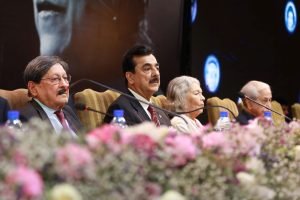
Diego Solana Giménez took to the podium to introduce the World Jurist Association, and extended an invitation to the World Law Congress 2025, set to be held from 10th to 12th March 2025, in Santo Domingo, Dominican Republic.
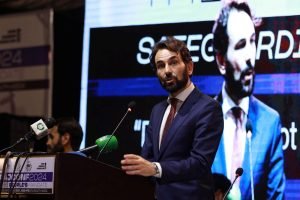
Journalist and AGHS board member Munizae Jahangir hosted the closing ceremony, where she expressed disappointment that the participants of the Baloch missing persons sit-in, who traveled from Turbat to Islamabad, were not given a proper hearing even after elections. She also called for an end to military trials of civilians, the immediate lifting of all restrictions on the internet, and urged political parties to form a consensus on a charter of fundamental rights to ensure that rights of citizens are not violated.
Nasreen Azhar, a founding member of the Women’s Action Forum (WAF), noted the challenges faced by political parties as agents of change, and lamented Pakistan’s history of military rule.
Yasin Azad, former President of the SCBAP, said: “In my opinion, the strongest institution should be the parliament.”
He added that we must implore our political leaders to fulfill their roles responsibly and refrain from overstepping boundaries set for various institutions.
Farooq Hamid Naek, Chair of the Executive Committee of the PBC, said, “It is crucial to recognize that the law serves as a shield – not a sword – protecting the rights of civilians.”
Syed Ali Zafar said when politicians are at odds, it creates an opening for the establishment to intervene.
The closing’s Chief Guest of Honour, Senate Chairman and former Prime Minister of the Islamic Republic of Pakistan, Yusuf Raza Gilani delivered the concluding speech, paying tribute to Asma Jahangir.
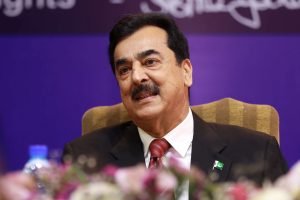
He recalled that when the PPP struck down Article 58-2(b) of the Constitution of Pakistan (which empowered the President of Pakistan to depose an elected government), Jahangir remarked that instead of the establishment, it will be the judiciary that will dismiss Prime Ministers. Gilani observed that that was exactly how Nawaz Sharif as well as himself were removed from power.