

September 4, 2025
By Kaleem Ullah
LAHORE
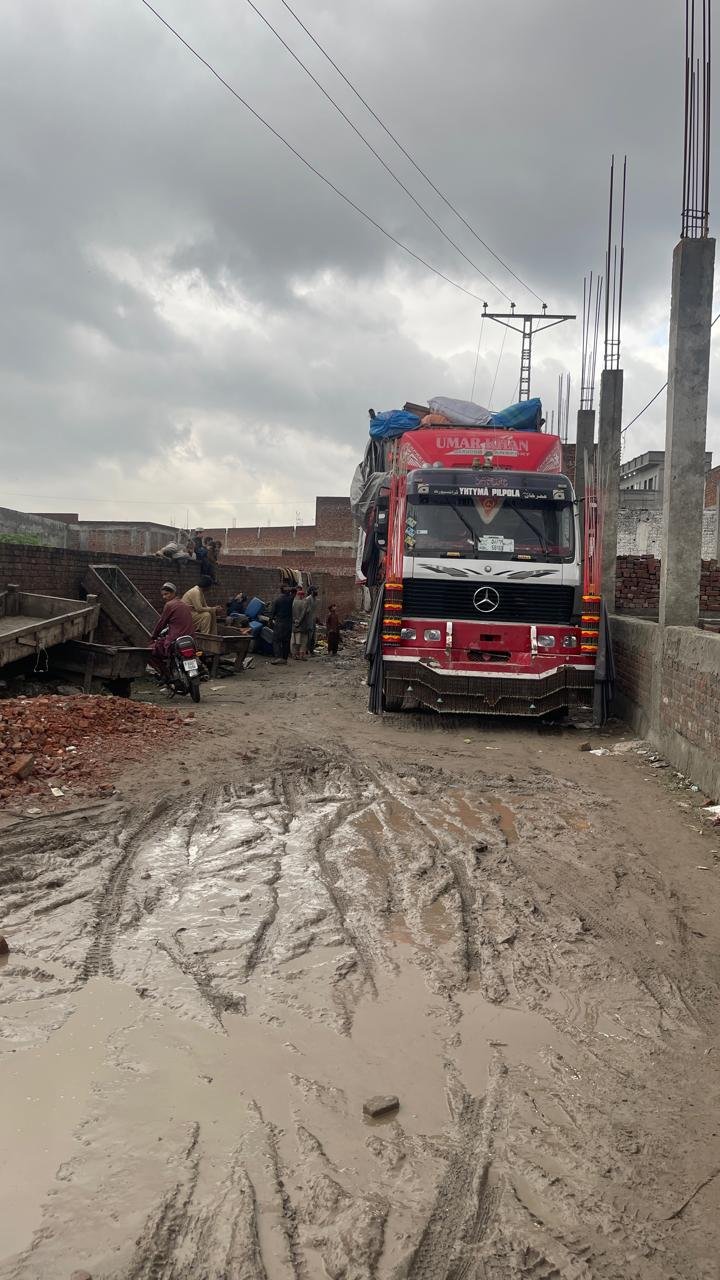
Dozens of Afghan refugee families, that had settled near the Saggian Bridge, near Ravi Road in Lahore, spending years building their businesses, now must bid their lives farewell, as the next phase of the government’s Afghan repatriation program.
Among them is Imranullah, a fluent Punjabi speaker.
Imranullah was born here. and has little knowledge of Afghanistan. After putting in years of hard work, he managed to open a small store in the Afghan settlement here. He has had to sell it for a pittance to collect money for his journey back. He points to the last item left in his shop — a freezer for cold drinks.
“I bought this fridge for over a hundred thousand rupees; now I am selling it for scrap at throwaway prices.”
Imranullah’s story is not the only one. This is the story of more than at least a thousand families who are living in this settlement.
Another person from the Afghan community, Abdul Khaliq, talks about the Taliban government in Afghanistan.
“Maybe there is peace now in Afghanistan, but peace alone cannot feed our children,” he said.
He points an angry finger at the Pakistani government decision to completely expel them, and asks, “If no one in the entire world including Pakistan, has refused to recognize Afghanistan as a legitimate state, and call it a land of terrorists – then why are you sending us there, where there is livelihood to survive on?”
Across the Afghan Basti here, everyone seems distressed, depressed and uncertain about their future in Afghanistan. Most of them say they have never even seen the country and do not know what they will do once they get there.
Thirty year old Muhammad Yousaf, recently returned from Afghanistan on a Pakistani visa that cost him $540. But living in Afghanistan has changed him. The person sitting next to him jokes about it but there is an underlying feeling of an uncomfortable reality.
“He used to be clean-shaven when he lived here in Pakistan, but now we see him with a beard,” says his friend. “Its because the Taliban authorities have strictly barred barbers from shaving beards in Afghanistan, deeming it an un-Islamic practice.”
Meanwhile Mohammad Yousaf talks about his life in Afghanistan ever since he was ‘repatriated’ by the Pakistani government.
“I was looking for a piece of land to buy in Kabul, but it was highly disputed – many owners would show up to claim the same property, leaving me empty-handed. Renting a house was also extremely difficult. Apart from these hurdles, the people in Afghanistan have not been ready to accept us wholeheartedly, because they consider us Pakistani citizens.”
For more than four decades, Pakistan has hosted millions of Afghans fleeing war, persecution, and instability in their homeland. Many of them have been living as unregistered citizens, but for those who were registered, their last legal lifeline has been the Proof of Registration (PoR) card — which have now expired, leaving 1.3 million refugees at risk of forced deportation. The government had set September 1 as the deadline for the deportation of all Afghan refugees, including PoR cardholders. Since then, refugees say they have been living in constant fear, trying to keep a low profile to avoid the authorities.
Those refugees who have been deported also complain that despite two generations of their families being born in Pakistan, they were never deemed eligible for Pakistani nationality — while even in Western countries, citizenship is granted within five years. They do not want to lose everything they have worked for and start life from scratch.
“I will not go to Afghanistan under any circumstances,” says Saifullah another Afghan. “All my money and property are here.”
PoR card holders also point out that they are only allowed to take essential belongings with them to Afghanistan. According to them, this time, UNHCR is not even providing any meaningful financial assistance, unlike in the previous deportation drives.
Meanwhile, UNHCR says it has called on the Government of Pakistan to halt the process of forced returns and adopt a humanitarian approach to ensure the gradual, voluntary, and dignified repatriation of Afghans. In a recent statement, UNHCR acknowledged Pakistan’s generosity in hosting refugees for decades but stressed that since PoR cardholders have long been recognized as refugees, their forced return would be contrary to Pakistan’s long-standing humanitarian policy and would constitute a violation of the principle of non-refoulement.