

April 1, 2024
By Afrasiab Khattak
Terrorist attacks, mainly by the Tehrik-e-Taliban Pakistan (TTP) in Pakhtunkhwa and the Pashtun belt of Balochistan have significantly increased in recent years. Police force, as face of the state, along with other security forces, is bearing the brunt of these attacks.
However, these escalating attacks have not received comprehensive media coverage due to official constraints.
The year 2023 stands out as the bloodiest year in recent times, with this trend continuing into 2024. The month of March, particularly during the 10-day period from March 16 to 26, has witnessed five high-profile attacks, killing at least 18 people.
The attack on a military base in North Waziristan on March 16 drew immediate attention from the country’s leadership, as it resulted in casualties among high-ranking military officers. The attack prompted Pakistan to conduct airstrikes inside Afghanistan on March 18.
In another terror incident, a suicide bomber crashed his explosive laden car into a vehicle carrying Chinese workers in Shangla, in north-east of Pakhtunkhwa on March 23. The attack claimed the lives of five Chinese nationals and their Pakistani driver. The incident gained international attention due to its impact and implications.
Here, however, it is relevant to inquire about the origins of this new cycle of violence.
The cycle of terrorism that started after 9/11 culminated in a huge military operation in Waziristan in 2014. The situation remained calm for a limited period of time but the security state declared it to be the final victory. The TTP’s hibernation was temporary.
From 2017 onwards, the TTP gained momentum, attracting other militant factions and individuals under its new leader, Noor Wali Masood. The revival of TTP was part of the Afghan Taliban’s empowerment through the Doha process. But, there was nothing surprising about it, as the TTP was born in 2007 from the womb of the main body of Taliban to work as a camouflage for the Afghan Taliban in their sanctuaries in Pakistan. The TTP leadership pledged allegiance to the amir of Afghan Taliban, and maintained its subordination to his decrees. Further, it was midwifed by Pakistani intelligence agencies.
The Pakistani security state remained in complete denial regarding the presence of the Afghan Taliban and their association with the TTP. Despite this denial, their support for the Taliban project continued to thrive.
The Pakhtunkhwa province has once again become a hotspot for terrorism in the last few years. The resurgence of terrorism did not come unexpectedly. The Doha deal acted as a Trojan horse, as it paved ground for the state collapse in Afghanistan.
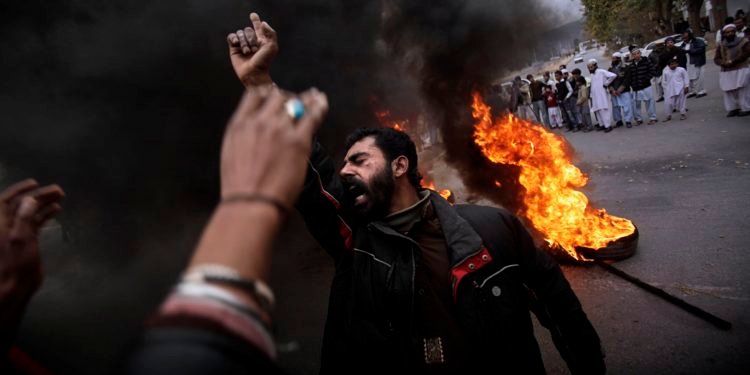
A section of progressive Pakhtun political activists, intellectuals and journalists voiced concern, as they could see Taliban living in safe havens in Pakistan, flexing their muscle for yet another round of Talibanisation. The common people in Pakhtunkhwa also took to the streets to express their apprehension, particularly in response to reports of secret negotiations between high-ranking officials of the security state and the TTP. At least 40 demonstrations were held across different parts of Pakhtunkhwa in 2023.
The negotiations aimed at addressing the return and rehabilitation of thousands of TTP fighters, who had been released by the Taliban from Afghan jails. The agenda included discussions on the release of militants convicted by anti-terror courts in Pakistan.
While the military publicly denied any deal with the TTP, the presence of the organisation’s fighters, between 2022 and 2023, noticeably increased in southern districts and newly merged districts of Pakhtunkhwa, particularly those situated close to the Durand Line. The TTP’s extensive extortion of money from businessmen in Peshawar and other cities has been widely known.
Equipped with sophisticated weapons abandoned by departing US troops in Afghanistan, the TTP has transformed into a fully-fledged insurgent army. Unlike in the past, where their attacks targetted bazaars, schools, and political activists, the majority of their assaults now concentrate on security forces, where they seize police stations and security centres.
Another crucial aspect of the TTP’s new strategy is the establishment of parallel or shadow government administrations in every division and district of the provinces. They have appointed their commanders as administrators, security heads, and even intelligence officers for various provinces and divisions. In Pakhtunkhwa, their administrative network is particularly extensive. Often, they announce new appointments and transfers within this shadow administration.
The Islamic State (IS) or Daesh is another important player of the realm of terrorism. Originating from the Middle East, where it is known as the Islamic State Khurasan (IS-K), this international organisation has established regional branches. IS-K aims to dismantle all national states through the use of force, with the ultimate goal of establishing an international Islamic Caliphate in their place.
A cursory examination of the jihadist networks’ evolution over the past 44 years in AfPak (the term coined for Afghanistan and Pakistan in 2009 by US Special Representative Richard Halbrooke) reveals a consistent trend of increasing radicalism with the introduction of each new network into the arena.
The initial Afghan refugees, termed Muhajireen, were transformed into Mujahideen, or holy warriors, through jihadist training camps established in Pakistan with billions of dollars invested by the US and its allies in the 1980s. The subsequent wave brought forth the Taliban, who viewed the former Mujahideen as insufficiently devout Muslims to enforce Sharia law in the 1990s, leading to the establishment of the Taliban’s Emirate. Now, IS-K poses a challenge to the Taliban, accusing them of deviating from Islamic principles.
This higher radicalism in every new outfit guarantees the continuity of jihad in and around the AfPak region.
The strategic objective of the jihadist project is to sow widespread chaos, aiming to obstruct the Chinese Belt and Road Initiative (BRI), and destabilise Central Asia – opening a second front for Russia in the south. Afghans in Afghanistan and Pashtuns in Pakistan are among the primary victims of this latest stage of the so-called ‘great game’, characterised by the three Ds: death, destruction, and displacement.
The forced eviction of Afghan refugees is part of the policy of generating deep chaos in the region. Upon returning to Afghanistan, the refugees are faced with lack of jobs, housing, food, and other basic living requirements. The only jobs available to them are in the ranks of militant and terrorist organisations, where they are likely to be used as canon fodder.
Besides the influence of Western policies aimed at containing rival big powers, another significant factor contributing to the continuity of this militancy is the black economy. This encompasses the illicit trades of narcotics, arms, illegal mining, human trafficking, and extortion. The beneficiaries of the black economy continue to staunchly support this policy.
In Pakistan, the jihadist project persists as part of the status quo maintained by militarised authoritarianism. A popular and determined movement for democratic transformation can only challenge it, which is not yet visible on the political horizon of the country.