

March 12, 2024
Staff Report
LAHORE:
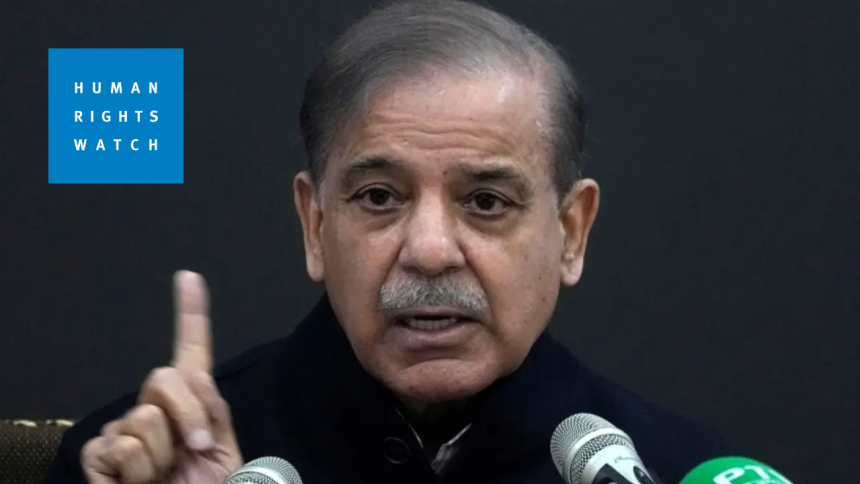
In a letter addressed to the newly-elected Prime Minister Shehbaz Sharif, the Human Rights Watch proposes a comprehensive human rights agenda on issues such as freedom of expression, protection of minority rights, women’s empowerment, judicial reform, and accountability for human rights violations.
The agenda aims to promote and safeguard fundamental rights and liberties for all citizens of the country. It primarily stresses on the rule of law and the strengthening of democratic institutions.
“The government should begin by reversing abusive laws and policies and demonstrating a genuine commitment to the rule of law and equal justice,” said Patricia Gossman, Associate Asia Director, Human Rights Watch (HRW).
The letter, dated March 11, 2024, states that as Pakistan faces “one of the worst economic crises in its history”, the government is obligated to ensure adequate social security to uphold the rights of Pakistanis to health, food, social security, and an adequate standard of living.
HRW states that the Pakistani government must take concrete steps to protect fundamental civil, political, economic, social, and cultural rights in nine key areas, that include “economic justice; electoral reforms; digital rights; freedom of expression and protecting civil society; freedom of religion and belief; prison reform; ending violence against women and girls; improving access to education; and protecting rights in counterterrorism operations.”
The HRW has consistently observed human rights violations in Pakistan. In its annual report for 2023, the HRW noted that the government of Prime Minister Shehbaz Sharif, between April 2022 and August 2023, implemented measures to clamp down on the media, nongovernmental organizations, and political opposition. “The authorities used draconian counterterrorism and sedition laws to intimidate peaceful critics,” the report stated.
It further said that blasphemy-related violence against religious minorities, fostered in part by government persecution and discriminatory laws, intensified in 2023. “Attacks by Islamist militants, notably the Tehrik-i-Taliban Pakistan (TTP) and Islamic State of Khorasan Province (ISKP), targeting law enforcement officials and religious minorities, killed dozens of people in 2023,” it read.
The HRW held that the insistence of the International Monetary Fund on austerity and the removal of subsidies without adequate compensatory measures resulted in additional hardship for low-income groups. “Pakistan remained exceedingly vulnerable to climate change and faced rates of warming considerably above the global average, making extreme climate events more frequent and intense.”
HRW, vigilantly monitoring legal, democratic, and constitutional developments, remarked on March 6, 2024, that the Supreme Court’s ruling Martial Law-Era Trial which lead to the death sentence and execution of former Prime Minister Zulfikar Ali Bhutto in 1979 was an important first step “toward reforming the system to provide justice for those to whom it has long been denied, reverse the abusive laws of the Zia era still in effect”. It acknowledged that the ruling holds those responsible for grave crimes to account.