

November 05, 2026
By Rehan Piracha
LAHORE: The UN Committee on Economic, Social and Cultural Rights in Geneva has concluded its review of Pakistan’s second universal periodic report under the International Covenant on Economic, Social and Cultural Rights. Experts welcomed a 2025 law raising the minimum marriage age to 18 but pressed Islamabad on bonded labour and flood reconstruction.
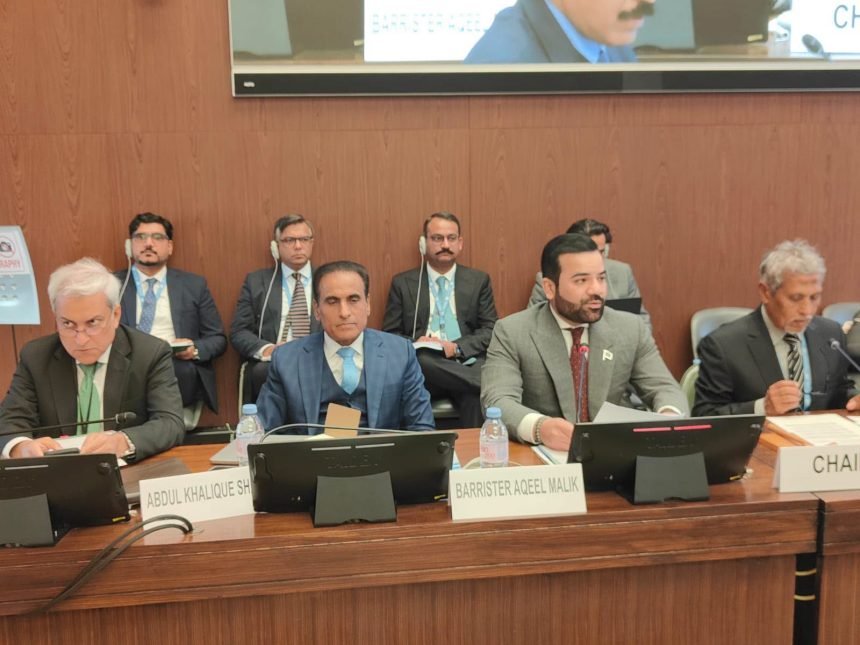
Pakistan’s delegation, led by Minister of State for Law and Justice Aqeel Malik, acknowledged that “the gap between Pakistan’s obligations and their realisation was real”. It argued that the country had made measurable progress despite severe fiscal, security and climate pressures.
A welcome reform, and lingering concern
The Committee on Economic, Social and Cultural Rights concluded its review of the second periodic report of Pakistan under the International Covenant on Economic, Social and Cultural Rights on November 4.
Michael Windfuhr, a Committee Expert and member of the Taskforce for Pakistan, welcomed the 2025 amendment to the Child Marriage Restraint Act of 1929, which raised the lawful marriage age to 18 for both sexes. He said the Committee remained concerned by the high number of child brides and asked what impact the new measures had had. Mr. Malik said child marriage restraint laws now set the minimum age at 18 for boys and girls in Islamabad, Balochistan, Punjab and Sindh, and criminalise child, early and forced marriage.
Bonded labour
Lazhari Bouzid, another Taskforce member, said bonded labour continued to pervade agriculture and the informal sector, notably brick making. Construction companies and government agencies were reportedly complicit, buying bricks produced through debt bondage. He asked how the State had responded to these reports.
The delegation said the Constitution prohibits slavery and forced labour and that a 1992 act abolished the bonded labour system. It said Punjab had documented more than 210,000 kiln workers and set up district vigilance committees in many districts. Labour inspectors identified more than 2,900 victims of forced labour last year.
Reconstruction and displacement from floods
Mr. Windfuhr asked how Pakistan had coped with the catastrophic floods of 2022 and 2025. He asked whether affected people’s housing had been rebuilt, whether their access to land and productive resources had been restored, and how many remained displaced.
The delegation said the Government had created a national emergency operations centre focused on high-risk areas, along with a national flood protection programme. The programme aims to protect at-risk people, eight million acres of farmland and 2.2 million housing units, and each province is implementing its own measures. Of the 2.1 million homes destroyed in 2022, about 600,000 have been rebuilt, with reconstruction of the rest continuing. The delegation did not give a figure for people still displaced.
In his opening statement, Mr. Malik said the 2025 floods caused losses estimated at 822 billion rupees, affected about 4.9 million people and disrupted some 3.3 million jobs. He also warned that per capita water availability had fallen below 900 cubic metres.
Judicial independence under scrutiny
Julieta Rossi, the Taskforce leader, said most Covenant rights were still not incorporated into domestic law. She noted that, following the 27th Constitutional Amendment of November 2025, the guarantee of fundamental rights lies with a new Federal Constitutional Court. She cited the UN High Commissioner for Human Rights, who had warned that the 26th and 27th Amendments, adopted without extensive consultation, “seriously undermined” judicial independence by changing how judges are appointed, promoted and transferred. She asked how the State would safeguard the independence of the new court and of judges subject to transfer.
The delegation said the 27th Amendment created the court to relieve a Supreme Court burdened by a “gigantic workload” and long delays. It said the Constitution provides for the separation of powers and recognises the judiciary as a separate organ. Judges, it added, are appointed independently by majority vote of the Supreme Judicial Council, which comprises judges of the Supreme Court and the Constitutional Court and the Chief Justice.
The delegation also noted that the 26th Amendment enshrined a right to a clean, healthy and sustainable environment, and that Pakistan’s superior courts have ruled on issues relevant to the Covenant, including food security, public health, disability employment rights and women’s inheritance.
Human rights defenders and disappearances
Ms. Rossi described the situation of human rights defenders and civil society, particularly Baloch and Pashtun communities, as “extremely worrying”. She cited reports of arbitrary arrests, ill-treatment, enforced disappearances, extrajudicial executions and excessive use of force in the context of counter-terrorism operations, including against peaceful protesters searching for missing relatives. She said these incidents had reportedly intensified since 2023. Women defenders and journalists, she added, faced online harassment, and the 2025 amendments to the electronic crimes act broadly criminalised the spread of “false or fraudulent” information.
She relayed an allegation that 18,000 people had disappeared in Balochistan since 2020, in the context of foreign companies’ operations on Baloch lands. She questioned the effectiveness of the Commission of Inquiry on Enforced Disappearances, established in 2011, noting that no criminal conviction had resulted. She asked when Pakistan would criminalise enforced disappearance and ratify the International Convention against Enforced Disappearances.
The delegation said disappearances are neither permitted nor justified under Pakistani law and that security measures must respect constitutional safeguards. It said the National Commission on Enforced Disappearances had received 10,900 cases and disposed of 87 per cent of them. It said the State “protected dissent but prosecuted violence” and that all State power is subject to judicial review. It cited a federal commission for the protection of journalists, with similar bodies in some provinces, and said more than 100,000 civil society organisations and 112 international organisations are registered in Pakistan.
On the electronic crimes act, the delegation said the 2025 amendments aim not to suppress expression but to protect citizens. It said the National Cyber Crimes Agency received 157,000 complaints in 2025, mostly involving blackmail and abuse of women and children. Only about 2,250 reached the courts, the rest being judged unjustified.
Delay in appointments in NCHR
The Committee recognised the National Commission for Human Rights’ “A” status under the Paris Principles but noted that its members’ terms expired in November 2025 and that no one had been reappointed. Ms. Rossi asked how the State would ensure a transparent, merit-based appointment process and protect the Commission’s financial autonomy.
The delegation said the Government was committed to strengthening the Commission, which reports to Parliament annually. It said the Commission’s budget had risen by more than 200 per cent between 2021-2022 and 2024-2025.
Regional inequality
Experts focused heavily on fiscal policy. Ms. Rossi said provinces, which are responsible for health, education, housing and social security, receive 57.5 per cent of the federal revenue pool. She said the National Finance Commission’s last resource-sharing agreement expired in 2015 despite a constitutional requirement to review it every five years. She added that poverty ranges from 23.3 per cent in Punjab to 47 per cent in Balochistan.
She said revenue mobilisation remained “insufficient and regressive” at 10.6 per cent of GDP in 2024-2025, one of the lowest rates in the region, and that the tax burden falls disproportionately on poor households. Poverty has risen to 28.9 per cent, and the Gini coefficient climbed from 28.4 to 32.2, its highest since 1998. Debt service will consume 42.9 per cent of the federal budget in 2026-2027, up from 27 per cent in 2016. She noted that health spending is about 0.9 per cent of GDP and education about 1.95 per cent, far below the national four per cent target, while defence accounts for 14.5 per cent of federal spending. She asked about plans for progressive taxation, including wealth and agricultural income taxes, and whether Pakistan would seek debt restructuring.
The delegation described two parallel tax systems, federal and provincial, with provinces collecting a 17 per cent sales tax on services, agricultural income tax and motor vehicle taxes. It said poverty rates form a baseline for allocating resources to provinces and that tax revenue rose 26.3 per cent over the 2024-2025 fiscal years. It said the tax-to-GDP ratio rose from 8.8 to 10.3 per cent, a figure slightly below the Committee’s 10.6 per cent.
In its opening statement, the delegation highlighted social protection gains. The Benazir Income Support Programme now reaches about 12 million households, and its allocation was raised by 20 per cent this fiscal year. The out-of-school rate fell from 38 per cent in 2023 to 28 per cent in 2025, though about 20 million children remain out of school. Around 84 per cent of workers are in the informal economy, where minimum wage enforcement remains a challenge.
Indigenous peoples, discrimination and refugees
The Committee raised concern that Pakistan has no legal framework recognising indigenous or tribal peoples or requiring their free, prior and informed consent for land, mining or infrastructure projects. Ms. Rossi said the impact assessment for the Reko Diq mining project in Balochistan classified the Baloch as an ethnic minority rather than an indigenous people.
The Committee also noted the absence of a comprehensive anti-discrimination law covering grounds including sexual orientation, gender identity and nationality. It asked about steps to decriminalise same-sex relations and to protect religious minorities. Mr. Malik pointed to the 2025 National Commission for Minorities Rights Act as a step to combat discrimination.
On refugees, the Committee cited the forced return or expulsion of about 2.7 million Afghans since 2023 under the illegal aliens repatriation plan, and the irregular status of 1.4 million refugees since 2025. It asked whether Pakistan would adopt an asylum law and ratify the 1951 Refugee Convention. The summary of the dialogue contained no response from the delegation on these topics.
In concluding remarks, Ms. Rossi said the delegation had described both the processes in place and the “significant challenges” the State faces, along with gaps between legislative progress and implementation. She said this would be reflected in the Committee’s concluding observations, which she hoped Pakistan would implement in good faith.
Mr. Malik said Pakistan had presented its efforts to close the gap between constitutional guarantees and their realisation. He said the State was on a trajectory toward progressive realisation of Covenant rights and had “travelled a considerable distance” since its first review. He hoped the Committee’s “candour and rigour” would help pave the way for the full realisation of these rights for all.
Committee Vice-Chair Asraf Ally Caunhye, acting as Chair for the dialogue, thanked the delegation for its participation and its stated commitment to the Covenant. He said the dialogue gave the Committee a strong basis for drafting its concluding observations.
The delegation included representatives of the Ministry of Law and Justice, the Ministry of Human Rights and Pakistan’s Permanent Mission to the UN Office at Geneva. The Committee’s eightieth session runs until 13 November 2026.