

June 6, 2026
By Ahmed Saeed
MUZAFFARABAD
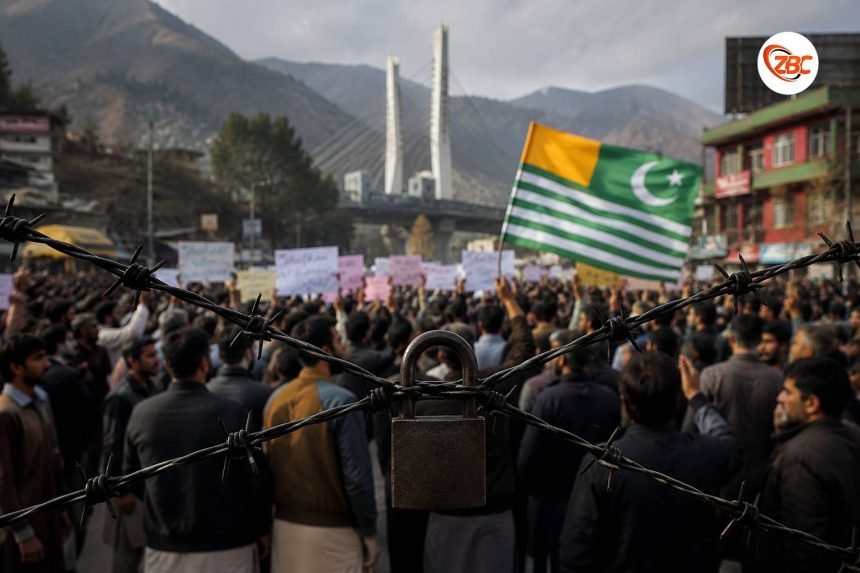
The Azad Jammu and Kashmir (AJK) government on Friday June 6, declared the Jammu and Kashmir Joint Awami Action Committee (JK-JAAC) a proscribed organisation under the Anti-Terrorism Act 2014, just three days before the group’s planned June 9 wheel-jam strike.
The move also came hours after the Election Commission announced July 27 as the date for general elections in the region. The decision was approved by the AJK president under Section 12 of the Anti-Terrorism Act 2014. A notification issued by the Home Department placed JK-JAAC in the First Schedule of the law and accused the organisation of engaging in activities prejudicial to peace and security.
According to the notification, the committee has been creating anarchy by intimidating the public, promoting hatred and creating a sense of insecurity in society.
Prime Minister Faisal Mumtaz Rathore defended the decision, saying the government was fulfilling its responsibility to protect citizens and maintain law and order.
In a post on X, he said the government had so far taken precautionary measures to safeguard the lives and property of citizens. He added that violence, chaos and anti-state activities would not be tolerated and would be dealt with according to the law. The prime minister said peaceful protest was a democratic right but threatening state institutions was a crime.
In another statement, Rathore drew a distinction between peaceful protest and actions that disrupt public life.
“Freedom of expression is a fundamental right, but forcing businesses to close, blockading roads and cities and paralysing the system cannot be justified as protest,” he wrote.
In a third post, the prime minister said it was time for an “end of mob rule” and warned against challenging the writ of the state.
Government officials have long accused JAAC of using the slogan “Band, Matlab Band” (Closed means Closed) to pressure traders and shopkeepers into observing strikes. Authorities argue that such tactics amount to coercion rather than political expression.
JAAC rejects ban
JAAC rejected the government’s decision and described the ban as an attempt to silence the people of Azad Kashmir.
In a statement issued on social media, the committee said the action was not merely against one organisation but against millions of people demanding their rights, dignity and a better future.
“The June 9 call is not the call of a few individuals or a single committee. It is the voice of people from every city, town and village of Azad Kashmir,” the statement said.
The committee argued that when a movement includes workers, traders, students, women and the elderly, declaring it unlawful amounts to declaring the collective will of the people unlawful. JAAC warned that if the committee could be banned today, tomorrow anyone speaking against injustice or an exploitative system could also be declared unlawful.
The statement concluded by saying that June 9 would be a demonstration of people’s power and that the voice of the people could not be suppressed.
Human rights activists have also criticised the ban as undemocratic.
Veteran politician and former chairperson of the Human Rights Commission of Pakistan (HRCP), Senator Afrasiab Khattak, said banning the Jammu and Kashmir JAAC, which he described as a non-violent voice of the people, under anti-terrorism laws amounted to a gross violation of fundamental rights. “Attempting to “conquer” Kashmir through force instead of winning hearts and minds could have dangerous consequences,” he said.
Former federal information minister Senator Mushahid Hussain Syed also criticised the decision, calling it a “wrong decision at the wrong time” and warning that authorities were repeating past mistakes in handling political dissent.
“At a time when India was facing diplomatic challenges over its policies in Indian-administered Kashmir, he said, Pakistan’s officialdom had created a new crisis in sensitive Azad Kashmir by imposing what he termed a shortsighted ban and invoking anti-terror laws against political dissenters”, he added.
Who is JAAC?
The Jammu and Kashmir JAAC is a civil society alliance that has emerged in recent years as one of the most influential protest movements in Azad Kashmir outside the formal political system.
Presenting itself as a platform representing ordinary citizens, the committee has organised large protests, long marches and strikes across the region, often challenging policies that it says strengthen Islamabad’s influence over AJK affairs.
The movement’s protests have at times turned violent. Clashes between demonstrators and law enforcement agencies resulted in the deaths of 13 civilians during protests in 2024 and 2025.
Key Timeline
May 2024: Large-scale protests over economic issues turned violent, resulting in multiple fatalities during clashes with law enforcement.
September 2025: JAAC announced a long march on Muzaffarabad. Authorities suspended mobile internet services and the protests again turned deadly.
October 4, 2025: An agreement was reached between JAAC, federal ministers and the AJK government with a 90-day implementation deadline.
January 2026: The deadline expired without implementation. JAAC accused the government of reneging on its commitments and tensions resurfaced.
May 30, 2026: Government proposals regarding refugee seats were rejected and JAAC boycotted an All Parties Conference.
June 5-6, 2026: The government issued a travel advisory, formally banned JAAC and intensified security measures. Prime Minister Rathore warned against “mob rule” while JAAC vowed to proceed with its June 9 protest. The Election Commission confirmed July 27 as the date for general elections.
The committee’s latest campaign centres on its demand for the abolition of 12 seats in the AJK Legislative Assembly reserved for refugees from Indian-administered Jammu and Kashmir who settled in Pakistan after 1947.
JAAC argues that these seats allow Pakistan’s mainstream political parties, particularly the PML-N and PPP, to influence government formation in Azad Kashmir. The dispute intensified this week after the Election Commission announced that nomination papers for the July 27 elections would be filed from June 9, the same day JAAC plans to hold its wheel-jam strike. Government officials and members of the AJK Legislative Assembly have accused the committee of attempting to disrupt the electoral process.
JAAC Chairman Shaukat Nawaz Mir has rejected the allegation, saying the protest date was announced before the election schedule.
Security measures intensified
Amid fears of fresh unrest, the AJK administration has stepped up security arrangements across the region.
The Inspector General of Police requested 14,000 additional personnel from the federal government for deployment between June 7 and June 21. Videos circulating on social media showed security convoys entering Muzaffarabad on Friday.
Mobile phone and internet services across parts of Azad Kashmir were reportedly suspended late Thursday night as part of security measures ahead of the planned June 9 protest. Multiple officials said the restrictions are expected to remain in place until June 12. However, no formal notification regarding the suspension had been issued by the government till the filing of this report.
During protests in September and October 2025, internet services remained suspended for nearly a week, disrupting online businesses, freelance work and communications across the region.
The University of Azad Jammu and Kashmir announced on Friday that Spring 2026 examinations scheduled to begin on June 8 had been postponed until further notice. The government also issued a travel advisory asking tourists to avoid visiting the region between June 5 and June 20. Visitors currently in Azad Kashmir were advised to leave by Saturday evening.