

May 12, 2026
Staff Report
ISLAMABAD
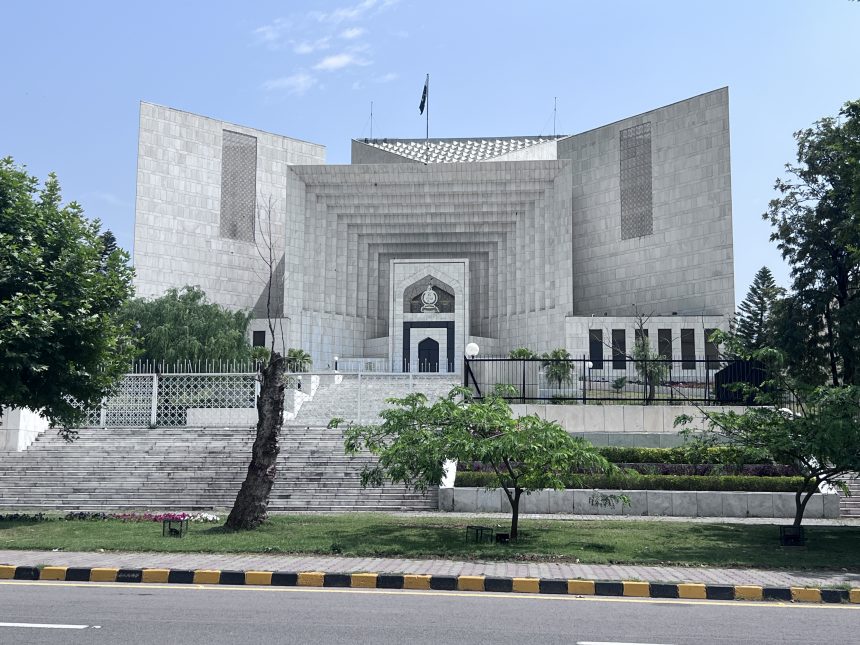
The Supreme Court has acquitted a man convicted in a 19-year-old murder case, holding that ‘mere abscondence is not conclusive proof of guilt.’
In a judgment authored by Justice Ishtiaq Ibrahim, a two-member bench headed by Justice Muhammad Hashim Kakar set aside the life sentence awarded to Muhammad Iqbal in the murder of Jameel Khan, observing that the evidence produced by the prosecution was “replete with doubts” and material inconsistencies.
The judgment extensively discussed the principle of the benefit of the doubt in criminal law, stressing that courts must lean in favour of acquittal where the prosecution’s evidence is uncertain or infirm.
“It is by now a well-settled principle of criminal jurisprudence that even a single circumstance creating reasonable doubt in the prosecution’s case entitles an accused to acquittal,” the judgment stated.
The bench further linked the doctrine to Islamic legal principles, observing that the concept had long been recognised in Islamic jurisprudence.
“This principle is also deeply rooted in Islamic jurisprudence, which more than fourteen centuries ago laid down the salutary maxim that it is better to acquit ten guilty persons than to convict one innocent individual,” Justice Ibrahim observed.
The Judgement added that this doctrine has, over time, evolved into the well-
recognized rule that “it is better to err in acquittal than to err in conviction.” The same finds manifestation in the principle of benefit of doubt, which is invariably extended in favour of the accused to ensure the safe and just administration of criminal justice
Muhammad Iqbal had been convicted under Section 302(b) of the Pakistan Penal Code by the Additional Sessions Judge-II Karachi West on Jan 26, 2024, for an incident that allegedly took place on April 29, 2006. Besides life imprisonment, he was ordered to pay Rs500,000 in compensation to the legal heirs of the deceased.
The conviction was later upheld by the SHC in June 2025.
One of the principal reasons relied upon by the high court was the conduct of the accused, who remained at large for nearly 14 years before his arrest in October 2021. The SHC had viewed the prolonged absence as indicative of a “guilty conscience.”
However, the Supreme Court found serious legal and procedural defects in that reasoning.
The judgment noted that the appellant belonged to Bara in Khyber district, formerly part of the Federally Administered Tribal Areas (Fata), and the prosecution had failed to establish that mandatory legal procedures concerning an absconding accused were ever initiated against him.
According to the court, there was no material on record showing that proceedings under Sections 204, 87 or 88 of the Criminal Procedure Code — relating to issuance of warrants, proclamation of abscondence and attachment of property — had been lawfully undertaken during the relevant period.
The court also pointed out another significant flaw in the prosecution case: the accused had never been confronted with the allegation of abscondence during his examination under Section 342 of the CrPC.
“It is by now a settled principle of law that any piece of evidence or circumstance not put to an accused in his statement under Section 342 CrPC cannot be used against him,” the judgment stated.
The bench further emphasised that abscondence, by itself, does not constitute proof of guilt and may occur for several reasons unrelated to the commission of an offence.
“An accused may abscond for a variety of reasons, rightly or wrongly, including fear of arrest or police harassment,” the judgment observed.
“Mere abscondence, therefore, is not conclusive proof of guilt. It is trite law that abscondence is, at best, a corroborative piece of evidence and cannot by itself be treated as substantive evidence to sustain a conviction.”
The court explained that such conduct can only be used to support otherwise trustworthy evidence and cannot independently form the basis of conviction where the prosecution’s ocular account is doubtful.
After examining the record, the apex court concluded that the prosecution evidence suffered from “material contradictions and inherent discrepancies,” which had either been ignored or improperly appreciated by the courts below.
“The courts below also fell into patent error in recording the conviction of the petitioner by disregarding and overlooking such material infirmities in the prosecution case,” the judgment noted.
Justice Ibrahim reiterated that the benefit of doubt is not a concession dependent on judicial generosity but a substantive legal right available to every accused person.
“Reasonable doubt in the mind of a prudent person is sufficient to entitle an accused to the benefit of doubt as a matter of right and not grace,” the court observed.
Holding that the prosecution had “miserably failed” to establish guilt beyond reasonable doubt, the Supreme Court acquitted the appellant and ordered his immediate release.