

February 23, 2026
Staff Report
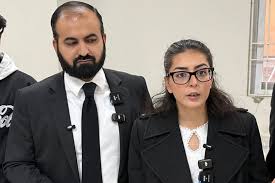
LAHORE: Five United Nations Special Rapporteurs have written to the Pakistani government expressing serious concern over what they describe as a pattern of legal harassment targeting two prominent human rights lawyers Ms. Imaan Zainab Mazari-Hazir and Mr. Hadi Ali Chattha, warning that criminal charges including “cyber terrorism” appear designed to silence legitimate advocacy work.
In a formal communication dated December 22, 2025, and addressed to the Pakistani government, five UN Special Procedures mandate holders raised the alarm over the treatment of lawyers Ms. Imaan Zainab Mazari-Hazir and Mr. Hadi Ali Chattha — a married couple whose legal practice centers on criminal defense, constitutional litigation, and pro bono representation of some of Pakistan’s most vulnerable communities, including victims of enforced disappearances and those wrongfully accused of blasphemy.
The communication, referenced as AL PAK 17/2025, was signed jointly by Margaret Satterthwaite, Special Rapporteur on the independence of judges and lawyers; Irene Khan, Special Rapporteur on freedom of opinion and expression; Gina Romero, Special Rapporteur on peaceful assembly and association; Mary Lawlor, Special Rapporteur on human rights defenders; and Ben Saul, Special Rapporteur on human rights and counter-terrorism.
The communication was written prior to the conviction of the couple in the cyber terrorism case on January 24 this year. Mazari-Hazir and Ali Chattha were convicted of offences under sections 9 (glorification of an offence), 10 (cyber-terrorism) and 26-A (false and fake information) of Pakistan’s Prevention of Electronic Crimes Act 2016. They each received multiple concurrent sentences of imprisonment, totalling 17 years, with the longest being a 10-year sentence for cyber-terrorism. They were also fined a total of Rs 36 million each.
A pattern of prosecution
The rapporteurs’ letter details what they characterize as a sustained and escalating campaign of legal pressure against the two lawyers. Since 2022, ten First Information Reports — the first stage of criminal prosecution under Pakistani law — have been registered against Ms. Mazari-Hazir alone. None have resulted in a conviction.
The cases cited in the communication range from a 2022 FIR for peacefully protesting enforced disappearances alongside Baloch students — later withdrawn by police — to a charge of inciting hatred against the armed forces for criticizing the Chief of Army Staff, dismissed by the Islamabad High Court. In 2024, both lawyers were arrested under the Anti-Terrorism Act for allegedly “creating a security risk by interfering in state duties during an international cricket team’s visit” — the alleged interference being the moving of road barriers to clear traffic.
The rapporteurs wrote that they wished “to express serious concern about the allegations that Ms. Imaan Mazari-Hazir and Mr. Hadi Ali Chattha continue to be targeted for prosecution, reportedly in connection with their exercise of their role as lawyers and as human rights defenders; as well as for the exercise of their right to freedom of expression, all of which are guaranteed by international human rights law.”
The cyber terrorism charge
The most serious development prompting the December 2025 communication is an FIR registered on August 22, 2025, by the National Cyber Crime Investigation Agency Islamabad. The FIR accuses Ms. Mazari-Hazir of using her social media accounts, particularly X (formerly Twitter), to spread content described as “highly offensive and intimidating in nature.” Mr. Chattha was named in the same complaint for having “shared, reposted and glorified” his wife’s posts.
The FIR alleges that Ms. Mazari-Hazir incited ethnic hatred, portrayed the armed forces as responsible for terrorism, held the military accountable for enforced disappearances in Balochistan and Khyber Pakhtunkhwa, and propagated that state institutions were colluding with banned organizations. It characterizes her years of social media commentary as “a calculated and organized attempt to undermine public trust on State Institutions, create unrest in the country and destabilize national security.”
The charges fall under Sections 9, 10, 11, and 26-A of Pakistan’s Prevention of Electronic Crimes Act (PECA) 2016, covering glorification of offences, cyber-terrorism, hate speech, and dissemination of false information. Conviction under these provisions carries a maximum sentence of fourteen years’ imprisonment.
The rapporteurs found this characterization difficult to reconcile with the actual content cited in the FIR.
“The posts quoted in the FIR contain Ms. Mazari-Hazir’s commentary on public affairs and discussion of human rights, including calling out alleged human rights violations, and do not appear to include language that advocates hatred, incite violence or discrimination, or poses any kind of threat for Pakistan’s national security,” the communication states.
Applying the Rabat Plan of Action’s six-part threshold test for incitement, the rapporteurs concluded that Ms. Mazari-Hazir, as a lawyer without formal public office, had “a very limited likelihood of mobilizing or inciting others into harmful action,” and that “the intent and especially the likelihood, including imminence, of her statements leading to any harm, in the form of discrimination, hostility or violence in Pakistan is virtually none.”
The letter goes further, finding the charges legally problematic at their foundation. The rapporteurs expressed concern about PECA’s “vagueness and ambiguity,” noting that the cyber-terrorism provision’s intent elements closely mirror the broadly criticized Anti-Terrorism Act of 1997. Conduct criminalized under the cyber-terrorism definition, they wrote, “go well beyond conduct that is genuinely terrorist in nature according to international standards, by incriminating conduct that is not intended to cause death or serious personal injury.”
Due process failures
Beyond the substance of the charges, the rapporteurs documented a troubling series of alleged procedural violations in the conduct of the trial itself, which began following indictment on October 30, 2025.
Ms. Mazari-Hazir and Mr. Chattha reportedly learned of the FIR through informal sources rather than official notification. Key prosecution documents — including the original complaint, technical reports, and screenshots cited in the police report — were not disclosed to the defence, despite legal requirements to do so. When the lawyers applied for these materials, the trial court dismissed the request and ordered the trial to proceed.
In a particularly striking episode on October 29, 2025, Mr. Chattha — who had informed the court he was appearing before the Islamabad High Court that morning — arrived at the trial court at 2:30 p.m. Within five minutes, a non-bailable arrest warrant was issued against him. He was handcuffed at the courthouse door and held in a lockup at NCCIA offices described as lacking functioning bathroom facilities or running water.
On November 5, 2025, despite both accused attending the hearing in person, the trial judge issued non-bailable arrest warrants against them both. Multiple lawyers reportedly withdrew from the case or declined representation due to pressure and intimidation. At one point, prosecution witnesses gave evidence in the complete absence of the accused and their chosen legal representatives.
The rapporteurs noted that the rapid pace of hearings — far more frequent than typical — was itself a tool of pressure, preventing the lawyers from representing their own clients in other ongoing matters.
The Islamabad High Court, reviewing the proceedings on October 24, 2025, acknowledged the concerns, reserving judgment and noting that the “question raised needs consideration.” The trial court, however, continued proceedings regardless.
International law violations alleged
The communication invokes multiple provisions of the International Covenant on Civil and Political Rights, to which Pakistan acceded in 2010, including Article 14 on the right to a fair trial, Article 19 on freedom of expression, and Article 15’s principle of legality. The rapporteurs also referenced the UN Basic Principles on the Role of Lawyers, which prohibit identifying lawyers with their clients’ causes and require governments to protect lawyers from prosecution arising from their professional duties.
“The charges filed against Ms. Mazari-Hazir and Mr. Chattha, including the charge of ‘cyberterrorism’, seem to conflate exercise of the right to free speech with terrorism, and risk undermining, chilling, and potentially criminalizing, the work of human rights defenders in Pakistan more broadly,” the letter warns.
The rapporteurs called on Pakistan to halt the alleged violations, ensure fair trial guarantees, and undertake reforms of PECA’s cyber-terrorism definition to bring it into compliance with international human rights standards. They noted the communication would be made public within sixty days and indicated they may issue a press statement in the near future.
This is the seventeenth Special Procedures communication addressed to Pakistan in 2025 alone — a figure that underscores growing international concern over the country’s treatment of lawyers, journalists, and civil society actors.
On February 4, the UN experts had expressed alarm at the conviction of Imaan Mazari-Hazir and Hadi Ali Chattha on multiple criminal charges, which resulted in lengthy prison sentences, for simply exercising rights guaranteed by international human rights law.