

December 31, 2025
By Rana Malhi
ISLAMABAD
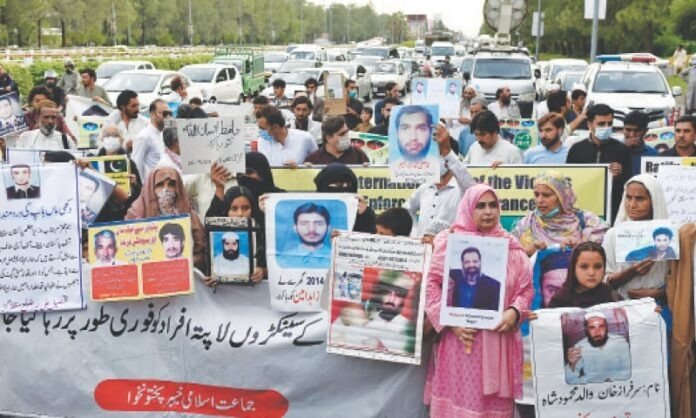
Enforced disappearances continued across Pakistan throughout 2025 despite repeated government assurances, legal proceedings, and the existence of an official inquiry mechanism. A year end report released by Defence of Human Rights (DHR) has revealed that there have been 60 new cases of enforced disappearances registered in 2025 alone, involving students, political workers, journalists ethnic minorities, human rights defenders, and ordinary citizens.
The organization was founded in 2006 by Amina Masood Janjua, the wife of a missing person and has documented enforced disappearances and supports affected families through legal advocacy, psychosocial assistance, and engagement with national and international human rights bodies.
According to the report, these cases were reported from Balochistan, Khyber Pakhtunkhwa, Sindh, Punjab, and Islamabad Capital Territory, underscoring the nationwide nature of the practice.
Of the 60 cases documented by DHR during the year, 50 were formally submitted to the United Nations Working Group on Enforced or Involuntary Disappearances (WGEID). Only 11 individuals were released, while three were traced in detention facilities, leaving the majority of cases unresolved. The organization notes that hundreds of families continue to live without information about the fate or whereabouts of their loved ones, often for years.
The report highlights that enforced disappearance continues to be treated by authorities as a security or administrative issue rather than a criminal offence. Pakistan once again failed in 2025 to ratify the International Convention for the Protection of All Persons from Enforced Disappearance (ICPPED) and still lacks a domestic law criminalizing enforced disappearance, allowing perpetrators to operate with near-total impunity.
DHR pursued legal remedies throughout the year, filing nine new habeas corpus petitions in various High Courts and initiating contempt proceedings against the Commission of Inquiry on Enforced Disappearances (COIED) for non-compliance with court orders. However, the report documents persistent problems, including delays in hearings, non-implementation of production orders, lack of transparency, and routine closure of cases without accountability.
While the government frequently cites COIED statistics as evidence of progress, DHR argues that many cases are marked as “disposed of” without determining responsibility or addressing unlawful detention. The report notes that compensation payments, including cases where families were awarded Rs 5 million, were presented without a clear legal framework and often functioned as substitutes for justice rather than accountability.
Legislative developments in 2025 further aggravated the situation, the report says. Amendments to the Anti-Terrorism Act expanded preventive detention powers, allowing individuals to be detained for up to 90 days without charge or trial. Human rights groups documented a rise in short-term and unacknowledged detentions following these amendments, raising fears that enforced disappearances were being retroactively legitimized as lawful detention.
The 26th and 27th Constitutional Amendments are described in the report as having weakened judicial independence, leading to stalled habeas petitions, inconsistent court hearings, and declining confidence among families seeking legal relief. The appointment of the COIED chair to the Federal Constitutional Court further raised concerns about conflicts of interest and institutional accountability.
On the international front, DHR submitted four urgent action appeals to the UN Working Group in 2025 and participated in global advocacy forums, including the first World Congress on Enforced Disappearances in Geneva. The organization also remained active in regional networks documenting disappearances beyond official figures.
Beyond legal work, the report documents significant psychosocial support efforts. In 2025, DHR provided mental health and psychosocial assistance to 92 family members of disappeared persons across five regions through a combination of field visits and online counselling. Swat accounted for approximately 74 percent of the total caseload, indicating a heavy regional concentration of cases. The data shows 63 percent male and 37 percent female participation, highlighting the gendered impact of enforced disappearances, particularly on mothers and wives.
Public advocacy remained a key component of DHR’s work. Throughout the year, the organization held press conferences, protests, and awareness activities, including events marking the International Day of the Victims of Enforced Disappearances. DHR also used documentaries and public screenings to document the long-term human cost of disappearances and keep public attention focused on the issue.
The report concludes with a call for urgent reforms, demanding the immediate end to enforced disappearances, ratification of ICPPED, criminalization of enforced disappearance under domestic law, restoration of judicial independence, and the reform or dismantling of ineffective inquiry mechanisms. It stresses that financial compensation cannot replace truth, accountability, or the safe return of the disappeared.
According to DHR, without structural legal reform, independent investigations, and genuine political will, enforced disappearances will continue to undermine the rule of law in Pakistan and prolong the suffering of thousands of affected families.