

December 17, 2025
By Xari Jalil
LAHORE
A report co-authored by researchers Humera Qasim Khan and Waqas Naeem, and published by International Media Support (IMS) and Institute for Research, Advocacy and Development (IRADA) has revealed the extent of disinformation surrounding climate change and issues across Pakistan and the subsequent silencing of indigenous peoples’ voice as a result.
According to this report, the results show that the disinformation thrives especially during environmental crises. It spreads rapidly through social media and often carries emotional, conspiratorial or fatalistic messages. For Indigenous Peoples, whose livelihoods are deeply tied to fragile ecosystems, such disinformation not only erodes trust in science and institutions but also undermines traditional knowledge systems and excludes them from climate policy discourse. In this way, the climate crisis is compounded by an information crisis, both of which demand urgent and coordinated responses.
These dual crises have put the country’s Indigenous Peoples (IPs), which cover diverse groups ranging from tribal people, fisher folk, pastoralists, ethnic minorities and mountain communities, at severe risk of fatalities, economic damages and dispossession. These IPs comprise diverse groups ranging from tribal people, fisher folk, pastoralists, ethnic minorities and mountain communities, and place them at severe risk of fatalities, economic damages and dispossession.
Why this matters for Pakistan
Pakistan is among the top 10 most climate-vulnerable countries, despite contributing less than 1% to global emissions. However because of its vulnerable communities, the country faces disproportionate harm due to ecosystem-dependent livelihoods, lack of formal recognition, limited access to credible climate information and climate disinformation worsens existing governance failures and marginalisation.
Main forms of climate disinformation
The report shows there are at least five types of climate disinformation that are seen throughout the news. Research done on news spread through social media shows that around 70 percent of the 219 posts were of the first type which is the ‘alarmist & sensationalised type’. Such content includes exaggerated death tolls, AI-generated visuals, panic-inducing narratives. It aims as fuelling fear, confusion, and mistrust in early-warning systems.
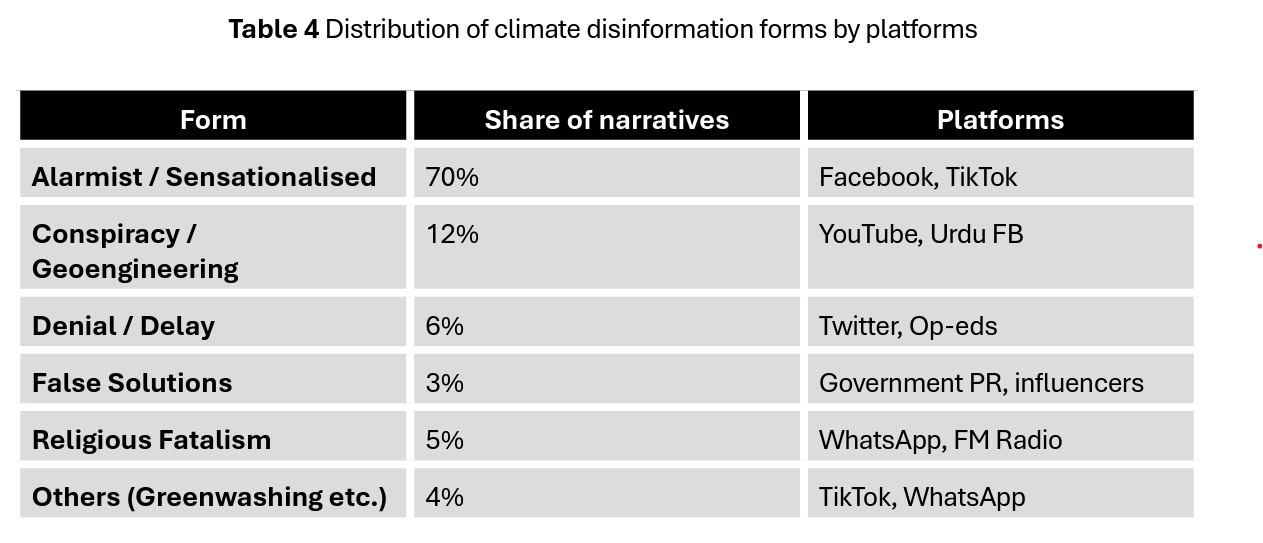
The second type of disinformation is the conspiracy-driven narrative which claims of foreign sabotage, geoengineering, the kind of narrative that tries to prove that floods have come about due to dam water being “deliberately released”, or smog being present because of the eastern winds coming into Pakistan. It politicises disasters and undermines science and institutions.
The third kind are denial or delay narratives in which climate change is framed as a “natural cycle” or a “Western agenda”. It discourages urgency, policy action, and adaptation.
There are also the type that give extremely oversimplified or false solutions to large overarching problems. This fourth kind of disinformation highlights short term moves as permanent solutions, such as tree plantation drives or cloud seeding and these are presented as complete solutions. The content creates illusion of progress while masking structural failures.
Lastly content using religion as a tool was also seen across social media platforms and is counted as the fifth type of disinformation rampant in climate news. Religious fatalism includes climate disasters framed as divine punishment or inevitability. It reduces preparedness, evacuation, and proactive adaptation.
How disinformation spreads
Most disinformation spreads through social media platforms mostly dominated by Facebook, TikTok, and WhatsApp. The content here starts from short videos, memes, voice notes to AI-generated visuals and is usually always seen when disaster strikes and when official information is delayed.
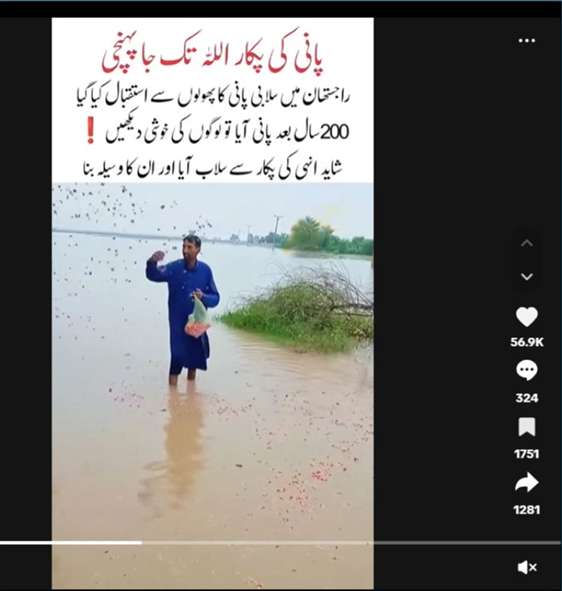
Rarely verified, this disinformation is shared largely by family members, elders, and are sometimes even given out during announcements made in mosques. Because indigenous communities often rely on informal networks, not government alerts, they are the most vulnerable to this disinformation.
Climate journalism in Pakistan
The study finds that in Pakistan, climate journalism is reduced to coverage that is mostly reactive, event-driven, and sensational. There is a serious lack of trained climate reporters and fact-checking protocols so that fact-based reporting is carried out. Algorithms reward virality over accuracy. Legal approaches to disinformation risk censorship rather than solutions.
As a result the study also gives its recommendations for the situation:
Recommendations
Government & UN Bodies
- Integrate information integrity into climate policies (NAPs, NDCs).
- Ensure Indigenous rights alignment with international commitments.
Media
- Create dedicated climate desks.
- Train journalists in climate science and disaster reporting.
- Institutionalise fact-checking and ethical standards.
Civil Society & NGOs
- Build community-based verification networks.
- Promote digital literacy in Indigenous languages.
- Amplify Indigenous knowledge and perspectives.
Technology Companies
- Algorithmic accountability for climate content.
- Priority ranking for verified climate information.
- Rapid-response alerts during climate emergencies.
Indigenous Communities
- Peer-led digital literacy programmes.
- Collaborate with independent media to counter disinformation.