


August 1, 2025
By Iqra Manzoor
LAHORE
The recent honous based killing Balochistan’s Deghari area, has spread a shockwave across the country, and serves as yet another stark reminder that women in Pakistan remain at risk for exercising their free will. It also proves that despite existing legislation and policy measures, ‘honour’-based crimes have been persisting across the country with alarming regularity.
While Balochistan has recently been in the news for honour based killing incidents that have taken place one after the other, it is not the only area in Pakistan where these crimes occur.
Shocking data compiled by the Human Rights Commission of Pakistan (HRCP) indicates that between January and May 2025, 268 individuals, including 155 women and 113 men, were killed in the name of ‘honour’ across Pakistan. The data highlights that men, too, fall victim to such crimes, often alongside women accused of tarnishing family honour.
HRCP’s stats are supported by data compiled by Sahil, another non-profit organization, monitoring violence against women and children. Sahil’s data says that 149 cases of ‘honour’ killings were reported in the media across Pakistan in the last six months – between January and June 2025. Within these numbers, Sindh recorded the highest number with 72 cases, followed by 54 in Punjab, 12 in Khyber Pakhtunkhwa (KP), nine in Balochistan, and two in the federal capital.
What is Honour based Killing?
‘Honour’ killing, as defined by the UN Economic and Social Commission for Western Asia (ESCWA), refers to the killing of a relative – most commonly a girl or woman – who is perceived to have brought shame or dishonour to the family.
The term ‘honour crime’ is used widely to refer to the killing or harm induced on persons, usually women, for the protection of the perpetrator’s perceived honour. An even more simplistic definition of ‘honour’ killings is given by a report by Shirkat Gah: When a man takes the life of a woman and claims that he did it because she was guilty of immoral sexual conduct it is called an ‘honour killing’, not murder.
To support this, it can be seen from Sahil’s data that in the majority of cases, the perpetrators were husbands (58 cases), followed by brothers (30 cases). Other abusers included acquaintances (16 cases), in-laws, parents, fathers, uncles, brothers-in-law, fathers-in-law, cousins, even strangers. The crime scene was most commonly the abuser’s residence (75 cases), while 15 incidents occurred at the victim’s residence. In 58 of the cases the location was not mentioned.
Ninety (90) of these cases were registered with the police, 17 went unregistered, and the status of 42 cases remains unclear as of now.
Punjab, not Balochistan, leads with most honour killings
The 2024 report of the HRCP, State of Human Rights, revealed that 178 women were killed in the name of ‘honour’ in Punjab alone during 2024. The report further notes that honour based killings continued unabated, with some perpetrators attempting to disguise these murders as suicides.
Meanwhile, data compiled for 2024 by the Punjab Police Department itself shows that 205 cases of ‘honour’ killings were registered across various districts of the province in 2024, indicating a troubling rise in reported incidents despite the existence of laws against such crimes.
Implementation, not just legislation
Legal reforms along cannot curb such crimes, says Rukhshanda Naz, Ombudsperson of Khyber Pakhtunkhwa. She says that ‘honour’-related crimes without strong institutional implementation can never be eliminated.
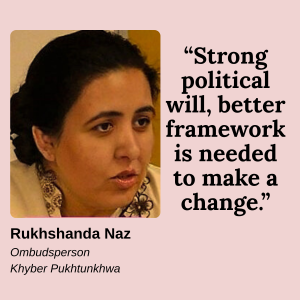
“Legislative measures and amendments cannot be effective unless our infrastructure on the ground is properly in place,” she said while speaking to Voicepk. “Duty bearers must not only be fully aware but also sensitized about these amendments. While our judiciary and police departments have undergone training, this needs to be implemented extensively because patriarchal values and the notion of ‘honour’ are deeply rooted in our society. Laws must act as a deterrent and be enforced at all levels. Alongside this, the mindset of society must change, whether through curriculum reforms or training programs,” she said.
Commenting on the Deghari case, Naz added that many social media influencers attempted to justify the woman’s killing, reflecting dangerous societal attitudes.
“In Pakistan, we treat ‘honour’ as an individual issue where one can take the law into their own hands. Even when such cases fall under the law, the process is so slow and delayed that it loses its meaning. The mere existence of laws is not enough, strong political will is needed for their implementation,” she stressed.
‘Community engagement is key’
Arfanah Mallah, leading rights activist and academic, based in Sindh, also highlighted the shortcomings in addressing these crimes, stating that while legislation was an important step, it has not translated into reduced violence.
“There has been an overemphasis on legislation. We assume that if laws exist, they will automatically fix societal issues, but that is not the case,” she says. “Honour’ crimes have existed for centuries, and initially, society did not even consider them crimes – rather they were seen as traditions. Much like harassment, it took time to redefine these acts as crimes,” Mallah explained.
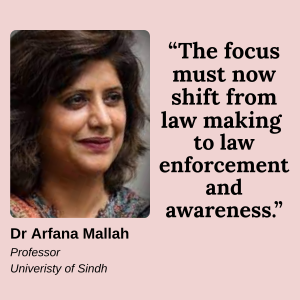
“Our institutions have frameworks, but there is no effective implementation. Despite laws, there has been no decrease in such crimes, only an increase in reporting. Institutional commitments, women’s safety bodies, and protective frameworks have not achieved their intended outcomes because they are not coupled with active community engagement,” she said.
Mallah urged the use of textbooks, social media, and mass communication tools like radio to reshape societal perceptions of ‘honour.’
“Just as we receive alerts for weather warnings, we should openly address ‘honour’-related issues through media and awareness campaigns. The government and civil society must work together to spread the message that these are crimes and are punishable. Policies need clarity, and their implementation is crucial. Civil society organizations also need to be strengthened to address extremism and change mindsets,” she said.
‘Honour crimes: a backlash against women’s empowerment’
Maliha Zia, human rights lawyer and Associate Director at the Karachi-based Legal Aid Society (LAS), pointed out that the persistence of ‘honour’ crimes is deeply tied to cultural norms, economic factors, and societal backlash against women’s empowerment.
“It keeps going back to ‘culture’, a lot,” she said. “Laws can only set a standard for the country, and they have indeed impacted the public narrative on honour killings. It has been 21 years since the first law on honour killings. Back then, there was far more impunity, both public and national, and an accepted tolerance for these crimes. That has changed; today, it is no longer publicly acceptable to openly support honour killings. However, the cultural practice continues, and we are seeing an increasing trend in recent years,” she said.
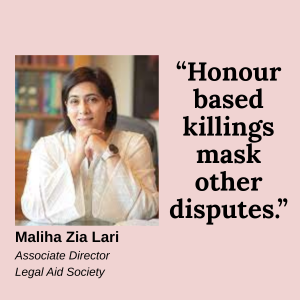
“Honour crimes are closely related to poverty as well. Even civil or property disputes have been disguised as honour based killings to seek lesser punishments or settle scores. Few have really delved into the true motives behind these cases,” she explained.
According to Zia, the current economic crisis and women’s growing resistance to patriarchal norms are fueling this violence.
“Given the economic hardships of most of the Pakistani population, I would not be surprised if these cases have risen. There is also a clear backlash against women’s empowerment. We are seeing women challenge the status quo, choose their own marriages, and leave abusive households. Historically, whenever women, or any marginalized group, rise up, the backlash tends to be violent,” she added.
Zia stressed that the laws themselves do not need major changes but require serious enforcement supported by strong investigations and evidence collection.
“The laws do not need to be changed; they need to be implemented properly. Evidence is critical. For example, the law clearly allows police to be the complainant and file FIRs themselves, yet this is rarely done. In cases like the one in Balochistan, where there is video evidence, there is no justification for inaction,” she emphasized.
She also called for dismantling illegal parallel systems that perpetuate impunity.
“Jirgas and panchayats, often run by influential people, play a major role in enabling these crimes. Strict action is required against these structures. While the laws address response, we need preventive measures, community-level awareness, early-stage interventions, integrating these issues into school curricula, and establishing emergency services to prevent crimes,” Zia concluded.
“Patriarchy still rules over justice”
Human rights defender Hameeda Noor told Voicepk that the persistence of honour-killings reflects a justice system captured by patriarchal norms.
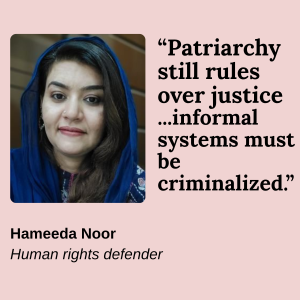
“Despite legal reforms, honour killings continue across Pakistan because patriarchy still rules over justice. From tribal customs to courtrooms, women’s lives are devalued in the name of ‘honour.’ Laws exist, but implementation is weak, police stay silent, medical and legal evidence is weakened, and society protects the killers. Until we challenge the mindset and hold the system accountable, justice will remain out of reach for countless women,” Noor said.
Hameeda Noor pointed out that while the 2016 amendment closed some legal loopholes—such as preventing full forgiveness by a victim’s family, judges can still grant lesser punishments under qisas and diyat if there is doubt about the intention of honour.
“There is no clear legal definition of ‘honour crime,’ which allows manipulation of interpretations. Cultural acceptance of honour as tied to women’s behavior remains strong, especially in tribal, feudal, and rural settings. Police often treat these killings as family matters, discouraging proper reporting and investigation. Judicial leniency, weak prosecution, and lack of protection for complainants and witnesses allow many offenders to escape justice or receive light sentences,” she explained.
Noor called for bold systemic action, including police reform, gender sensitization, and fast-track courts for honour crime cases.
“Informal justice systems like jirgas must be criminalized, and victims’ families must receive state protection and legal aid. Most importantly, nationwide awareness campaigns are needed to dismantle the mindset that normalizes violence in the name of ‘honour,’” she urged.
Noor highlighted another hidden atrocity often ignored by laws, that is, of a woman who is declared kari (dishonourable), even if her life is spared.
“The law must recognize the plight of women declared kari but left alive: they are not spared, but socially buried,” she said. “These women are denied identity, stripped of rights, and often sold like property in the name of honour. This is not just violence; it is gendered slavery. We demand urgent legal recognition, criminalization of such practices, and protection for every woman condemned without a crime. ‘Honour’ is the excuse, but money is the motive.”
These testimonies collectively underline that honour killings are not merely a legal issue but a cultural, social, and institutional crisis. Experts agree that ending this cycle of violence requires strict enforcement of laws, dismantling of parallel justice systems, societal mindset change, and comprehensive preventive measures to protect women’s rights and lives in Pakistan.