

January 31, 2025
By Rana Malhi
ISLAMABAD
The Supreme Court’s Constitutional Bench continued hearings on Friday regarding appeals against the military trials of civilians, with Justice Musarrat Hilali seeking clarity on the distinction between the 2014 Army Public School (APS) attack and the May 9 protests.
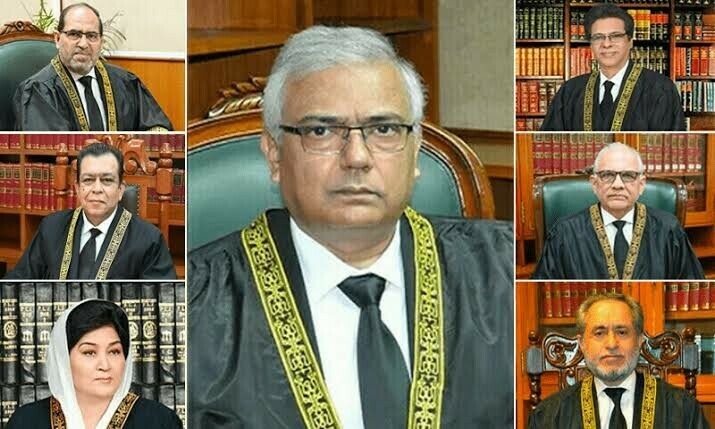
A seven-member bench, headed by Justice Aminuddin Khan, reviewed intra-court appeals challenging the trial of civilians in military courts. During proceedings, Khawaja Ahmed Hussain, counsel for former Supreme Court Justice Jawad S. Khawaja, argued that trying civilians in military courts undermines fundamental rights under Article 8(3)(a) of the Constitution. He clarified that his challenge focused solely on the Army Act’s application to civilians, not the legislation itself, and cited Justice Muneeb Akhtar’s prior ruling deeming such trials unconstitutional.
Justice Hilali, however, countered, “We were convinced yesterday that a military trial is a fair trial,” prompting Justice Hassan Azhar Rizvi to question whether civilians could legally fall under military jurisdiction under Section 2(1)(d)(1) of the Army Act.
Drawing a contrast between the APS attack and the May 9 protests, Justice Hilali noted, “The APS attack was an act of terrorism, whereas May 9 was a protest. What differentiates the civilians involved?” Hussain responded that the 2014 APS massacre prompted the 21st Constitutional Amendment, which authorized military trials for terrorism-related offenses. “May 9 protesters should face trial, but not in military courts,” he asserted. Justice Khan acknowledged the court’s authority to review legislation conflicting with constitutional principles.
When Justice Hilali emphasized that APS victims were civilians, Hussain distinguished the contexts: “December 16 [APS attack] involved terrorism necessitating legal amendments. May 9 accused are protesters, not terrorists.”
Debating judicial trust, Justice Hilali asked, “Why do we not trust civilian courts? They are also constituted under the law.” Hussain countered, “How can an aggrieved party ensure a fair trial?”
The court also referenced the Kulbhushan Jadhav case, with Justice Khan cautioning that invalidating Section 2(1)(d)(1) could jeopardize future trials of spies. Hussain argued such cases belong in anti-terrorism courts, eliciting a wry response from Justice Rizvi: “So future spies should also face anti-terrorism courts?”
Hussain further critiqued procedural fairness, citing the ISPR’s May 15 statement on the May 9 events as preemptive bias. “How can trials proceed impartially after the Corps Commanders’ meeting?” he asked, adding that defendants in military courts lack the right to choose counsel without the Army Chief’s approval.
Justice Hilali questioned whether Hussain’s arguments represented absent defendants, while Justice Jamal Khan Mandokhel referenced the FB Ali case to affirm existing legal provisions.
The bench also debated evidentiary challenges, with Justice Mandokhel stressing, “The administration must collect evidence to combat terrorism. Without it, how can courts decide?” Justice Rizvi noted delays in civilian trials, citing murder cases adjourned “25 times.”
Questioning the efficacy of the 21st Amendment, Justice Mandokhel asked, “Did it serve its purpose?” The hearing was adjourned until Monday, with Hussain granted leave to resume arguments. The court emphasized a thorough review to ensure a “constitutional and legal resolution”.