

Sept 13, 2024
Staff Report
LAHORE:
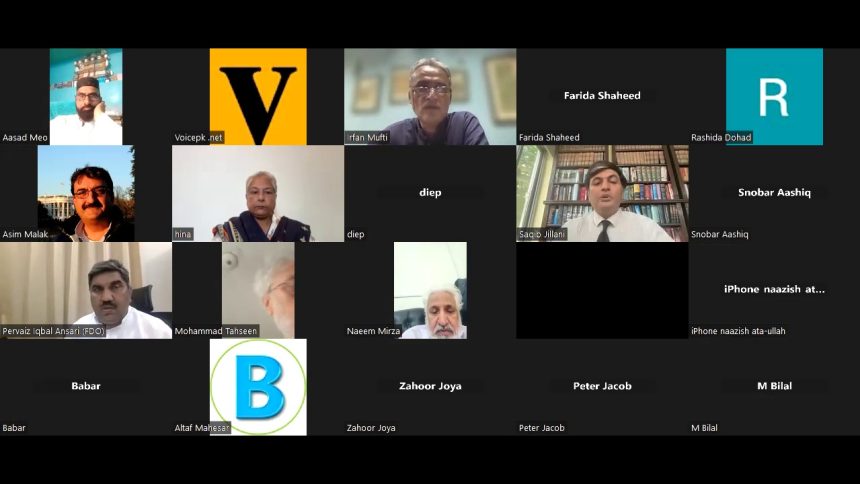
The Human Rights Commission of Pakistan (HRCP) and the Joint Action Committee for People’s Rights held a webinar on Friday, Sept 13, to welcome the decision of the Lahore High Court (LHC) to invalidate the 2022 policy introduced by the federal government for regulating foreign funding to non-governmental and non-profit organisations.
On September 6, the LHC overturned the federal government’s policy on foreign funding for local NGOs, ruling in favour of the petition filed by the HRCP.
Addressing the webinar, Hina Jilani, former chairperson of HRCP, and Saqib Jilani, a human rights lawyer, discussed the implications of the LHC decision. Human rights activists from various organisations also attended the discussion.
Saqib Jilani said that the main issue with the 2022 policy introduced by the government to regulate NGO funding was the lack of legal foundation – “The federal cabinet lacks the executive authority to regulate or impose restrictions on non-governmental and non-profit organizations without prior legislation from the parliament.”
He added that the LHC decision supports the HRCP stance.
Hina Jilani pointed out that earlier in 2013, a failed attempt to regulate organizations receiving foreign funds through a policy approved by the Economic Coordination Committee of the Cabinet failed. But, she said, “the policy was struck down by the courts”.
“Our fight is not over yet,” said Hina Jilani. “The government may challenge this court decision or enact new legislation in the future to obstruct the activities of human rights organisations. Such actions could lead to severe repercussions, including sanctions.”
During the webinar, participants had the opportunity to engage with the speakers by asking questions about the court’s decision and delve deeper into the implications of the ruling and discuss potential future challenges that human rights organizations might face.
What LHC order underscores
On September 6, the Lahore High Court overturned the federal government’s 2022 policy on foreign funding for NGOs, ruling it unlawful and invalid. Justice Asim Hafeez declared the policy unconstitutional, maintain that it lacked legislative authorisation and constituted an abuse of executive power.
Approved by the federal cabinet in November 2022, the policy required that only a senior officer from the Ministry of Economic Affairs could approve MOU requests and that security agencies grant clearance before any MOU could be signed. The court found that this policy infringed on constitutional rights under Article 18, which guarantees freedom of trade and business.
The judgment noted that the federal cabinet’s actions lacked legal sanction and that such policies must be enacted through legislative authority. The court also criticised the involvement of security agencies in scrutinising NGOs as unlawful and an unwarranted intrusion into fundamental rights.
The court emphasised that the executive must adhere to legal and legislative frameworks when regulating such matters and cannot impose restrictions without proper legislative backing.