8 August , 2024
By: Rana Malhi
ISLAMABAD
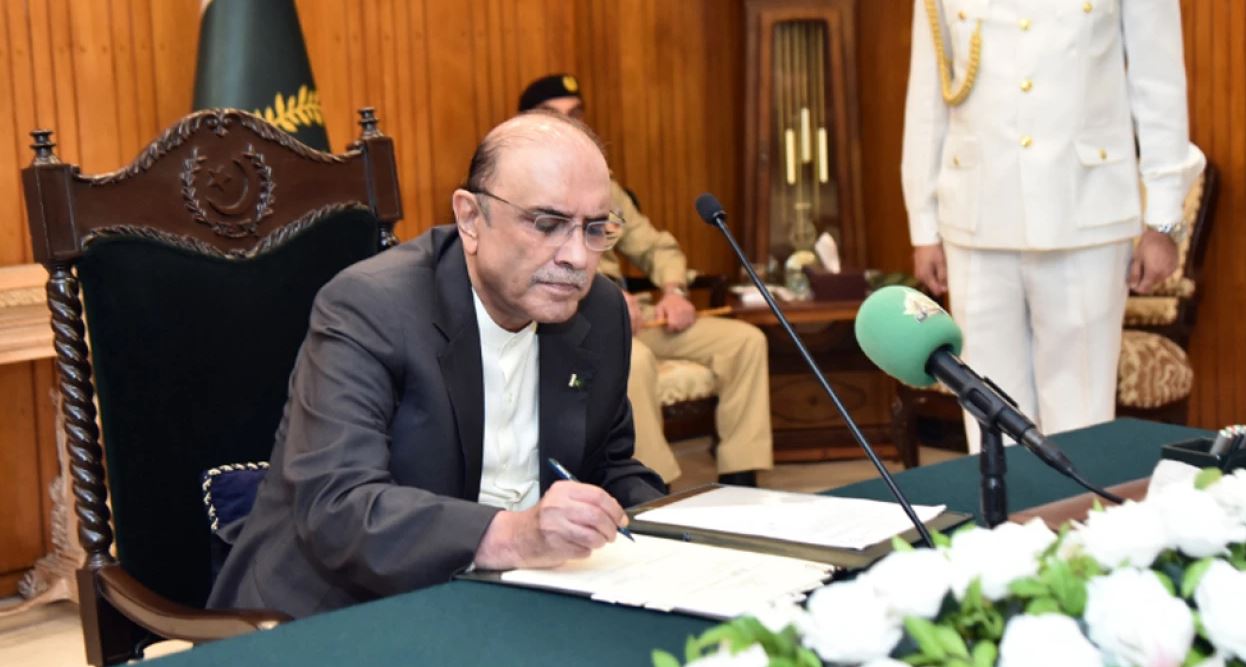
President Asif Ali Zardari has signed the Election Act Amendment Bill 2024, following its approval by both the National Assembly and Senate.
The National Assembly passed the bill on Tuesday, August 6, with a majority vote, despite strong opposition protests. The session was chaired by Speaker Ayaz Sadiq, where the bill was presented and discussed clause by clause. After receiving Senate approval, the bill was sent to the President for his signature.
Members of the Pakistan Tehreek-e-Insaf (PTI) protested in the house against the presentation of the amendment bill, raising slogans and tearing copies of the agenda.
PTI leader Muhammad Ali Khan condemned the bill, calling it unconstitutional and demanding it be sent to a committee for further discussion.
Opposition member Sibghatullah also voiced his discontent in the assembly, stating that the opposition’s consent was not sought, calling it a violation of the constitution. He argued that the bill was passed due to the numerical superiority of the ruling party – “It was designed to obstruct the implementation of a Supreme Court decision.”
On Tuesday, PTI Chairman Barrister Gauhar Ali Khan announced that his party would challenge the amendments in the Supreme Court. He accused the government of conspiring to take away PTI’s electoral symbol and undermine their chances in the upcoming elections.
The PTI has already filed a petition under Article 184/3 in the Supreme Court through Advocate Salman Akram Raja, making the Federation and the Election Commission of Pakistan (ECP) respondents.
What is the Election Act Amendment Bill 2024?
The amendments to the Election Act 2017 were introduced following the Supreme Court’s decision on reserved seats issued on July 12, which directed the ECP to allocate reserved seats to the PTI.
The first amendment stipulates that a member of the assembly cannot change their party affiliation certificate to another political party. The second amendment requires that parties submit a list of candidates for reserved seats for women and minorities on time.
The first amendment is introduced in Section 66 of the Election Act, 2017, while the second amendment is added to Section 104. Both amendments will come into force immediately following approval.