

March 24, 2024
By Xari Jalil
LAHORE
A Lahore Sessions’ court on Thursday, sentenced a woman to life imprisonment on charges filed under 295-B of the Pakistan Penal Code (Defiling of the Holy Quran). The 40 year old woman is a resident of Bedian Road area and has denied the charge.
According to details, the case originated in 2021 when Hayer area police filed an FIR against the woman under Section 295-B of PPC.
The defense counsel vigorously challenged the case, arguing that it was fake, lacking any concrete evidence. He said that the woman had been accused of burning pages of the Holy Quran, by residents of the area, but questioned why it was the police that had filed the FIR not the person or persons who had accused her. There were also glaring contradictions and inconsistencies in the statements of the prosecution’s witnesses.
The defense had also hinted at the possibility of the woman suffering from mental health issues at the time of the alleged incident. However, Judge Imran Sheikh, who was presiding over the case, noted that this point was not forcefully presented during the trial, and ultimately sided with the prosecution.
While the investigating officer did present the accused before a judicial magistrate after her arrest, and an application for a medical examination was submitted, the judge highlighted that the magistrate’s order stated the woman refused the examination and appeared to be responding rationally to questions. Furthermore, the defense itself never formally presented a plea based on the woman’s mental health during the trial.
The prosecution countered these arguments, asserting they had caught the woman ‘red-handed burning a copy of the Quran’, insisting that the evidence was irrefutable, and proved the charges against the accused beyond doubt.
The judge concluded that the prosecution had successfully established a strong case, fulfilling all the requirements of Section 295-B PPC related to the act of burning a Quran.
Accusations Run Rampant
In March 2024, a Gujrat court sentenced two students – a 22-year-old who was given a life sentence, and a 17-year-old who was given life imprisonment (on account of being a minor) having been convicted of sharing blasphemous media on Whatsapp. Both denied the charges.
Blasphemy accusations have been rolling out fast during 2024, including against even authorities.
In February 2024, a court overturned the blasphemy charges against two brothers in the Jaranwala case, offering a glimmer of hope. But in the same month, the situation became volatile when the release of an Ahmadi man accused on blasphemy charges, led to accusations against the Chief Justice himself.
Hundreds of radical elements spearheaded by the Tehreek-e-Labbaik Pakistan (TLP) took to the streets in parts of Pukhtunkhwa.
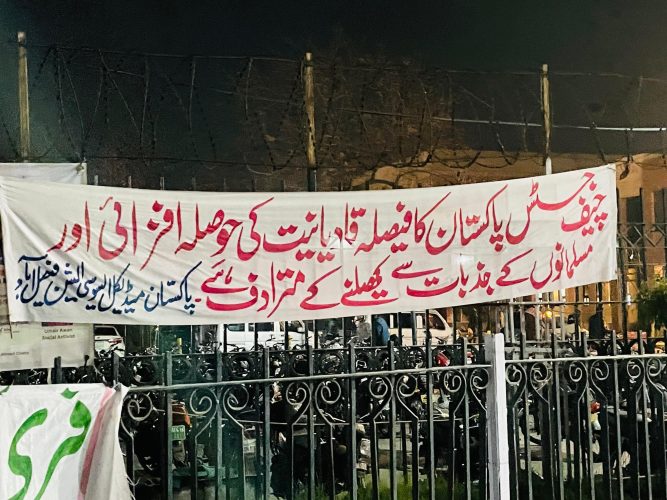
Incidents followed where Ahmadi places of worship were demolished in Karachi and in Kotli (AJK). In Kotli, in two separate incidents, graves belonging to the Ahmadi community were destroyed. In Faisalabad, a campaign continues to run outside one of the biggest hospitals the Allied Hospital where the CJP is condemned for releasing a blasphemy accused. In Hasilpur (District Bahawalpur), a local Ahmadi leader was shot dead by unknown assailants.
Courts and lawyers have usually remained reluctant and wary of taking on blasphemy cases. When they do, they give harsh sentences to avoid being harassed by right wing elements. This ends with the accused imprisoned for years without a trial, sometimes on death row. Junaid Hafeez was arrested in 2013 and convicted in 2019. Today, like all other death row inmates, he is said to be suffering from mental health issues.
It was a rare occurrence that in March 2024, a district court in Dera Ismail Khan sentenced to death two of the murderers of a blasphemy accused woman, while a third was given life imprisonment. All three of the murderers were also women. The incident had occurred in 2022.
Fewer Women Accused
Fewer women than men are accused of blasphemy.
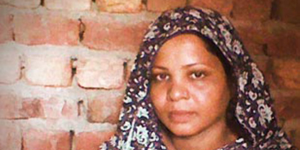
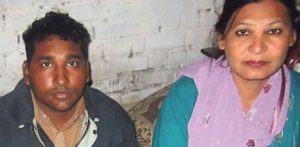
Yet there have been cases where women have also languished in prison for years, such as Asiya Bibi, and more recently Shagufta Masih (who was released after seven years along with her husband Shafqat Emmanuel.)
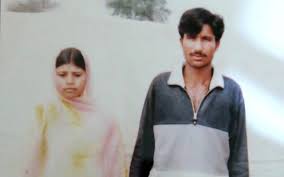
Aneeqa Atiq, a 26-year-old, remains on death row in Rawalpindi district. Atiq was sentenced to death in January 2022 for allegedly sharing blasphemous material on WhatsApp. (Shama and Shahzad’s horrific case in 2014 too, where the couple was burnt alive by a mob at a brick kiln after being accused of blasphemy.)
Most of the mob violence too that has occurred has resulted in men as being targets – from the mentally unstable 41 year old Mushtaq Ahmad of Mian Chunnu (accused of burning the Holy Quran, stoned to death and hung from a tree, to the Priyantha Kumara, a Sri Lankan factory manager in Sialkot, who was beaten to death by the factory employees who then set his body on fire.
Therefore it was disturbing and shocking to see how a woman in Lahore’s Ichhra market, who had only gone out to shop, was accused of blasphemy only for wearing a dress with a mundane Arabic word printed on it. Videos of the woman showed the horror on her face, seeing an angry crowd around her, ready to do whatever it took to ‘teach her a lesson’.
Personal Vendettas
The Human Rights Watch has noted – along with several other cases that have been in and out of court – that much of the time, blasphemy accusers are anything but religiously motivated. Its 2023 world report says that dozens of people remain on death row. ‘Since 1990, at least 65 people have reportedly been killed in Pakistan over claims of blasphemy’. Blasphemy laws have been misused and abused especially in personal arguments and disputes.
International rights groups like HRW prompted by human rights laws and treaties that Pakistan has signed and ratified push for Pakistan to repeal the Blasphemy laws but it hangs in the air. But the situation may have worsened with PECA (Prevention of Electronic Crimes Act 2016) with more people being accused of blasphemy on social media.