

March 1, 2024
By Xari Jalil
LAHORE
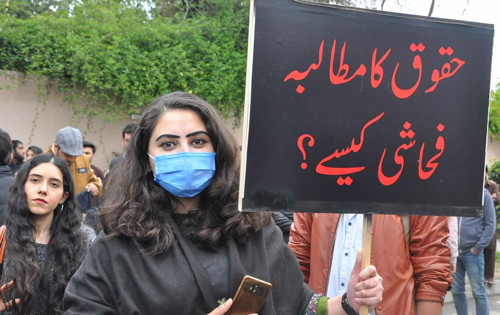
Organizers of Aurat March Lahore are waiting and hoping for a court order in response to a petition filed in the Lahore High Court on February 29 against Aurat March taking place on March 8, in commemoration of International Women’s Day.
In the petition Azam Ali Butt vs Government of Punjab, there is an attempt to explain that there are enough women-centric laws, provisions and policies in the country’s legal framework, not to mention in Islam, because of which women’s rights are protected.
The document spells out each of these laws and policies. Afterwards, it goes on to criticize the Aurat March saying that the march is a ‘Western attempt’ to destroy the ‘fabric of society’ by passing ‘profanely indecent comments’ that social media spreads without filtration. the document also mentions how there have been clashes between women of the Aurat March in Islamabad and the members of the Haya March organized by the women’s wing of the Jamaata-e-Islami, creating a ‘public order issue’, while according to Section 144, there are ample grounds to stop such an event or activity which can create public order or security issues.
“It is humbly prayed that this writ petition may be accepted and following the current security scenario, threat alerts, and law and order situation, and in light of activities like controversial cards and banners, and the strong reservation of the general public and religious organizations, the respondent may graciously be directed to take an immediate action to maintain public order and stop the organizers from holding Aurat March and take stern action against those who publish circulate and display obscene literature,” it says.
A source from within the Aurat March organizing committee told Voicepk that they were sitting tight for the court order to come out. It is expected on Saturday, and they hope that it will be a positive order.
“On the whole, we would not even pay attention to this kind of thing,” said one committee member. “We would prefer to ignore such petitions when it came to giving comments over them so as not to inflate their importance.”
Such petitions and complaints have been taking place ever since the second Aurat March in 2019 went viral, because of its flamboyance and spontaneity, but even more so for its bold slogans the most prominent of which ‘Mera Jism Meri Marzi‘ could not be digested by most.
2020
By the following year when it was time for the next Aurat March, they were ready with their petitions. The first such petition came in 2020.
The civil miscellaneous application was filed by Munir Ahmed and supreme court advocate Muhammad Azhar Siddique. Siddique – a serial petitioner’ himself – was also the lawyer for the case. The petition tried to prove that Aurat March was nothing other than ‘vulgar signs with an anti-men, anti-state, and anti-Islam’ rhetoric.
Siddique added in his claims that the march was “against the very norms of Islam” and that its hidden agenda is to spread “anarchy, vulgarity and hatred”. He had requested the court to “silence the advertisement of Aurat March on social media and to regulate protests such as the Aurat March”.
However, LHC judge Mamoon Rasheed Sheikh had said that there could be no ban imposed on freedom of expression.
Earlier the LHC had issued notices to the federal and provincial governments on an application seeking a permanent ban on the upcoming Aurat March. Meanwhile the other side was being fought in court by human rights advocates Hina Jillani and Saquib Jilani.
2021
By 2021, the cases against Aurat March had become more vicious. This time there were dangerous charges of blasphemy levelled against the organizers. Sources say that videos of the slogans being chanted by women activists were edited out to sound anti-Islamic and blasphemous when in actuality it was something else that was being chanted.
But feminists did not back down and vowed to fight these charges.
The petitioner, Nasir Minhas, a lawyer affiliated with the Tehreek-e-Labbaik party (TLP) known for their use of blasphemy accusations, announced plans to appeal a high court rejection of his petition against the Aurat March to the supreme court.
Minhas claimed the march involved “objectionable, anti-Pakistan, and anti-Islamic slogans and symbolic banners insulting the Prophet.” However, it’s important to note that this wasn’t the only attempt to halt the march. Nearly a month prior, police in Peshawar booked organizers and participants of the Islamabad event based on blasphemy charges, following a local court’s order. Despite this, no immediate arrests were made.
The FIR, which was registered at the East Cantonment police station, was filed under sections 295-A and C of the Pakistan Penal Code, which deals with ‘malicious acts intended to outrage religious feelings of any class by insulting its religion and use of derogatory remarks in respect of Holy Prophet Mohammad (PBUH)’.
It was filed by Ibrar Hussain and five other lawyers who had filed a petition with the court of additional district and sessions judge Syed Shaukat Ali Shah seeking the registration of a case against Aurat March organisers and participants in Islamabad under Section 22-A of the Code of Criminal Procedure over alleged blasphemy.
The court heard the petition on March 24 and ordered East Cant police station officials to register the FIR against organisers of the Aurat March, an annual protest marking International Women’s Day on March 8 in several cities of Pakistan.
The organisers had already filed a petition with the Peshawar High Court against the order of the additional district judge on multiple grounds, saying that no objectionable incident occurred during their event in Islamabad. They also wondered how an FIR could be registered in Peshawar for an event that occurred in Islamabad. Later, a committee headed by Senior Superintendent of Police Investigation was formed to investigate all aspects of the case. According to a statement by the Peshawar police, since the event under investigation took place in Islamabad and has no ties to Peshawar, the committee will decide whether it can investigate an incident which took place outside its jurisdiction.
In yet another case, during the same time frame, a sessions court in Lahore on April 14 dismissed a petition seeking an order for police to register a case against Tooba Syed and Marvi Sirmed, as well as over 200 unidentified participants of the Aurat March in Islamabad.
Petitioner Khalid Mehmood filed the petition under Section 22-A and 22-B, alleging that the Ravi Road police station house officer refused to lodge a FIR on his application. The petitioner alleged that the participants in the march displayed objectionable slogans, and also committed other criminal offences.
In his decision, Additional District & Sessions Judge Hafiz Rizwan Aziz brought up Article 19 of the Constitution which pertains to freedom of expression. He also cited a ruling by the Islamabad High Court that said nothing in the event was sacrilegious or against Islamic injunctions, and that the occasion of International Women’s Day should be commemorated.
The Khyber Pakhtunkhwa Bar Council had also passed two resolutions in its meeting on March 15, calling upon the government to take action against the organisers and different NGOs which had organised Aurat March in different cities.
In Lahore there were also allegations of the French flag being hoisted in the march.
2023
In 2023, a writ petition was filed in the Lahore High Court on Saturday (LHC) challenging an order of the deputy commissioner (DC) of Lahore, Rafia Haider, in which she declined to give permission for the Aurat March in the provincial capital on March 8 2023. This time it was the organizers that had filed the petition, with respondents being deputy commissioner Lahore, the government of Punjab (through its chief secretary), and capital city police officer (CCPO) Lahore.
The Aurat March organising committee had requested an NOC from the district administration to hold a rally on March 8 at Nasser Bagh followed by a march around the perimeter of the park.
DC Rafia Haider had rejected the permission to organise the Aurat March on the grounds of security concerns, ‘controversial’ cards and banners supporting women’s rights, and the likelihood of clashes with members of JI’s ‘Haya March’.
The petitioners challenged the commissioner’s order in court, arguing that it was “arbitrary and colourable,” meaning it lacked a legitimate basis and was issued improperly, and that it violated their fundamental rights enshrined in the Constitution of the Islamic Republic of Pakistan. The petition specifically requested that the court strike down the order, as it infringed upon their rights to assembly, free speech, non-discrimination, and equal treatment under the law, as guaranteed by Articles 15, 16, 17, 19, and 25 of the Constitution, respectively.
Advocate Asad Jamal and Lahore High Court Bar Association Secretary Sabahat Rizvi appeared on behalf of the petitioners.
In the same year, the Sindh High Court (SHC) too dismissed a petition aimed at prohibiting the Aurat March in Karachi.
Petitioner, Bisma Noreen (also known as Ameer Jahan), argued that the Aurat March should be banned due to the allegedly “unacceptable” nature of slogans chanted by participants. But upon reviewing the petition, the court found no basis for objection to the mentioned slogans.
Additionally, the court emphasized the fundamental right to freedom of movement guaranteed by the Pakistani Constitution for all citizens.
Impact
The blasphemy allegations may have been tossed out of court, but their impact has been negative. For Saira* a loss of agency and expression was the biggest result.
“These petitions, on frivolous grounds, are a hindrance to our right to protest and assembly, seek to deny us our Constitutionally guaranteed right, and legitimise propaganda against the march based on misinformation,” she said. “It is important for us to hold our ground and fight against these allegations because this is not just a matter of gender rights, but rather one that concerns all our civic freedoms.”