

October 20, 2026
By Hashir Ahsan
ISLAMABAD:
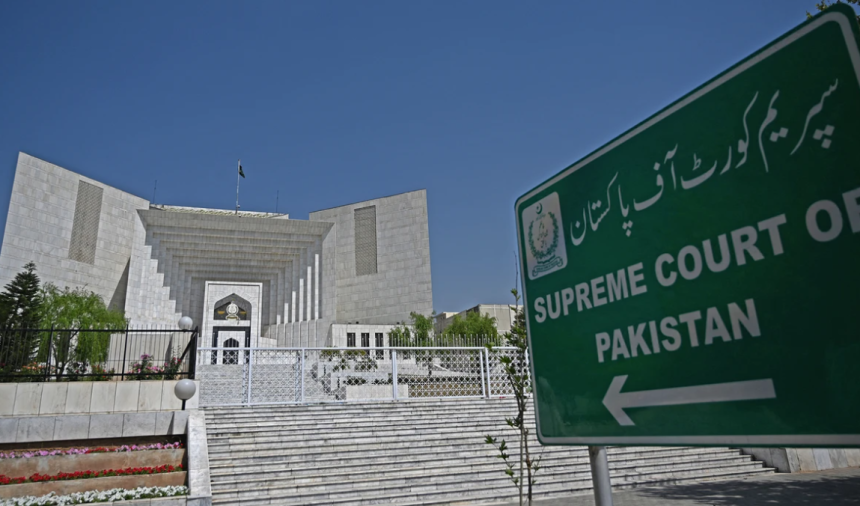
The Supreme Court of Pakistan has maintained an earlier decision taken by the Lahore High Court to commute the death sentence of the main accused, Muhammad Azhar, to life imprisonment in the 2017 murder case of Sakhiyan Bibi in Minchinabad, dismissing both the accused’s appeal and the complainant’s petition seeking an enhancement of the sentence.
A three-member bench comprising Justice Muhammad Hashim Khan Kakar, Justice Salahuddin Panhwar, and Justice Ishtiaq Ibrahim heard the case, while the detailed judgment was authored by Justice Ishtiaq Ibrahim.
In its decision, the Supreme Court declared the eyewitness testimonies provided by the prosecution, (including the deceased’s son Muhammad Shehzad and brother-in-law Muhammad Ashraf) to be completely trustworthy and truthful.
The apex court clarified that since the incident occurred in broad daylight and inside a residential house, the presence of family members at the scene was entirely natural and normal.
Although both witnesses are close relatives of the deceased, their credible testimonies cannot be rejected merely on the grounds of relationship, as close relatives are the primary witnesses in domestic incidents.
The court further stated that a civil litigation was already ongoing between the two families, due to which the accused was already well known to the witnesses, thereby leaving no possibility of mistaken identity or nominating someone else in his place.
According to the witnesses, firing was conducted from a distance of 5 to 6 feet, which is also verified by the post-mortem report and the statement of the medical witness mentioning the presence of burn and charring marks around the wounds.
The court set forth an important legal and human principle while conducting a detailed evaluation of the minor discrepancy between the eyewitness testimonies and the medical report regarding the number of wounds. The complainant and witnesses had stated that five shots were fired and struck specific body parts, whereas according to the post-mortem report and the doctor’s statement, seven entry wounds were found on the body.
On the difference of two wounds, the Supreme Court held that criminal life and human behavior cannot be confined to any mathematical formula or uniform scale.
The bench said that when a mother is killed in front of her son the human mind cannot function like a high-speed camera in such a terrifying and anxious condition, and expecting exact and mathematical counting of fired bullets from a witness is unnatural and impossible.
The Supreme Court bench remarked that if the witness’s intention had been to fabricate a story, he would have aligned his statement exactly with the medical report; however, this minor difference in his statement is clear proof of his truthfulness and honesty that he reported only what he experienced in those terrifying few seconds.
A grief-stricken son cannot be bound to physically inspect the body and count the wounds before informing the police; therefore, when uniformity exists in the foundation, a minor discrepancy does not affect the truthfulness of the testimony, said the bench.
Explaining the principles of criminal justice, the Supreme Court stated that every case must be decided in the light of its own specific facts and evidence, and a single formula cannot be applied to all events, because every individual’s reaction and behavior in response to mental trauma varies according to their psychological strength and life experiences. While precedents can be established on points of law, matters based purely on facts are evaluated solely on the distinct nature of each case.
In addition, the court expressed severe concern and reservations over the trend in the judicial system where witnesses detail the trajectory of a bullet leaving a gun and microscopic details of hits on the body.
The judgment stated that in an atmosphere of fear and severe stress, it is a physical and sensory impossibility for the human eye to track a fast-moving bullet through the air and observe which bullet enters which part of the body. If there were a single shot, an estimate might perhaps be made to some extent from the attacker’s body language, but when continuous bullets are showered within a few seconds, it is impossible for a witness to count and state.
Referring to the famous scientific research “Weapon Focus Effect” by renowned psychologist Elizabeth Loftus, the apex court explained that when a lethal weapon is suddenly brandished in front of a person, all their attention and cognitive capacity involuntarily become focused solely on that weapon. Due to this psychological state, termed “attensional tunneling,” the witness’s capacity to recall surrounding details becomes severely limited, making it impossible for the human eye to track a bullet traveling in thousandths of a second.
The Supreme Court strongly discouraged the practice of presenting artificial and overly detailed fabricated evidence in courts, instructing that witness statements should conform to natural human observation. For all these reasons, the Supreme Court declared the Lahore High Court’s decision to be correct and lawful, dismissed the appeals of both the accused and the complainant, and held the High Court’s reasons for commuting the death sentence to life imprisonment to be reasonable.
The incident took place on January 11, 2017, within the limits of Minchinabad Police Station, Bahawalnagar District, at 01:45 PM in the afternoon, while complainant Muhammad Shehzad was present at home with his sister Sadia Azam and mother Sakhiyan Bibi.
Meanwhile, accused Muhammad Azhar, riding a motorcycle and armed with a .30 bore pistol, forcibly entered the house and inquired about the complainant’s maternal uncle Muhammad Riaz, to which the deceased replied that Riaz had gone to Liaquatpur.
Infuriated by this answer, the accused hurled abuses at the deceased, issued dire consequences threats, and exerted pressure regarding the ongoing civil litigation dispute; when the deceased restrained him from abusing, the accused fired 5 continuous shots at her from extremely close range, hitting the deceased in her chest, abdomen, and right arm, as a result of which she died on the spot, whereas upon hearing the sound of firing, Muhammad Ashraf and Muhammad Nadeem also reached the spot, but the accused brandished his weapon and escaped on the motorcycle.
The Additional Sessions Judge Minchinabad had sentenced the accused Muhammad Azhar to death under Section 302(b) of the Pakistan Penal Code along with a fine of Rs 200,000 on February 28, 2018, while co-accused Muhammad Abbas was acquitted; later, the Lahore High Court Bahawalpur Bench, while deciding the appeal, commuted the death sentence to life imprisonment.