

August 7, 2026
By Xari Jalil
LAHORE
Eighty eight (88) accused individuals, who were arrested on July 31, have been sent into judicial remand, according to a court order released on Friday, August 7.
The 88 accused persons included three sisters, Safiya Alam, Azra Alam, and Naseem Alam. Azra Alam is a journalist with the Samaa TV channel. According to reports, the father of the sisters is in Kashmir and could not be traced.
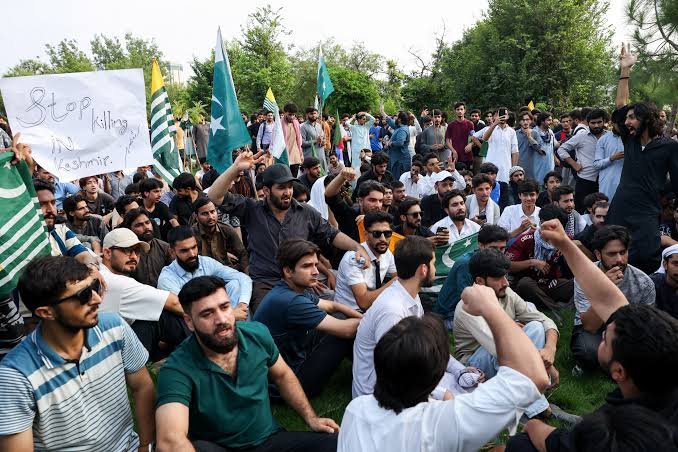
The 88 individuals were arrested in connection with a demonstration held in Islamabad’s F10 Markaz in support of protesters in Kashmir last week, as per FIR quoted in the court order.
The case was registered under FIR No. 648/2026 at Shalimar Police Station, and were heard before the Special Court-I (Anti-Terrorism). The case was booked by the police for participating in the ‘unauthorized’ rally/protest, the sub inspector acting as complainant in the FIR. The case was booked under sections PPC 324, 395, 342, 341, 427/440, 506ii, 109, 188, 353, 186, 148, 149; Section 2/3 Peaceful Assembly and Public Order Act 2024; and Section 8 & 7ATA (Anti-Terrorism Act).
The FIR states that the rally was announced on July 29, via social media by Mushtaq Ahmad Khan, along with Danial, Waseem, Muhammad Abdullah, Waseem, Muhammad Abdullah, Usman, Usman, Faisal Qayyum, Sardar Munsif, Bilal Rabbani, Waseem, Arslan Kiyani, Aziz, Tufail, Sardar Munsif, Malik Aslam Khan, Akhunzada Hussain Yousafzai, Ahmed Abdullah, and others.
“Under their leadership/supervision, approximately 400 to 500 protestors (men and women) gathered in Sector F-10 Centre at around 5:00 PM. Mushtaq Ahmad Khan, using a loudspeaker, delivered provocative speeches to the crowd, inciting them against the government and state institutions,” reads the FIR, a copy of which is with Voicepk. “At around 6:30 PM, Mushtaq Ahmad Khan, continuing his provocative speech, exhorted the mob to march towards Jinnah Avenue and block the road. When police force personnel tried to stop them from advancing, Mushtaq Ahmad Khan and other leaders incited the mob to break through police lines and march towards Jinnah Avenue.”
The FIR adds that the police repeatedly warned the crowd via loudspeaker that a ban under Section 144 was in place in Islamabad and that they lacked an NOC (No Objection Certificate) from the administration for any protest/assembly. However, according to the police, despite these warnings, Mushtaq Ahmad Khan and other leadership incited the protestors to resort to violence, stone-pelting, and direct confrontation.
“At approximately 07:10 PM, the mob blocked the main road. Present at the scene, media vehicles including two DSNG vehicles were damaged by the angry mob. The protestors attacked media personnel, damaged public and private vehicles, and threw stones at police personnel performing their duty.
When police force personnel moved forward to stop the violent protestors, the suspects attacked the officers. During the assault, police equipment/uniforms were damaged, and three officers (head constables) sustained injuries. The mob also broke into local shops and vandalized public and private property.
Mushtaq Ahmad Khan and other leaders violated Section 144, delivered anti-state and provocative speeches, incited violence, damaged public and media property, attacked police officials performing public duties, disrupted public peace, and created terror and fear among the public.”
After the arrests were made, Federal Minister for Parliamentary Affairs, Tariq Fazal Chaudhry had said in an interview with Voicepk, that he had ‘no knowledge’ of any such arrests made, and in fact the capital city was calm and under control.
At present the court has granted a 14-day judicial remand specifically to conduct an identification parade to verify each suspect’s role.
Arrests were also made in Lahore, from outside the Lahore Press Club, during a protest held in solidarity for Kashmir, but the individuals were later released.
Other arrests and detentions
Crackdowns on these protests have shocked the public, however similar arrests were made of journalists too.
Journalist Razi Tahir has been taken into custody again after police raided our office. According to the information we have received, police entered the office, seized computers and other equipment, sealed the office, and our editor was also allegedly assaulted.
Razi Tahir has…
— Harmeet Singh (@HarmeetSinghPk) August 1, 2026
Prior to these protests, on July 28, poet and activist Syed Farhad Ali Shah began a hunger strike after being detained for more than a month without charges, while initially it was also reported that two journalists Razi Tahir and Muhammad Saif were ‘unknown’ since police detained them on August 1. All three had covered the unrest. Later however the two journalists were presented in the ATC. Their names were included in the list of the 88 individuals who were arrested. The Committee to Protect Journalists (CPJ) has condemned the arrests.
Earlier their disappearance had worried their friends and colleagues.
Journalists Razi Tahir and Muhammad Saif remain missing after reportedly being taken by men in police uniforms on August 1. If they are in state custody, authorities must immediately acknowledge their whereabouts, ensure due process, and uphold their legal rights.
Kashmiri… pic.twitter.com/ofb4OvlWat
— Wassam Waheed (@wassamhaiwaheed) August 5, 2026
I strongly condemn the arrest of journalist @RaziTahirPak from district court today. #journalismisnotacrime @IFJGlobal @CPJAsia @RSF_en @mediadefence pic.twitter.com/mwMt4SvxCz
— Javeria Siddique (@javerias) June 23, 2026
Tahir and Saif are both independent journalists who published through Tahir’s own current affairs based social media channel called The Independent Lens.
CPJ notes that ‘before their disappearance, the journalists had reported on unrest in Pakistan-administered Kashmir, where authorities have suspended internet services and imposed severe restrictions on press freedom amid widespread protests by civil society groups, including the banned Jammu and Kashmir Joint Awami Action Committee (JAAC).’
“The two journalists were seized and taken to an undisclosed location on August 1, CPJ was told by a local journalist on condition of anonymity, in fear of repercussion,” said the CPJ statement. “The journalist said that the men who seized the pair were wearing police uniforms. However, police in Islamabad have not acknowledged the journalists’ detention and their whereabouts remain unknown.”
The CPJ has in general taken serious note of the various violations taking place in Pakistan of the basic freedom for expression and press, but especially in the light of media coverage in Kashmir. It also censured the newly constructed rules and called out the Pakistan government in trying to control reporting in Kashmir.
Urging the Pakistani authorities to withdraw the ‘draconian new guidelines requiring journalists working for international media outlets to obtain authorization before reporting outside Islamabad, Karachi, or Lahore’, the international watchdog for press freedom said in a statement that the new rules were most likely being made by the government to censor the coverage of unrest in the Kashmir region.
New guidelines for journalists in foreign meda
The guidelines require foreign journalists as well as Pakistani journalists who contribute to foreign media organizations, including social media and web-based platforms, to obtain a no-objection certificate (NOC) from the information ministry for “official assignments, especially for work outside Islamabad, Lahore and Karachi.
“The Foreign Media Facilitation Guidelines open the door for Pakistani authorities to further restrict international media coverage, prevent journalists from reporting freely outside Pakistan’s three main cities, and risk exposing them to administrative retaliation,” said CPJ Afghanistan and Pakistan Representative Waliullah Rahmani. “These guidelines mark yet another appalling blow to press freedom in Pakistan, where journalists are already facing an intense crackdown, particularly those reporting on unrest in Pakistan-administered Kashmir.”
The five-page guidelines were introduced days after the government criticized international reporting on elections and protests in Kashmir and accused Al Jazeera of engaging in “yellow journalism,” a term for sensational reporting. Access to Al Jazeera’s website has been restricted.
Authorities can suspend or revoke journalists’ accreditation or media outlets for “acts against the ideology, sovereignty, security or public order of Pakistan,” the guidelines say.
Authorities have banned coverage of protests demanding electoral reform in Kashmir, after international outlets reported on police brutality during clashes with demonstrators, and suspended mobile and internet services. International media say that at least 40 people died ahead of the vote, which began on July 27.
Condemnation over new rules
The PFUJ also condemned the government’s notification restricting the movement of foreign journalists. In a statement issued on August 5, PFUJ President Afzal Butt and Secretary General Arshad Ansari said the notification amounted to an attack on freedom of expression and a curb on press freedom. “The government has not only banned foreign journalists from visiting most areas of Pakistan except the major cities, but has also restricted the movement of Pakistani media persons working with international outlets. They are not allowed to visit these areas on their own either,” they said, questioning how foreign correspondents and their Pakistani colleagues were expected to perform their professional duties under the new rules.
PFUJ leaders warned that the move would damage Pakistan’s international image. “Pakistan is already ranked very low among countries with the worst record on press freedom, and this action will only add to it,” they said, demanding that the government immediately lift the ban. They warned it would also threaten the employment of Pakistani journalists working for international outlets: “If Pakistani journalists working with global media are unable to visit different areas, they will not be able to perform their professional responsibilities — and consequently, they would lose their jobs.”
“Such actions are taken in banana republics, not in countries that claim to follow democratic principles,” the two PFUJ leaders said. “If the government is genuinely interested in demonstrating its commitment to democracy and press freedom, it should immediately lift this ban. If our demands are not met, we will be left with no option but to resort to protest and demonstration.”
HRCP said it was also deeply concerned by the government’s new Foreign Media Facilitation Guidelines 2026, warning that rather than facilitating journalism, the guidelines would institutionalise bureaucratic control over newsgathering and risk deterring independent reporting on matters of public interest. “This is the latest in a growing pattern of restrictions on media freedom in Pakistan. From arbitrary curbs on reporting and increasing censorship to legal and administrative barriers, the space for independent journalism continues to shrink,” HRCP said, adding that requiring journalists to obtain state approval to report from large parts of the country sends “a chilling message: that critical reporting is unwelcome.” It urged the government to withdraw the restrictive measures and uphold its constitutional and international obligations to protect freedom of expression.
The British Broadcasting Corporation (BBC) also expressed serious concern over the new restrictions and called for their withdrawal. A BBC spokesperson said: “We provide independent and impartial news to approximately 8.6 million people in Pakistan every week and report from different parts of the country for our global audience. Our journalists, including local staff based in Pakistan, should be allowed to travel to all parts of the country so they can provide timely coverage of events and hear the voices of ordinary citizens.” The spokesperson added that “press freedom is under increasing pressure around the world, and this unwelcome change takes media freedom in Pakistan a step further back.”
Removal of Munizae Jahangir from TV channel
Condemning the sudden dismissal of Munizae Jahangir from her current affairs show on Aaj TV, CPJ said that it was ‘deeply concerned’.
“Reports show that veteran journalist Munizae Jahangir was dismissed and her current affairs show on Aaj TV taken off the air under pressure from authorities, after she interviewed an opposition leader and discussed the conviction of a Baloch rights activist,” said the statement, also posted on social media X. “Jahangir’s dismissal comes amid an escalating crackdown on Pakistani journalists and new restrictions on foreign correspondents reporting on protests in Pakistan-administered Kashmir.”
Jahangir signed off her 11-year-long television show, Spotlight with Munizae Jahangir, on Aaj News on July 22. The channel’s management discontinued the programme following her final episode, prompting concern from journalist bodies and political leaders over the show’s abrupt cancellation.
After her dismissal, Islamabad based journalist Asad Toor released a video statement, saying, “It seems that some issues she raised on her show caused some objections, including an interview with Leader of Opposition, Mehmood Khan Achakzai and then she has also discussed at length the conviction and sentence given to Baloch rights activist Mahrang Baloch, from the angle of a journalist with a strong legal background. Sources say there was pressure building up.” He also criticized the way journalists were being silenced.
“There is so much censorship, that even if one voice is speaking out about something which is disliked, that one voice will also be silenced. A month ago the axe fell on Matiullah Jan from his channel and now Munizae Jahangir has become the victim. Before there were others including Kashif Abbasi. Mainstream media is now fully compromised. It is completely sold,” Toor had said. “It shows there is no tolerance for different opinions.”
When Hafiz ullah Storai Sherani, VoicePK’s Islamabad correspondent, questioned Federal Minister for Information Attaullah Tarar regarding the abrupt termination of renowned Aaj TV anchor Munizae Jahangir and the off-airing of her show without prior notice, Tarar declined to directly address the decision, stating that only the management of Aaj TV could provide an official response on the matter. Furthermore, when Sherani asked whether freedom of expression currently exists in Pakistan, the Minister asserted that the country presently enjoys complete freedom of expression.”