

September 12, 2025
By Iqra Manzoor
LAHORE
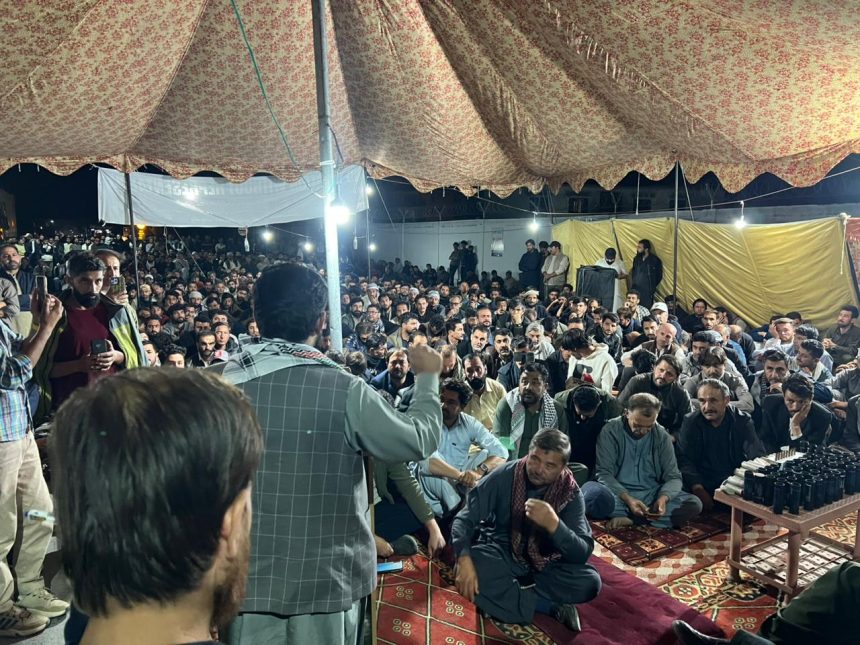
After 54 days of protests by traders at the Pak-China border in Gilgit Baltistan, the Khunjerab Pass Immigration Office was briefly opened, however the protest is still active. The Gilgit-Baltistan (GB) government finally accepted the demands made by the protesters who had been staging a sit-in and blocking the Karakoram Highway (KKH) for the past 53 days. The demonstrators said that they were opposing the collection of sales tax, income tax, and excise duty by the federal government from GB residents and traders.
The protest sit-in, called by the Tajir Ittehad Action Committee, and backed by trade organisations, government and opposition parties, and religious groups in the region, has paralyzed cross-border movement. Trade and travel between Pakistan and China, as well as business activities at the Sost Dry Port, have remained completely shut for the past 54 days.
The reopening allowed hundreds of stranded Chinese nationals, foreign tourists, and students, who had been stuck in Sost for three days, to finally cross into China.
GB government response
Speaking to Voicepk, GB Home Minister Shams ul Haq Lone, who is also part of a committee formed by Chief Minister Haji Gulbar Khan, said the provincial government had heard the concerns of the protesters and forwarded them to the federal government.
“It is understandable that the protesters consider it unconstitutional to collect federal taxes from GB, as the region has no representation in Pakistan’s parliament,” Lone explained. “We have accepted their demands at the provincial level and have requested the federal government to consider them.”
He further clarified that most consignments arriving through the Khunjerab Pass are destined for other regions of Pakistan.
“Consignments that remain within GB should be exempted from federal taxes,” Lone added. “We have developed a regulatory mechanism to determine which shipments stay in GB and qualify for exemption.”
Acknowledging the sensitivity of the matter, the minister stressed that the provincial government is working to resolve the issue swiftly to prevent further hardship for GB residents.
Meanwhile, Chief Minister Gulbar Khan, in a statement to Voicepk, confirmed that the protesters’ demands had been formally sent to the federal government and expressed optimism for a resolution.
“On the advice of the Prime Minister, a committee led by Rana Sanaullah suggested two options. One was to collect sales and income tax on consignments stuck at Sost Port worth Rs. 6 billion and allow the provincial government to use it. The second was to impose a fixed tax, which was more feasible. We refined this option: consignments consumed within GB will be exempted, while those going to other regions will pay taxes. Since GB has no representation in parliament, people have demanded they should not be liable to federal taxes.”
“We have forwarded these demands to the federal government, and I am hopeful they will be accepted. The FBR has delayed matters, but the Prime Minister has been supportive, and this will bring relief to the people of GB.”
Protest enters 54th day
Local journalist Arsalan Ali, who has been covering the sit-in since its first day, told Voicepk that the government’s decision to reopen the immigration office was a temporary concession to ease the crisis.
“The demands of the protesters have been accepted by the GB government and forwarded to the federal government,” he said. “But the federal government has not yet issued a notification confirming the acceptance of these demands.”
Ali highlighted that the protest has now entered its 54rd day. He recalled that even during Prime Minister Shehbaz Sharif’s visit to GB during floods, he advised the authorities to release around 300 consignments stuck at Sost Dry Port for over a year under a one-time amnesty scheme.
Protesters have demanded exemption from income tax, sales tax, and other federal levies on goods imported from China through the Khunjerab Pass. They allege that the federal government’s taxation is unconstitutional and claim that the increase in taxes on stuck consignments was an attempt to disrupt trade between Pakistan and China.
Background of protesters’ demands
According to earlier media reports, protesters at the sit-in had warned the GB government of “dire consequences” if it attempted a crackdown instead of resolving their grievances. They maintained that the Federal Board of Revenue (FBR) could not lawfully collect federal taxes from GB residents and traders since the region had no representation in Pakistan’s parliament.
Another organizer of the protest, Ebad Nagari, was also quoted as saying that the policies of the FBR had rendered thousands of people in GB jobless.
Standoff at Sost
Earlier this week, hundreds of Chinese nationals, students, and foreign tourists were stranded at Sost after protesters blocked entry and exit at the Khunjerab Pass. The disruption triggered protests from the stranded travelers, who exchanged heated words with local police over the delay in their departure.
The sit-in has paralyzed cross-border movement for weeks. Protesters argue that, under Pakistan’s Constitution, GB is not formally part of the federation, and therefore, the federal government cannot legally impose taxes on its residents.
During earlier talks, a federal government committee reportedly acknowledged that levying sales tax, income tax, and excise duty on GB residents and traders was unlawful.
Uncertain way forward
While the GB government has accepted the protesters’ demands and temporarily reopened the Khunjerab Pass, the matter remains unresolved at the federal level. Negotiations between the GB and federal committees have yet to reach a final decision, and no official notification has been issued by the federal government.
As talks drag on, protesters remain firm on their stance, warning that trade and travel through the vital Pakistan-China route could once again be disrupted if the federal government fails to formalize the agreement.