

September 23, 2025
By Xari Jalil
LAHORE
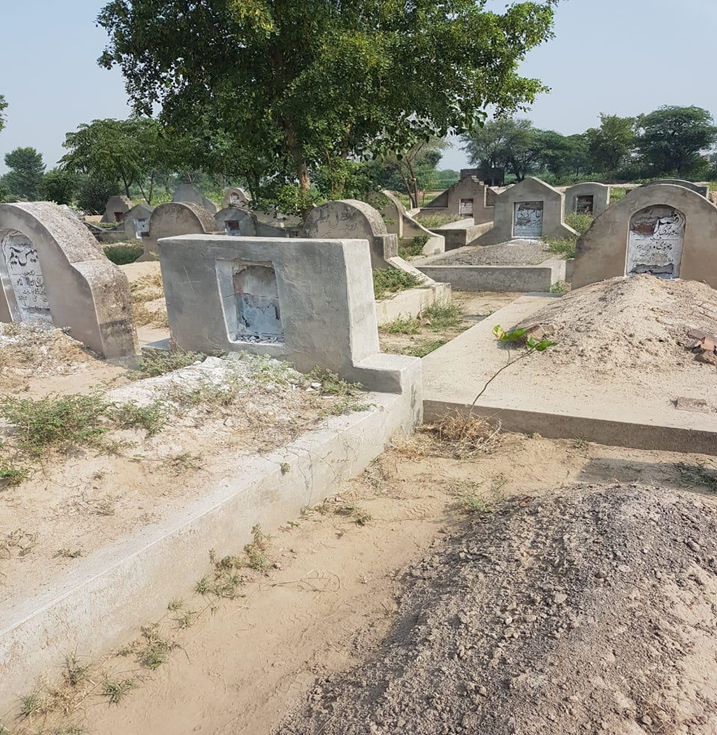
A woman from the Ahmadi community who had passed away two days ago is still being kept in the mortuary in Daska, because the family is not being “allowed” to bury her in their graveyard.
The Ahmadi community from Daska, Sialkot told Voicepk that the deceased Qudsia Tabassum, wife of Muzaffar Ahmed, was to be buried in a graveyard located in Piru Chak Tehsil, Daska, within the limits of Police Station Motra. However, the burial was obstructed by hardline elements.
“This is a graveyard that is originally owned by the Ahmadi community, and there are a large number of graves of Ahmadis here,” said Babar* a representative of the Ahmadi community from Sialkot. Babar told Voicepk that the graveyard was owned by the Dogar clan when they came from India during Partition.
“The graveyard was completely ours, but after some time we opened our hearts and shared the space with some others too,” said Babar. “However, since a couple of years – ever since the Tehreek-e-Labbaik (TLP) started flexing their muscles in the area, we have been facing a lot of problems.”
Babar said the TLP workers did not allow burials and they were supported by the area administration and police.
“When this happened for the first time, the Assistant Commissioner, the District Commissioner and the police higher ups told us to accommodate and bury somewhere else,” he said. “We shifted the body to Rabwah for burial. Then this happened again and again, and now it is slowly becoming a norm.”
Voicepk repeatedly tried to contact the AC Sadia Jafar and DSP Daska Khalid Aslam for their comments, however they refused not respond.
“They have always told us to ‘let it go’, whenever there are issues with the hardline elements in the area which stop us from our burials,” says Babar. “This is even though 200 of the graves in the graveyard are ours and 100 belonging to other communities. We have never objected to them burying in our cemetery but they are stopping us from burying our own.”
Meanwhile a letter issued in 2022 by the District Peace Committee says that the disputed graveyard was allocated in the name of migrants (Ahmadi) at the time of Pakistan’s creation. After 1973, Ahmadis were declared non-Muslims. Despite this constitutional change, no dispute ever arose. However, around six months ago, disagreements began to emerge between the parties.
In the disputed graveyard, the number of Ahmadi graves is higher than the other graves. In view of the above circumstances, the Committee members recommend that the Deputy Commissioner should resolve the issue so that the risk of religious discord and conflict may be averted.
“There must be some kind of reconciliation to this,” says Babar. “Either they seal the entire cemetery and do not allow any burials here so there are no fights. Or else they allot land somewhere else to them.”
For now the community is trying to reason with the local administration in a way that this is not repeated. However, the option of a court case is not on the table per se, because courts tend to delay cases.
A female Ahmadi is being stopped from burial today in Perochak, Tehsil Daska, Sialkot—inside a graveyard already filled with Ahmadi graves. Even in death, Ahmadis are denied peace. A tragedy not just for Ahmadis, but for Pakistan itself.#AhmadiApartheid
— Mona Farooq Ahmad (@MonaChaudhryy) September 21, 2025