

July 25, 2025
Staff Report
LAHORE
The Islamabad High Court (IHC) has suspended its July 15 order directing the federal government to form a commission within 30 days to investigate allegations of entrapment in blasphemy cases.
Last week, a single bench headed by Justice Sardar Ejaz Ishaq Khan had cited 20 compelling reasons for establishing the commission after hearing petitions from over 100 families of individuals accused in blasphemy cases. The order required the commission to complete its work within four months, with the option for an extension.
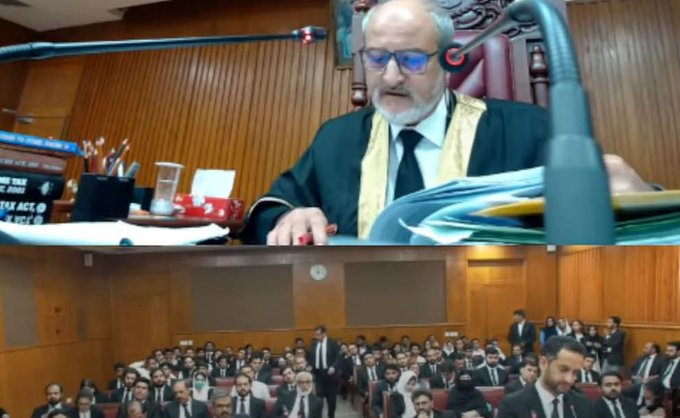
However, a division bench comprising Justices Khadim Hussain Soomro and Azam Khan has now suspended the single-bench ruling while hearing an intra-court appeal. The appeal was filed by Rao Abdur Rahim, a lawyer from the Legal Commission on Blasphemy Pakistan, along with other petitioners.
Advocate Kamran Murtaza, representing Rahim, argued that the appellants had not been granted a proper hearing. “There are 400 cases, and some fall outside the jurisdiction of this court,” he contended. “Can a commission even be constituted in such a situation?” He further criticised the single-bench order, stating that the court appeared to be acting “as though it were above the Supreme Court.”
The division bench subsequently suspended the earlier order and issued notices to the parties involved.
Justice Khan’s 10-page judgment, published on the IHC website on July 18, had invoked Article 199 of the Constitution, citing the federal government’s “failure to act in accordance with law” despite repeated calls for intervention.
“This Court had to assess whether there existed sufficient circumstances to alert the Government to the need for a deeper probe through a commission,” wrote Justice Khan. “It did not have to determine with finality whether a ‘blasphemy gang’ existed as alleged… or whether the accused named in FIRs were innocent.”
The judgment stemmed from a petition filed by more than 100 families whose relatives had been charged in blasphemy-related cases. Petitioners alleged that their loved ones were entrapped—often by individuals using female online aliases—into sharing or creating content later deemed blasphemous.
🔵 اسلام آباد پریس کانفرنس ،
اگر یہ سچے ہیں تو انہیں تحقیقاتی کمیشن کا خوف کیوں ہے ؟
ایمان مزاری👇 pic.twitter.com/Q53LfdpmuO
— Voice of the Victims of Blasphemy Business Group (@VictimsofB_Gang) July 24, 2025
The petition relied heavily on two key documents: a January 2024 intelligence report from the Punjab Police Special Branch and an October 2024 investigative report by the National Commission for Human Rights (NCHR). Both reports raised concerns about an organised network allegedly working with officials from the Federal Investigation Agency (FIA) to frame young men in blasphemy cases for financial gain.
The Special Branch report called for exposing “the dubious tactics of this gang,” while the NCHR report detailed the alleged use of women with multiple digital identities to lure men into online conversations that led to blasphemy charges.
Justice Khan also highlighted the case of Komal Ismail, a central but elusive figure in an ongoing blasphemy case. She was identified during proceedings as ‘Iman’, a shadowy online persona allegedly involved in entrapping multiple accused. Earlier this month, the court ordered her CNIC to be blocked due to her failure to appear.
In his judgment, Justice Khan enumerated 20 reasons for directing the formation of an inquiry commission. These included:
- Approximately 400 FIRs and 700 accused in online blasphemy cases, with many alleging entrapment that was never investigated.
- Repeated failure to identify or interrogate the mysterious woman ‘Iman’, despite consistent claims from unrelated accused across different regions.
- Use of the same Facebook IDs and passwords in multiple FIRs, even after those credentials had been surrendered in earlier cases.
- Four accused dying in custody without any judicial or administrative inquiry—one case included a video shown in court depicting visible bruises and signs of torture.
- FIA officials admitting that in many cases, they failed to forensically examine the complainant’s digital devices, despite defense claims of digital manipulation.
- A video allegedly showing a private citizen arresting a suspect outside Layyah University using a vehicle registered to a lawyer accused of leading the entrapment network.
Counsel for the respondents, including federal agencies and telecom companies, argued that only the accused themselves—not their families—could seek judicial review. Justice Khan rejected this argument. “The test of being ‘aggrieved’ under Article 199 is not limited to a direct and personal interest,” he wrote. “An accused’s father or relative qualifies as an ‘aggrieved’ person if the federal government fails to act despite compelling circumstances.”