

May 10, 2025
By Iqra Manzoor and Kaleem Ullah
LAHORE
After nearly five days of deadly cross-border shelling, India and Pakistan have agreed to a ceasefire, bringing a temporary halt to the latest standoff between the two nuclear-armed neighbors. But while both governments move to de-escalate, it is once again the people of Kashmir—on both sides of the Line of Control (LoC) — who have paid the highest price.
The renewed hostilities left homes destroyed, lives lost, and entire communities gripped by fear. Each time such violence erupts, a ceasefire may follow, but the damage lingers on in the valleys of Kashmir.
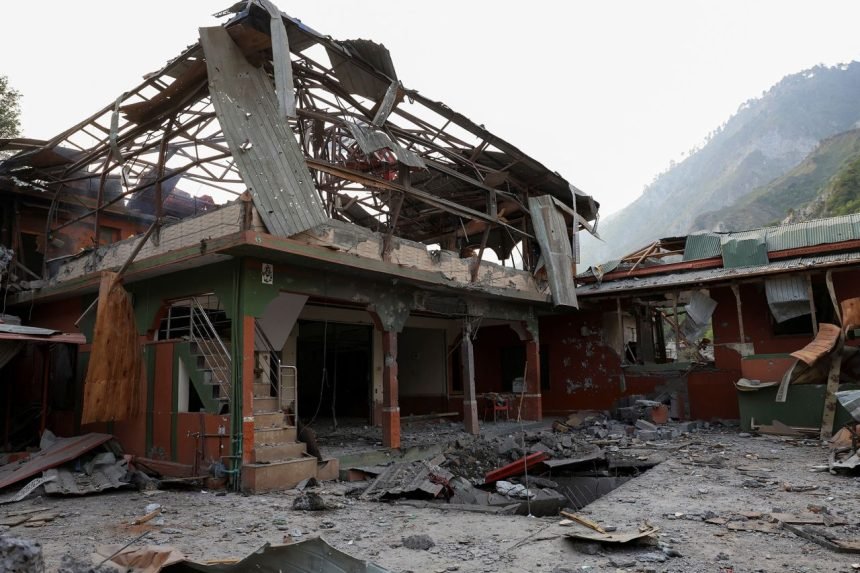
District Muzaffarabad in Pakistan-administered Kashmir has become a temporary haven for those fleeing shelling and violence near the LoC. According to the State Disaster Management Authority (SDMA) Muzaffarabad’s LoC Situation Report (09-05-2025), the cross-border violence has claimed at least 17 lives from May 7 to May 9.
Among the dead are one child, five women, and 11 men. The report also lists 51 injured— eight children, 17 women, and 26 men. Losses include far more than just human lives. The report notes extensive damage to property and infrastructure: 12 homes fully destroyed and 27 partially damaged, affecting over 139 structures. Ten livestock animals were also lost. Public buildings, including an Electricity Office, five mosques, schools, cattle sheds, a hospital, and a Forest Department check post, were either partially or fully destroyed.
An official from the District Disaster Management Authority (DDMA) in Muzaffarabad, told Voicepk.
“A woman was brutally killed in a bomb blast in District Jhelum—she was just outside her house. We have been continuously observing, hearing, and seeing firing, blasts, and smoke in different districts of Kashmir. People are panicking and relocating to Muzaffarabad city because of the loss of lives and damages to the properties of innocent Kashmiris.”
On the night between May 6 and May 7, multiple cities in Pakistan came under airstrikes by India, which later claimed the targets were “terrorist camps.” Pakistan has denied the allegations. The strikes resulted in numerous civilian casualties, including women and children.
The suffering is not one-sided. According to a statement released by the Indian Ministry of Defence on May 8, “Sixteen innocent lives have been lost including three women and five children, due to Pakistani firing.” Independent Indian outlets corroborate this. The Wire reported consistent shelling over three nights in Jammu’s Poonch district, prompting evacuations. On May 10, 60-year-old Rashida Bi was killed when a mortar shell hit her home. According to The Wire,
“We faced heavy firing from Pakistan last night,” Mohammed Shabir, a resident of Behra village in Mendhar told The Wire’s reporter in Poonch on May 10. “We are poor people who live here, we’ve lost everything. We request the government to defend us, where will we poor people go? We will die here. We should not have to face such shelling.”
“Last night, the shelling was extremely intense. If we hadn’t moved away from here last night, you would have seen 40 dead bodies here today,” another resident of Behra village told The Wire. “There are 40 bullets lying here. Peoples’ houses have been destroyed. Our only option is to leave.” The Wire reported.
“Whatever happens, all the losses are being borne by the poor,” a resident of Behra village added. “Hence I fervently appeal to Narendra Modi, Amit Shah, the Jammu and Kashmir administration…I request that both countries sit down and discuss matters. We have already lost so much. Please do not let us poor people suffer these life-threatening consequences.”
A representative from a local NGO operating in Muzaffarabad told Voicepk:
“There are almost 10 districts in Azad Kashmir and almost all of them are near the LoC. Particularly, Muzaffarabad, Bhimber, Hajira, and small villages like Nakiyal and Pattni are under direct threat. There’s been open firing and missile attacks. It’s extremely unsafe.”
“District administrations have directed all humanitarian organizations to begin emergency response preparations. IDP camps, first aid stations, and medical camps are being set up.”
“People are fleeing in such urgency that they’re leaving behind most of their belongings. This, coupled with the trauma of losing loved ones, has left many of the internally displaced in severe psychological distress.” She added, “As for why Kashmir is always at the center of Pakistan-India conflict, it is hypothesized that it has to do with the geopolitical significance of Kashmir since it borders both India and China. Secondly, owing to the fact that almost all 5 rivers originate their flow from Kashmir and into Pakistan, having control over the flow of these rivers is a major advantage (both for Pakistan and India).”
Beyond the physical devastation, this ongoing conflict lays bare a political reality often ignored: Kashmiris themselves remain voiceless in decisions that determine their fate. The human cost of this geopolitical tug-of-war is immense.
Ali Abdullah Khan, President of the Progressive Students Collective (PSC) and a Kashmiri student studying in Lahore, articulated this painful reality:
“The real root of this recent conflict lies in the occupation of Jammu and Kashmir. Both India and Pakistan claim the region as their own, but neither side seems truly concerned about the people who live there. It’s impossible to understand what’s happening now without first questioning the decades-long occupation that has left so many lives in ruins.”
“The people of Jammu and Kashmir on both sides of the LoC have paid the highest price. They’ve lost their homes, their families, their futures. And while they’ve suffered, the political and military elites of both countries have found ways to benefit.”
“In India, Modi’s government used the conflict to win back public support it had lost in earlier elections. Most political parties and a large chunk of the public stood behind him. Meanwhile, in Pakistan, the military also regained its waning popularity and used the war to suppress internal dissent and unrest.”
“In the end, both Modi’s government and the Pakistani military were more interested in boosting their own popularity than protecting the people of Jammu and Kashmir. And once again, it’s the people on the ground who suffer the most.”
Voices from the Kashmir point to the strategic importance of the Kashmir region—its proximity to both India and China, and the fact that most of Pakistan’s rivers originate there—as a key reason why the conflict remains unresolved.
But amid these calculations of strategy and sovereignty, the people of Kashmir continue to live—and die—under siege. The most tragic consequence of this never-ending conflict is that neither nation seems willing to prioritize the safety and dignity of the people it claims to represent.