

February 14, 2025
By Rana Malhi
ISLAMABAD
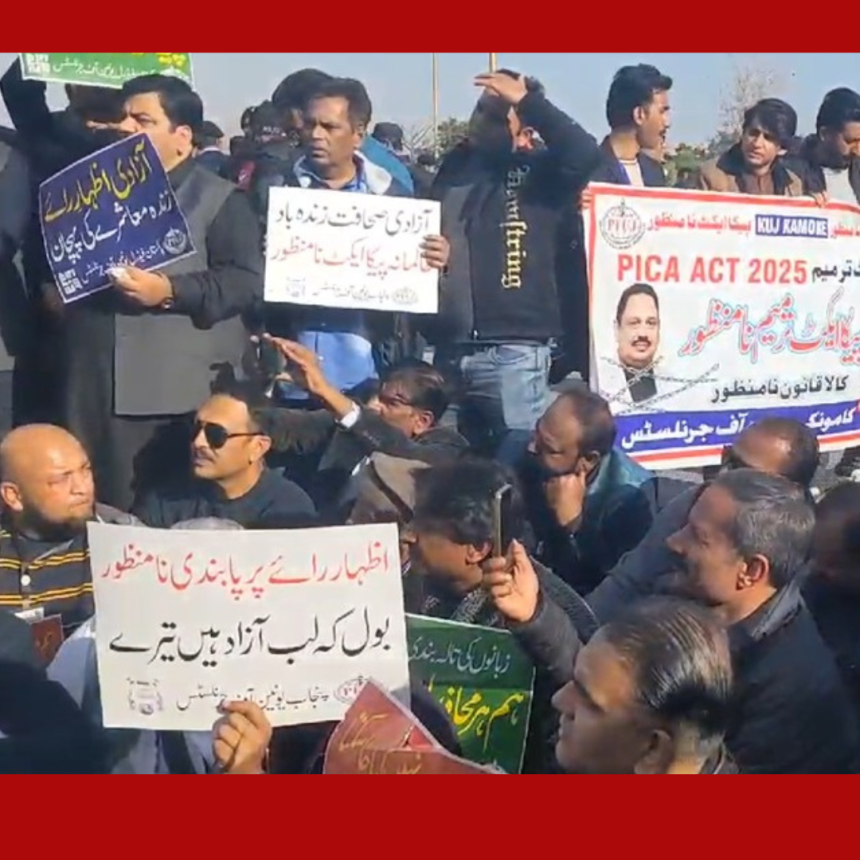
Journalists affiliated with one of the factions of the Pakistan Federal Union of Journalists (PFUJ), staged a protest sit-in at the capital city’s D-Chowk on Friday against the Prevention of Electronic Crimes Act (PECA) Amendment Act 2025, calling it a direct assault on press freedom and free speech.
The demonstration saw participation from journalists who were representing various cities across the country, and who expressed their concerns over the provisions of the PECA law through their speeches.
The gathering was joined by President of the International Federation of Journalists (IFJ), Dominique Pradalié, also attended the protest as a special guest and addressed the gathering.
Speaking to Voicepk, former PFUJ central president G.M. Jamali condemned the amendments, calling them a “black law” designed to suppress free speech.
“Through this protest outside Parliament, we want to warn lawmakers that this law will harm them as well. Political parties stand with journalists while in opposition, but their attitude changes once in power,” he remarked.
Karachi Union of Journalists (KUJ) General Secretary Lubna Jerar Naqvi said that had all stakeholders been consulted before drafting the law, such protests would not have taken place.
“Freedom of expression in Pakistan was already fragile, and this law further weakens it. If the government wanted to legislate, it should have consulted journalists,” she said.
Punjab Union of Journalists (PUJ) President Shahid Nadeem also denounced the amendments, asserting that journalists would never accept this draconian legislation. “Our struggle against this oppressive law will continue. In the coming days, we will expand our protest, and all journalist unions will launch a nationwide movement against it,” he vowed.
Protests and hunger strikes against the PECA Amendment Act 2025 are ongoing across the country, with journalists pledging to continue their resistance until the law is repealed.
The amendments introduce strict penalties, including imprisonment of up to three years, a Rs2 million fine, or both, for individuals spreading fake news on social media. The Bill also seeks to restrict the circulation of content deemed inappropriate or harmful. Additionally, statements from banned organizations or individuals and content removed during parliamentary proceedings will no longer be allowed on social media. The amendments further classify criticism of religion, the state, constitutional institutions, the judiciary, and the armed forces as illegal, alongside content that incites crime, false reporting, and contemptuous material.