

July 1, 2024
Press Release
LAHORE
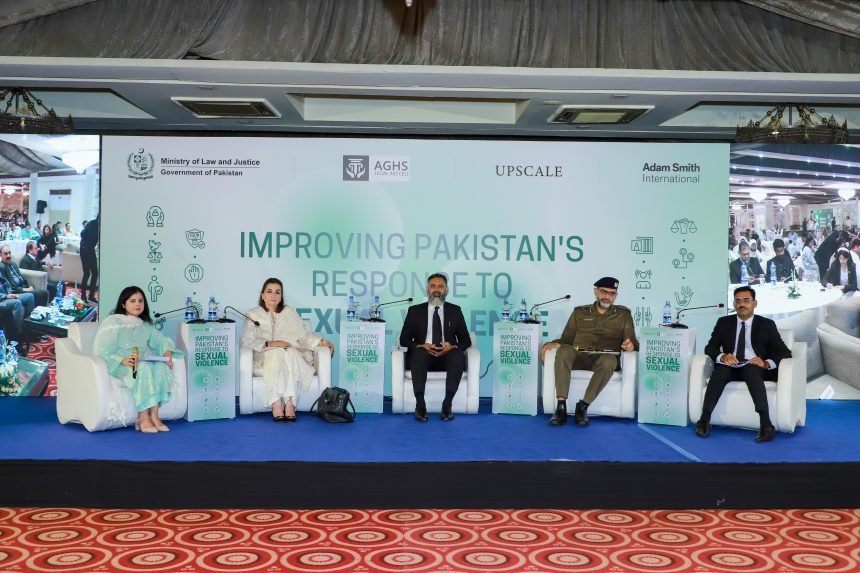
The Ministry of Law and Justice, in collaboration with AGHS Legal Aid Cell and the UK-Pakistan Serious Crime and Law Enforcement (UPSCALE) programme launched by the Adam Smith Foundation, held the first panel discussion in a series of events aimed at increasing awareness of the Anti-Rape (Investigation and Trial), Act 2021.
The panel featured experts with a deep understanding of and extensive experience in dealing with cases of sexual violence. These included the Chair for the session, former MNA and Special Committee member Mehnaz Akbar Aziz; Additional Prosecutor General Punjab Rai Akhtar Hussain; DIG Investigation Lahore Zeeshan Asghar; Shabbir Hussain, a lawyer affiliated with AGHS Legal Aid Cell; and moderator for the session Zainab Mustafa, member of the Special Committee, and Community Protection Advisor at UPSCALE.
The session began with a keynote address by Ayesha Raza Farooq, Chairperson of the Special Committee established under the Anti-Rape Act, who acknowledged the significant progress made under the Anti-Rape Act for combating sexual violence and ensuring justice for survivors. She emphasised the critical need for specialised legislation to address the increasing instances of sexual violence in society and called for a whole-of-government approach to ensuring the implementation of the Anti-Rape Act to help “create a society where justice prevails, and survivors of sexual violence receive the support and protection they need.”
To set the context for the panel discussion, official government data collected by the Ministry of Law and Justice from relevant departments across Pakistan was presented by Omar Maniar, Community Protection Advisor at UPSCALE. He emphasised that although the necessary resources have been allocated by the state, the data shows a critical need for ensuring effective utilisation of resources and sustained monitoring of compliance in order to achieve outcomes the Anti-Rape Act was enacted for.
The panel carried forward the discussion on the challenges faced in the justice process of sexual violence with an emphasis on solutions from the perspective of legal practitioners and law enforcement. Several key issues that were discussed included low conviction rates, acquittals due to resiling of witnesses, delays in resolution of cases, and repeat offending by convicts. Specialised structures and mechanism established under the Anti-Rape Act comprehensively address these issues. A pertinent example is provided by the Sex Offender’s Register mandated under Section 24 of the Act which allows for enhanced monitoring of convicted sex offenders through a centralised database to ensure the risk towards vulnerable members of society is minimised.

Shabbir Hussain, representing AGHS Legal Aid Cell, provided that while the Anti-Rape Act 2021 addresses the loopholes of previous rape laws as well as prevailing issues, its implementation is severely lacking. One example of this is the fact that there are 6 GBV courts in Lahore yet the measures for gender sensitisation and victim management provided in the new law are not being seen even now.
The event concluded with an acknowledgement of the collaborative effort required to implement the Anti-Rape Act 2021 effectively and reaffirmed the commitment of all stakeholders to fostering a safer and more just society.