

August 8, 2026
By Hashir Ahsan
ISLAMBAD
The Pakistan Bar Council (PBC) has condemned the National Cyber Crime Investigation Agency (NCCIA) for issuing notices to journalists and arresting them, and has called on the government to withdraw these notices and avoid actions that go against the freedom of expression.
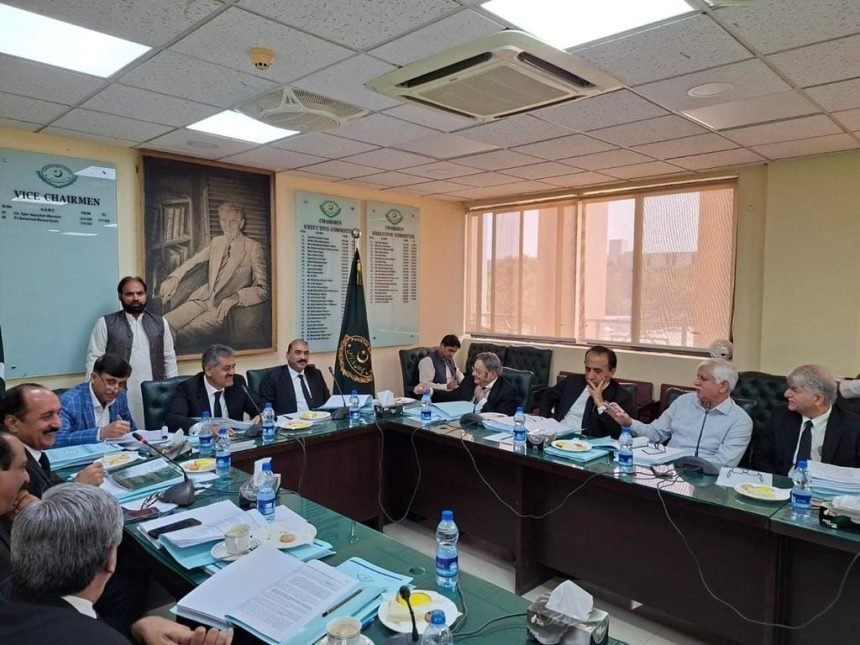
The 250th session of the Pakistan Bar Council was held in Islamabad, chaired by Vice Chairman Pir Muhammad Masood Chishti. Along with other agenda items, the council unanimously passed four resolutions, one of which dealt with the notices being sent to journalists by the NCCIA. The council strongly condemned the practice of issuing notices under PECA to journalists in Islamabad and detaining them, and demanded that the government immediately withdraw all such illegal notices and refrain from any actions that harm the constitutional guarantees of free speech and press freedom.
The council added that the legal community has always stood with a free and independent media as a pillar of democracy and the rule of law, and will continue to oppose any attempt to intimidate, harass, or suppress media freedom.
The council made these statements following a trend in which the NCCIA has been issuing PECA notices to several journalists and even registered cases against some of them. Journalist Asad Toor has once again been receiving repeated notices, and he had previously been arrested in a case filed under the PECA Act. Besides him, the NCCIA has also registered cases against journalists Waheed Murad, Khalid Jameel, Jameel Farooqi, and others.
New provinces
Separately, the Bar Council also discussed the issue of creating new administrative units or provinces in the country. It reaffirmed its commitment to upholding the supremacy of Pakistan’s Constitution, stressing that all constitutional matters should be resolved strictly within the constitutional framework.
It was unanimously agreed that the question of forming new provinces should be considered according to constitutional principles and procedures, and the members urged all political parties to set aside their differences and engage in meaningful dialogue for the country’s broader interest.
The council passed a resolution stating that if new provinces are deemed necessary, they must be created only through the parliamentary process and national consensus, as required by the constitution.
It authorized its Vice Chairman and the Chairman of the Executive Committee to invite leaders of all parliamentary political parties and representatives of provincial bar councils to a national seminar, aimed at building broad, inclusive national consensus to strengthen the federation, promote good governance, ensure fair economic development, and improve the welfare of ordinary citizens.
Separately, the President of the Supreme Court Bar Association (SCBA) also voiced support for creating new provinces. President Haroon-ur-Rasheed said all political parties should agree on a common agenda, expressed strong support for new provinces, endorsed their creation in line with the constitution and law, and said new provinces would bring better governance, economic growth, and political stability. He added that all outstanding issues should be resolved through serious and meaningful negotiation.
Raids on AG’s and PBC chairman’s residences
The Bar Council also strongly condemned an unauthorized raid carried out by Punjab Police on July 27, 2026, at the residence of Attorney General for Pakistan (AGP) and Bar Council Chairman Mansoor Usman Awan in Lahore. The council expressed deep concern, saying police personnel entered his residence without any legal authority or search warrant, violating the sanctity and privacy of his home.
They also hihlighted that police illegally surrounded the residence, caused damage, and threatened and harassed staff present there, while also damaging plants and other property outside the house during the operation. They said that the legal community should not stay silent on such illegal and oppressive conduct, especially when it was taregtting the Attorney General of Pakistan – a constitutional officeholder, and the Chairman of the Pakistan Bar Council, adding that such actions are completely unacceptable in a constitutional democracy.